What a fintech bank really is
Most people meet a fintech bank through its app. The clean onboarding and the notification that lands the moment money moves. That polished surface is the part customers see, and it is the part founders are tempted to obsess over. But fintech banks are defined by the machinery underneath, and that machinery is a set of choices about licensing, infrastructure, payments, and who carries the regulatory weight.
Think of it the way a builder thinks about a house. The paint colour is what visitors notice first. The foundation is what decides whether the building stands. For founders and payment-led institutions building fintech banks, the foundation is the operating model, and the operating model is where the real decisions live. Get those wrong and no amount of design polish will save the product later.
The tension worth naming early is this: people conflate the brand with the engine. A founder will say "we're building a fintech bank" and mean an app, when the words actually describe how regulatory cover, account infrastructure, and payment rails are assembled. Hold that distinction in your head, because the rest of this piece returns to it again and again.
Fintech bank vs neobank vs digital bank
These three terms get used as if they were synonyms. The differences carry real operational weight. Each one describes a different relationship to a banking licence and a different level of ownership over the stack, while the customer's view of who they are dealing with remains part of the operating question. Sorting them out gives you the vocabulary to place your own product correctly before you read another word about infrastructure.
How a neobank operates
A neobank is a brand and an experience layer on top of someone else's licence. It builds the app and owns the customer relationship. It relies on a sponsor or a partner bank to provide the regulated account underneath, an arrangement that lets it launch in months rather than years.
So what does a neobank actually own? The interface, the data, the customer experience, and the product logic that makes it feel different. What does it rent? The licence and the safeguarding of customer funds, including the regulatory permissions that allow money to move at all. That split is the whole trade in the partner bank model. You gain speed to market, and you give up direct control over the part of the stack that regulators care about most.
How a digital bank operates
A digital bank is a fully licensed institution that runs its operations through digital channels. It holds its own banking licence and keeps deposits on its own balance sheet under direct regulatory oversight. The lighter footprint a neobank enjoys does not apply here. A digital bank carries the full obligations of a chartered bank.
That deeper responsibility changes the economics. A full banking charter in the EU takes two to four years and upwards of 20 million euros in capital, according to a breakdown by Crassula comparing licensing paths. The payoff is control. A digital bank owns more of the stack and keeps the margin a partner would otherwise take. The cost is time and capital, with a permanent compliance burden that never lifts.
Where the fintech bank sits
Here is where the framing from the opening pays off. A fintech bank can use several licence types. Its model is defined by how it assembles infrastructure and payments, with compliance shaping where it sits on the spectrum between a thin neobank and a fully chartered digital bank. The label tells you little. The operating decisions tell you everything.
Under the partner bank model, one fintech bank might run entirely on a partner's licence and place a rich lending product on top. Another might hold its own electronic money licence and rent only the card rails. Because the model is a set of choices, the useful question is what this fintech bank has chosen to own and what it has chosen to rent.
The partner bank model

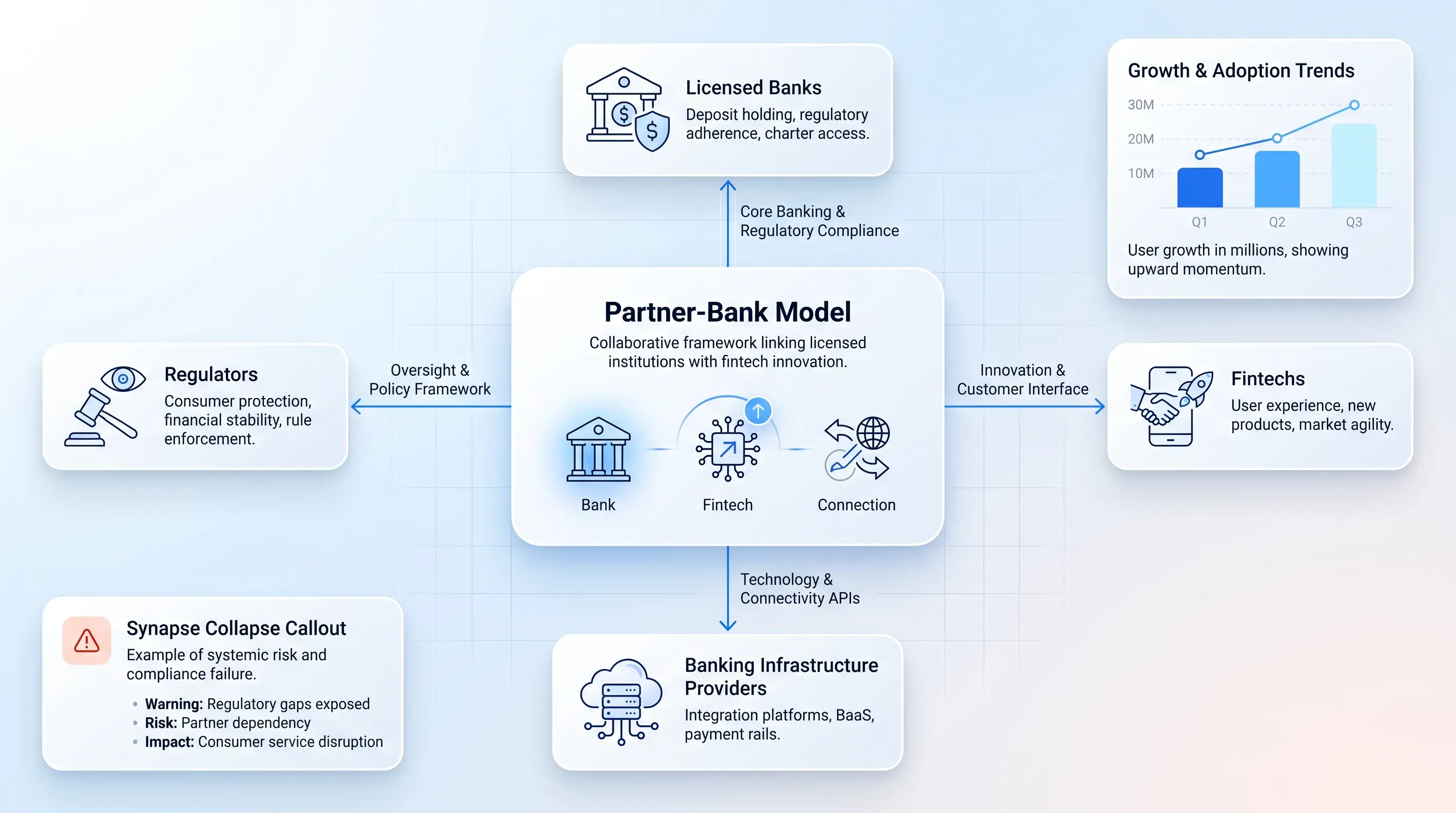
The partner-bank model is the arrangement that makes most fintech banks possible. A licensed bank provides the regulatory cover and the account infrastructure, and the fintech builds everything the customer touches. The bank holds the deposits and answers to the regulator for the regulated activity. The fintech owns the brand and the relationship. This is the engine behind a large share of the products people call fintech banks today.
What the fintech gains is obvious and real. Launching on a partner's licence collapses a multi-year licensing journey into a matter of months. The global market for the partner bank model was valued at 29.5 billion dollars in 2024 and is projected to reach 74.8 billion by 2030, which tells you how many builders have chosen speed. What the fintech gives up is control and margin. The partner takes a cut and can say no to products that sit outside its appetite.
The model also shapes the relationship with banking infrastructure providers in ways that are easy to underestimate. The fintech becomes dependent on the partner's systems and the partner's risk tolerance, while the partner's own standing with regulators still affects the chain. Banking infrastructure providers sit in the middle of that chain because they supply the ledger and the connections that hold everything together. When those dependencies form, they form for years, and they are difficult to unwind once customers are live.
The Synapse collapse made the danger concrete. When the banking-as-a-service firm filed for Chapter 11 in April 2024, it left an 85 million dollar shortfall in customer funds and around 100 fintech clients scrambling. By May, partner banks could not retrieve accurate balance records, and more than 100,000 people lost access to over 265 million dollars. The partner-bank model creates real dependencies, and you have to treat them as liabilities from day one.
The infrastructure stack underneath
Underneath every fintech bank is a stack of components that have to be assembled and made to work together. The core banking system, the payment rails, the onboarding flow, the application programming interfaces (APIs) that connect them, and the digital channels customers actually use. For fintech banks, each layer carries a build-versus-buy decision, and each decision shapes what the business can do for years. Frame the whole thing around operating consequences, and the choices get clearer.
Core systems and APIs
The core banking system is the foundation. It records every balance and every transaction, and it is the single component you cannot afford to get wrong. Sitting on top of that ledger are the APIs, and their quality decides how fast the bank can move. Good APIs let a team ship a new product in weeks. Poor banking infrastructure providers turn every change into a negotiation with the underlying system.
The choice of banking infrastructure providers locks in flexibility or rigidity for a long time. A modern modular core, built cloud-native with clean APIs, lets you swap components and launch products without rewriting everything. A legacy core does the opposite. It works, but every new feature costs more than it should.
Here are the trade-offs that matter most when you choose:
-
A modular cloud core gives faster product cycles and cleaner integrations, at the cost of a younger vendor track record.
-
A legacy core offers proven stability and regulatory familiarity, but it slows down every future change you want to make.
The banking infrastructure providers you pick at this stage set the ceiling on how quickly your fintech bank can respond to the market, which is why the decision deserves more scrutiny than almost any other.
Payments and rails
Payment rails differ so sharply between Europe and Africa that they reshape the entire model. In Europe, the rails are converging around instant account-to-account transfers. Under the EU Instant Payments Regulation, any euro transfer within the Single Euro Payments Area (SEPA) must now settle within 10 seconds, whatever the hour or day. Card schemes still matter, but instant rails are now the regulatory baseline a European fintech bank builds against.
Africa runs on a different logic. Mobile money is the dominant rail across much of the continent, and in Kenya, M-Pesa alone serves over 34 million active users. In Nigeria, the NIBSS Instant Payment platform processed nearly 11 billion transactions in 2024, more than double the figure from two years earlier. A fintech bank that ignores mobile money in these markets is not building for the customers who exist. Payments define what you can realistically offer, because the rail dictates the cost and the everyday behaviour you are designing around.
Onboarding and channels
Onboarding is where compliance and conversion meet at the same moment. Every identity check that protects you from fraud also adds friction that can lose a customer mid-signup. Know Your Customer (KYC) flows and identity checks sit on this line, and the quality of that flow shows up directly in how many people finish and how many drop off.
Regional assumptions about devices and connectivity change the design completely. In much of sub-Saharan Africa, basic feature phones still dominate, and Unstructured Supplementary Service Data (USSD) carried 63.5 percent of total transaction volume in 2024 because it runs on 2G without an app. A European onboarding flow built for a high-end smartphone and fast broadband simply will not work there. Onboarding quality connects straight to whether the business scales or stalls.
Who owns compliance
The question of who owns compliance is where founders deceive themselves. The partner bank model creates shared obligations, and in practice the fintech still has to run KYC and monitor transactions for money laundering, even when the licence sits with someone else. The partner carries the regulated activity, but the fintech carries the operational reality of staying compliant.
The Synapse aftermath proved how shared this responsibility is. In June 2024, the partner bank Evolve entered a cease-and-desist order with the Federal Reserve over anti-money-laundering and risk-management failures in its fintech partnerships. The regulator went after the bank, but the fintech banks built on it lost their products and their customers' trust. When compliance fails anywhere in the chain, everyone in the chain pays.
Europe and Africa apply this pressure differently. In the EU, the framework is harmonised and heavy. An electronic money licence runs under EMD2 and PSD2, with PSD3 already agreed and implementation targeted around 2026 to 2027, which means re-authorisation is coming for everyone holding a licence. African markets vary by country, with central banks like Kenya's running sandbox approaches that let innovation move while risk stays managed. The thread running through both is the same. A rented licence creates shared compliance responsibility, and shared responsibility is still yours.
Lending wallets and product reach
The infrastructure you assemble decides which products you can actually offer. Payments are the entry point. Stored-value wallets and lending sit further up the ladder, and each rung changes the risk and compliance picture beneath you. A fintech bank that wants to move from moving money to holding it, or from holding it to lending it, changes what kind of institution it is.
Adding stored value means you now hold customer funds, which pulls in safeguarding rules and the obligation to redeem at par. Adding credit is a larger jump still, because lending introduces balance-sheet risk and capital requirements under a different layer of regulatory scrutiny.
Consider how the ambition maps to the stack:
-
Payments and transfers need rails and a basic ledger, with the lightest compliance load of the three.
-
Stored-value wallets need safeguarding and fund-protection controls, which raises the bar on both infrastructure and oversight.
-
Lending needs a licence or a partner willing to underwrite, plus capital and credit-risk systems the other two never touch.
Product ambition has to be matched to the underlying stack and the licence behind it. A fintech bank that promises credit on infrastructure built only for payments will hit a wall, because the operating model cannot carry the product. Decide what you want to offer first, then build the stack that can actually support it.
Scaling risk for fintech banks
Growth exposes the decisions made at the start. As fintech banks expand across European and African markets, the risks shift from "can we launch" to "can we survive what we built." The early choices about partners and licences, including the rails behind them, either open the door to scale or quietly close it, and by the time the constraint shows up, it is expensive to fix. The risks that matter most fall into a few clear categories.
Dependency on banking infrastructure providers and partners is the first. A fintech bank built on a single sponsor inherits that sponsor's fate, as the firms tied to Synapse discovered when the platform failed. Regulatory shifts are the second, and Europe's move toward PSD3 means licence holders face re-authorisation whether they planned for it or not. Payment concentration is the third risk. A business routing everything through one rail or one processor has a single point of failure that grows more dangerous as volume climbs. Operational strain is the fourth, because systems that handled 10,000 customers do not automatically handle 10 million.
The through-line is that scaling is constrained by the operating model long before it is constrained by the market. Fintech banks that chose a rigid core or leaned on one partner will feel those choices most acutely when they try to expand into a second country with different rails and different rules. The work of scaling is partly the work of unwinding early shortcuts, and the fintech banks that scale cleanly are the ones that left themselves room to change.
Making the right model choice
The correct model is the one that fits your purpose in the market and your appetite for risk. A founder chasing speed in a single country will reasonably lean on the partner bank model and accept the dependency. An institution building for the long term across multiple markets has a stronger case for owning more of the stack, even at the cost of years and capital. The decision is a trade, and naming the trade honestly is most of the work.
The markets themselves keep moving. Europe is consolidating around instant payments and tightening its rules under PSD3, while African markets are building some of the most advanced real-time and mobile-money rails in the world. Both directions reward fintech banks that understand their own infrastructure behind the app. Before you build or pick a partner, define your operating model clearly, because that definition shapes every compliance and infrastructure choice that follows for fintech banks of every size.
Doocat builds the banking software that sits underneath this kind of decision, with a remote banking system covering retail, corporate, e-wallet, and instant-transfer services deployed across markets in Europe and Africa. If you are weighing the core and compliance setup for fintech banks, book a consultation with the Doocat team to pressure-test your operating model before you commit to building or partnering.