Why month-end reconciliation fails
The cost of getting transaction reconciliation wrong is not abstract. Ernst & Young found that 59% of finance department resources go to transaction-intensive processes, and a team handling a hundred accounts a month can spend over 800 hours on reconciliation alone. As transaction reconciliation moves from hundreds to tens of thousands of daily records, manual matching stops being slow and starts being impossible, which is the point at which errors and fraud slip through undetected.
Treat transaction reconciliation as operational infrastructure that runs continuously. The distinction matters because month-end thinking assumes you can catch problems in a periodic sweep. At scale you cannot. The 2024 ACFE Report to the Nations estimates organizations lose 5% of annual revenue to fraud, much of it catchable through rigorous transaction reconciliation. Every unmatched entry is a potential audit finding and a regulatory exposure, which is why transaction reconciliation belongs in the architecture from the start.
Failed transactions and exception handling
Some transactions will fail. Some will hang halfway. Some will partially complete, and money will end up in a state your happy-path code never imagined. This is the normal condition of moving money across networks you do not control, and the difference between a stable product and an unstable one is how deliberately you handle it.
The common failure states fall into a few groups worth naming clearly:
-
Hard declines, where a fintech payment rail rejects the payment outright for insufficient funds or a fraud flag. An expired card can trigger the same kind of rejection. According to Count's benchmarks, insufficient funds cause 45% of failures in a typical breakdown.
-
Timeouts and hangs, where a request goes out and no clear response comes back, so your system does not know whether the money moved.
-
Partial completions, where one leg of a multi-step transfer succeeds and another fails, which leaves the ledger out of balance.
Beyond the happy payment path
The silent, unowned failure is the dangerous one. A hard decline the customer sees is annoying but honest. A transaction that hangs with no owner sits in a queue while the customer wonders where their money went and no team is assigned to find out. Failed payments already cost the global economy an estimated $118.5 billion in 2020, per an Accuity study of more than 200 payments professionals, and much of that cost comes from handling the failure itself.
Exception workflows have to hand off cleanly between the people who can act. Engineering diagnoses whether the money actually moved. Finance confirms the ledger position and any funds in limbo. Operations talks to the customer and closes the loop. If those handoffs are not designed, each team assumes another is handling it, and the transaction rots. That is why exception handling has to be built alongside the happy path. The happy path is the smaller half of the work. The exceptions are where trust is won or lost.
Risk controls and operational ownership
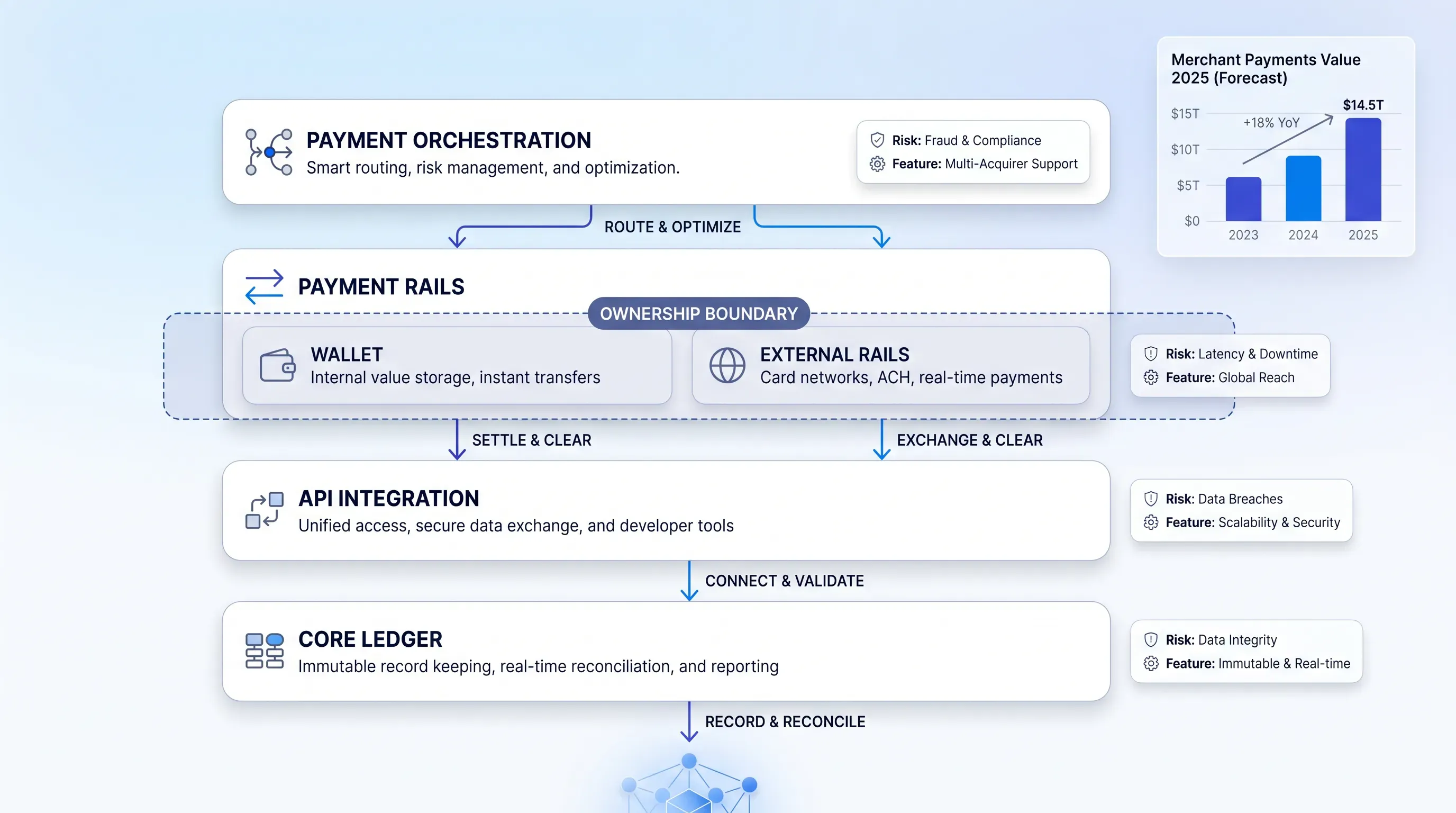
The risk layer wraps around fintech payment flows as a control layer outside the transaction code. Fraud monitoring watches transactions for patterns that do not fit. Limits cap exposure per user and per transaction, with period-based caps handled in the same control layer. Anti-money-laundering (AML) checks screen against sanctions lists and flag suspicious activity. Positioned as a layer around the flow, these controls can be updated and audited in one place. Scattered through the codebase, they become impossible to reason about and impossible to prove to a regulator.
The scale of this is not optional overhead. LexisNexis Risk Solutions found that financial crime compliance cost US and Canadian institutions $61 billion in 2023, and PwC analysis cited across the industry puts the false-positive rate of rule-based monitoring between 90% and 95%. Build these controls into the architecture deliberately and you can tune them. Bolt them on and you inherit the false positives without the ability to fix them.
Ownership prevents system failures
Here is the argument that matters most: infrastructure is an ownership problem as much as an engineering problem. Every component and every failure mode needs a named owner, because the worst incidents happen in the gaps where finance assumes engineering is watching a stuck transfer. Engineering can make the same assumption about operations, while operations assumes the system caught it. No one was watching, and the money sat there.
If you are deciding how to structure responsibility, map ownership onto the same components this article walked through. Who owns routing failover? Who owns the reconciliation break at 2 a.m.? Who owns a hung transaction that finance sees but engineering has to diagnose? Clear ownership of each component and each failure mode is what keeps the system trustworthy, because a system no one owns is a system no one can fix when it breaks.
Define your flows before building
Before anyone writes implementation code, map every fintech payment flow end to end and define how each exception is detected and resolved, with ownership assigned. This upfront work is what prevents settlement confusion and transaction reconciliation breaks, and it also stops orphaned failed payments, because those problems are the cost of a flow that was never fully drawn before it was built.
The mapping exercise is concrete. For each flow, trace the money from initiation through routing and settlement, then follow it to the final ledger posting before you list every point where it can fail and name who acts when it does. Doocat has built this kind of infrastructure for banks and MFIs on a modular core, with wallet providers served by the same architecture, and can help your team define flows and exception handling before implementation begins. Treat flow definition as the first deliverable of any fintech payment project, and book a call with Doocat to pressure-test your fintech payment flows before they reach production.