Why payment infrastructure matters now
Financial institutions and fintech teams in Europe and Africa are rebuilding their payment operations because customers no longer accept delays and regulators no longer permit them. In fintech and payments, the gap between a Friday transfer that clears Monday and one that settles in seconds now decides which provider a customer trusts. Real-time rails and mobile money have reset expectations across both regions.
The two regions arrive at this moment from opposite directions. Europe runs on mature card and account rails, and it is now mandating instant settlement through the Instant Payments Regulation 2024/886, adopted on 13 March 2024. Africa took a different path. Mobile money carried more than $1.4 trillion in sub-Saharan Africa during 2025, which is two-thirds of the global total. This fintech and payments guide treats the stack as one connected system so decision makers can plan upgrades with a clear view of the trade-offs.
Components of a fintech and payments stack
A modern fintech and payments system has four layers that depend on each other. Front-end channels capture the customer's intent, processing logic decides how a transaction moves, the core banking system holds the authoritative record, and back-office functions confirm that everything balanced. When one layer is treated as a standalone tool, gaps appear between them, and that's where money goes missing or reports stop matching.
Think of the stack as a chain of accountability. A wallet that accepts a payment is worthless if the core ledger never records it, and an instant rail that promises ten-second settlement falls apart if reconciliation can't keep pace. Across fintech and payments, the institutions that scale cleanly are the ones that design these layers to talk to each other from the start. The sections below detail the major payment methods first, then the infrastructure that binds them.
Cards and bank transfers
Card payments and account-to-account transfers are the foundational fintech and payments rails in both regions, though they carry different weight. A card transaction involves the issuer that gave the customer the card and the acquirer that signs up the merchant, with the clearing scheme between them. Card fraud is a real cost to manage, with global losses of $33.41 billion recorded in 2024 according to the Nilson Report.
Bank transfers move money directly between accounts, which makes them cheaper for high-value payments and slower under older batch systems. In Europe, the Single Euro Payments Area gives transfers wide reach and standard formats. Africa's transfer rails are more fragmented across national systems, which raises the cost and complexity of cross-border movement. The choice between cards and transfers comes down to a trade-off between reach and speed, with per-transaction cost shaping the final decision.
Wallets and mobile money
In fintech and payments, mobile money dominates parts of Africa because it solved a problem cards never could. M-Pesa, launched by Safaricom in March 2007, converts cash into stored value through a network of agents who act as human ATMs. By 2020 the service ran through 237,637 agents serving 30.5 million active Kenyans. The model rests on telco partnerships and agent commissions, with stored value accounts tied to a phone number as the primary customer record.
The fintech and payments technology behind this reach is unglamorous and effective. In the West African Economic and Monetary Union region, 89% of mobile money interactions happen over Unstructured Supplementary Service Data, which runs on basic 2G feature phones. European wallets work differently. They sit on top of existing cards and bank accounts, so an Apple Pay or a PayPal balance is a layer over rails that already exist and serves customers who already have access to them.
Instant payments and clearing
Real-time payment schemes in fintech and payments demand more from a stack than any batch system did. The European Instant Payments Regulation requires settlement in ten seconds with 24-hour availability every day of the year and no premium pricing over standard transfers. That means a bank can no longer schedule downtime for weekend maintenance or overnight batch runs. Sanctions screening has to happen in those same seconds.
Africa is building its own real-time infrastructure for cross-border trade. The Pan-African Payment and Settlement System, launched in 2022 by Afreximbank with the African Union, is operational in 15 countries and clears payments in local currencies. Institutions in fintech and payments across both regions have to decide which schemes to support, because each one adds availability requirements and changes how the operations team works.
Core banking and APIs
The core banking system holds the source of truth for every balance, and the Application Programming Interface (API) layer exposes that truth to channels and partners. APIs let mobile apps and agent terminals read and write to the same ledger, while fintech partners connect through the same controlled layer without touching it directly. The core ledger stays authoritative while the APIs handle the conversation.
Integration quality at this layer decides overall reliability. If an API times out or returns a stale balance, the failure cascades into every channel that depends on it. This is why a strong API design matters more than any single payment method bolted on top. Get the core and its interfaces right, and the rest of the stack has solid ground to stand on.
Reconciliation and settlement

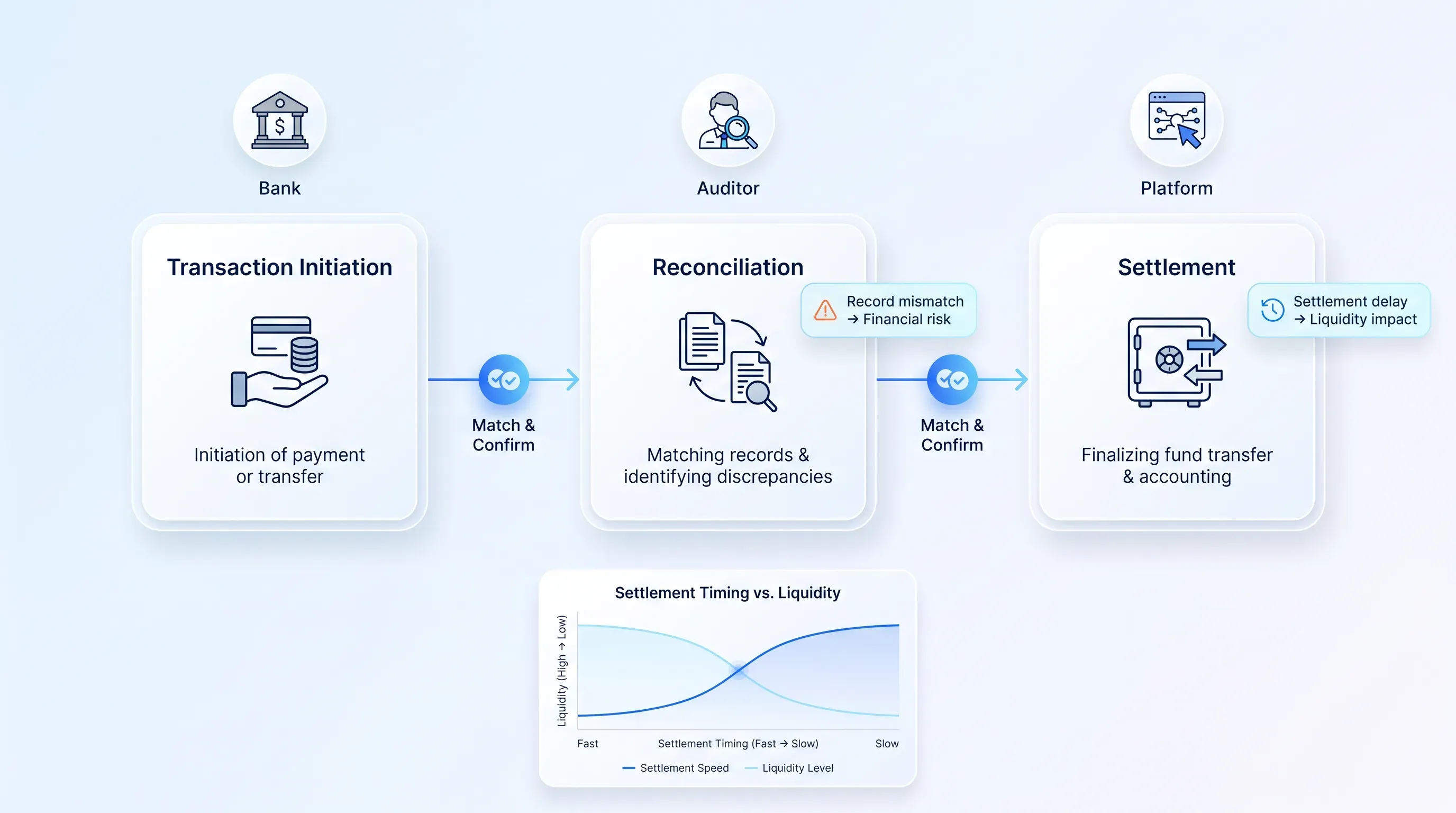
Reconciliation is the process that matches every transaction across the systems that touched it, and it's where operational control is won or lost. The core ledger may say one thing while the card scheme and mobile money platform report something else. Reconciliation confirms those records agree. When they don't, the institution faces a financial hole and a regulatory question at the same time, because auditors want to know why the numbers diverged.
Settlement timing varies by rail, and that variation shapes liquidity planning more than people expect. Here is how the timing differs:
-
Card transactions clear in seconds but settle to the merchant days later, which creates a gap the institution funds.
-
Instant payments settle in real time, so liquidity has to be available around the clock.
-
Mobile money settles into trust accounts held at a commercial bank, which adds a reconciliation step between the telco platform and the bank.
The lesson across fintech and payments is that connecting payment methods is the easy part. Keeping the money provably accurate afterward is the work that determines whether an institution stays in control or loses the thread.
Compliance across Europe and Africa
Compliance shapes architecture before a single line of code is written, because the rules decide what an institution is even allowed to build. In Europe, the revised Payment Services Directive (PSD2) sets licensing requirements across the European Economic Area and links them with a regime for strong customer authentication plus open access. A payment institution license under PSD2 starts at €125,000 in initial capital for full services, and that license passports across member states.
Africa has no single equivalent. Each country sets its own rules, which means an institution operating across borders manages a patchwork of frameworks. Ghana reached 95.06 points on the GSMA Mobile Money Regulatory Index in 2024, while neighboring markets sit far lower.
The compliance burden covers four broad areas:
-
Licensing and authorization to operate as a payment or e-money institution.
-
Anti-money-laundering controls, with transaction monitoring and sanctions screening.
-
Data handling rules that govern where customer information lives and who can access it.
-
Consumer protection standards for fees and disclosure, with dispute resolution built into the process.
Because requirements differ this sharply, the compliance map drives provider choices and system design from day one. An institution that picks infrastructure before it reads the rulebook rebuilds later.
Build versus buy decisions
The build-versus-buy question rarely has one answer for the whole stack. Building gives you control and a system shaped to your exact needs, but it costs more upfront and ties up engineering for years of maintenance. Buying gets you to market faster and shifts the maintenance burden to a vendor, though you accept their roadmap and pricing. The honest framing is that this decision varies by component.
Three factors push the decision one way or the other. Team size matters, because a small fintech can't staff a payments engineering group the way a large bank can. Regulatory scope matters, since heavily regulated functions are sometimes safer to buy from a provider who already carries the compliance load. Existing systems matter too, because a modern core banking platform makes integration easier than a legacy mainframe does. Most institutions build the pieces that differentiate them and buy the commodity infrastructure underneath.
Choosing providers and managing integration risk
Evaluating a payment provider comes down to a handful of criteria that predict how the relationship will go. Coverage tells you which markets and methods the provider reaches. Reliability, measured in uptime and authorization rates, tells you how often transactions actually succeed. Support quality decides how fast problems get fixed, and pricing transparency tells you whether the quoted rate is the real one. A provider that scores well on three of these and poorly on the fourth is still a risk.
The harder work begins after selection, when you connect the provider to your stack. Integration risk is the chance that a technically sound provider breaks your operations through a bad connection or a missed edge case that monitoring fails to catch. The two sections below separate the strategy of routing across providers from the practical work of wiring them in.
Payment orchestration choices
Payment orchestration is a control layer that routes transactions across multiple providers from a single integration point. You connect once to the orchestration layer, and it decides where each transaction goes across acquirers. The benefits are redundancy through automatic failover and smart routing that sends payments to the cheapest or highest-performing provider. One report found that multi-gateway failover can reduce downtime-related losses by up to 80%.
The approach has grown into real money. The payment orchestration market reached $2.8 billion in 2025 and is projected to hit $9.7 billion by 2035. But payment orchestration adds a layer to the stack, which means another vendor and another failure point to monitor. The trade-off is worth it when you run several providers, and harder to justify when you run one. Payment orchestration earns its place once fragmentation becomes the bigger problem than the layer itself.
Many institutions adopt payment orchestration specifically to escape the bargaining trap of a single provider. When you can shift volume away from an underperforming acquirer in milliseconds, pricing conversations change in your favor. That leverage is one reason payment orchestration appeals to teams scaling across both European and African markets, where provider quality varies by country. Still, payment orchestration manages complexity around a core that was designed well.
Multi-rail payment integration
Connecting cards and transfers alongside wallets and instant rails into one coherent system is the central engineering challenge of a modern stack. Each rail has its own message format and settlement timing, with failure modes that multi-rail payment integration has to reconcile without confusing the ledger. A card decline and a mobile money timeout look nothing alike, yet both have to be caught and resolved through clear logs. Multi-rail payment integration changes how you test and monitor everything. You can't test a wallet flow the way you test a card flow, and your monitoring has to watch each rail on its own terms.
The smart approach to multi-rail payment integration is to sequence the work carefully:
-
Start with the rail that carries the most volume, so you stabilize the largest risk first.
-
Add the next rail only after reconciliation proves clean on the first.
-
Treat instant rails carefully, because their 24/7 nature leaves no maintenance window.
Done in this order, multi-rail payment integration limits operational risk to one rail at a time. Rushing multi-rail payment integration across every method together is how teams end up with mismatches they can't trace. Good multi-rail payment integration is patient by design, and that patience is what keeps the failure handling clean when something breaks.
Planning your scaling decisions
A scaling roadmap ties the components and compliance work to provider choices in one sequence of investments. European institutions prioritize instant rails and PSD2 alignment because the deadlines are fixed and the rails are mandatory. African institutions weigh mobile money reach and cross-border systems like PAPSS against the regulatory patchwork they operate in, with agent networks shaping the local rollout. Maturity decides pace, since a young fintech sequences differently than an established bank.
Treat the stack as an evolving system that needs ongoing operational control throughout its life. Reconciliation and monitoring keep demanding attention long after the rails go live, with compliance embedded in that work. The institutions that scale well are the ones that plan for that maintenance from the start. Doocat builds core banking, mobile banking, agency banking, and e-commerce modules on a microservices architecture made for microfinance institutions across these regions, which puts reconciliation and multi-rail operations at the center of fintech and payments work. Define your payment flows and reconciliation needs before choosing providers, then book a consultation with Doocat to map those needs to a durable architecture.