Doocat

Loan Management System Software for Banks and MFIs: From Origination to Servicing

Content authorBy DoocatPublished onReading time9 min read
Modern mission-control hub for loan management with multi-screen dashboards, focused operators, and a blue-lit environment.

This article maps what happens to a loan after approval, and why the servicing side of the lifecycle carries most of the operational weight. It walks through eight capabilities you can use as an evaluation checklist, then closes with an audit you can run against your own platform.

Beyond loan origination

Approval is the moment lenders celebrate, but it is a small part of the work. A loan origination system captures the application and produces a credit decision through underwriting. Loan management system software takes over once money leaves the account, and that is where the portfolio actually lives for months or years. The demand is real: India's microfinance sector alone grew its loan portfolio 24.5% year-on-year in FY24 to about Rs 4.33 lakh crore.

Everything after disbursement is servicing. That means servicing scheduled payments and account changes, along with delinquency management through eventual closure or write-off. When these tasks live in disconnected tools, the same borrower exists in three places with three balances, and someone reconciles the difference by hand. Manual reconciliation at scale runs a 2 to 5 percent exception rate that hides until month-end. A payment misapplied on day three accrues wrong interest for the rest of the cycle before anyone notices.

Loan management system software

SaaS infographic UI showcasing a Loan Management System with rounded cards, icons, micro-charts, and a mobile banking statistic.

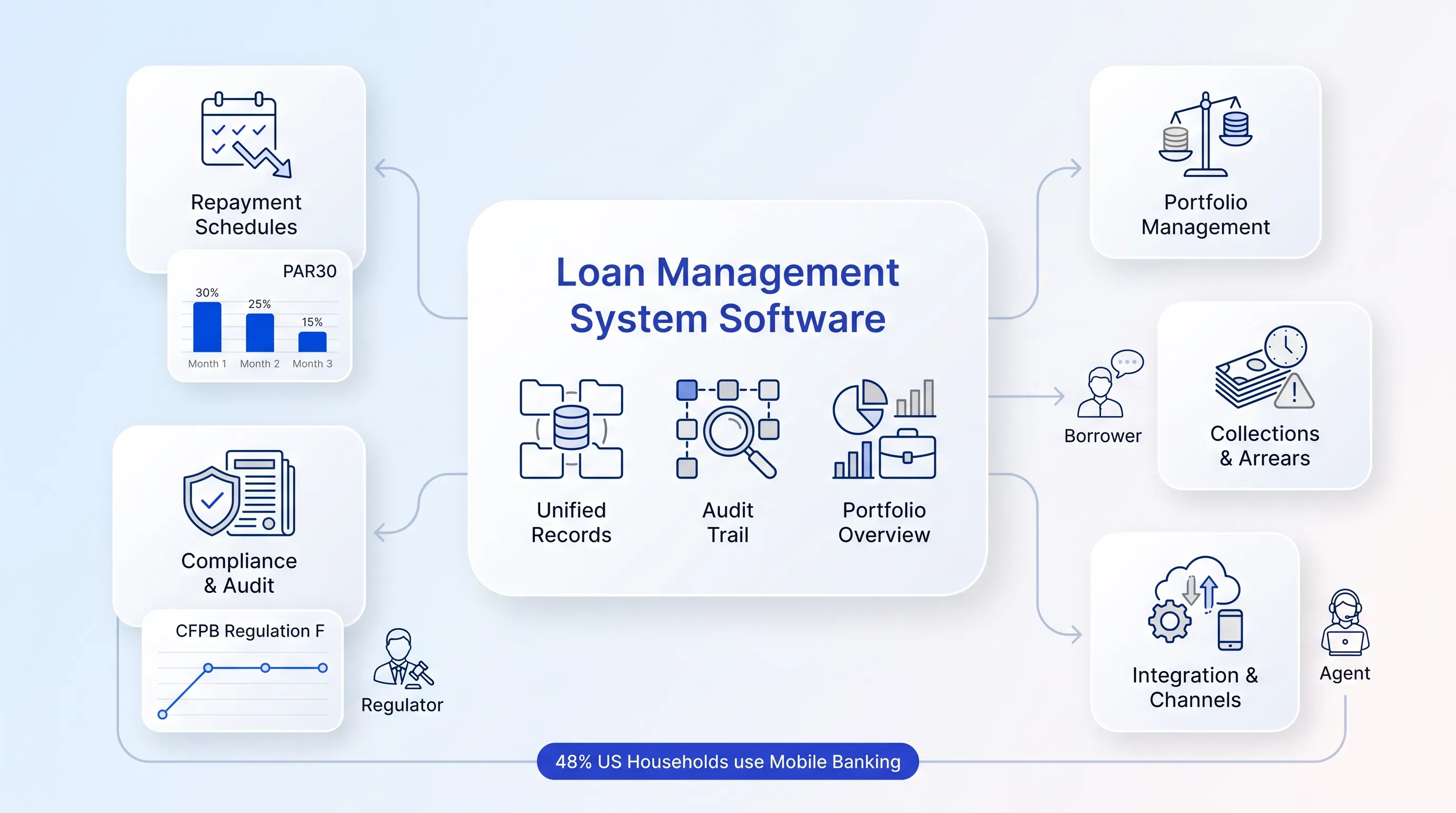
Treat the following eight capabilities as an evaluation checklist. Good loan management system software has to preserve accurate loan data and coordinate work throughout the loan lifecycle. As you read, hold each point against the challenges your teams actually deal with today.

1. Unified borrower records

One borrower, one record, linked to every loan they hold now or held in the past. That record carries contact details and loan terms. It also retains the account's financial and documentary history, including its communications and account-change log. When a collections agent and a finance analyst pull up the same account and see the same numbers, disputes shrink and handoffs stop leaking time.

The record has to stay traceable. Permissions decide who can change what, and an audit trail captures every edit with a timestamp and a name attached. That combination gives authorized teams a consistent view of the account while keeping changes defensible when an auditor or regulator asks who touched a balance and when.

2. Accurate repayment schedules

The loan management system software builds each schedule from the approved terms, then updates balances as loan transactions post against the loan.

Lending products rarely behave the same way, so the engine has to handle the range you actually sell:

  • Different payment frequencies, from weekly group loans to monthly installments

  • Grace periods affect schedules. The engine must also process prepayments and partial payments that don't clear a full installment.

  • Missed installments that shift the outstanding balance and trigger downstream status changes

Transparency matters more than most demos admit. When a borrower calls to dispute a balance, an operations agent has to explain how interest accrued and where a fee came from without escalating to IT. If the calculation is a black box, every dispute becomes a ticket.

Ready to digitise your financial institution?

Talk to our team about your roadmap and discover scalable digital banking solutions tailored to banks, fintechs and microfinance institutions.

Request a Demo

3. Loan servicing workflows

Most of the day-to-day work sits here. Routine servicing workflows repeat across the portfolio, forming the backbone of loan servicing workflows from payment posting through loan closure. Then there are exceptions, including a borrower request to change a payment date. A fee may also need a supervisor's sign-off, while some payments arrive without a reference number. Both the routine and the exceptions need somewhere to live that isn't a shared spreadsheet.

Configurable routing and clear task ownership make handling measurable through alerts and service-level controls. When loan servicing workflows carry ownership and deadlines, work stops falling between people. This is post-origination administration, so keep credit decisions and application processing out of it. The question is whether an approved loan gets serviced consistently.

4. Arrears tracking

The loan management system software should immediately identify missed or partial payments and apply the appropriate delinquency status based on days past due. Portfolio at Risk is the most widely accepted measure of portfolio quality, and the same guidance warns that any PAR30 above 10% should worry an MFI, because most microcredits carry no bankable collateral.

Good arrears tracking gives teams account-level histories that show aging and promises to pay, then alerts them before a two-day slip becomes a ninety-day problem. Timely data helps teams prioritize the accounts worth chasing first. A dashboard matters when it feeds a decision about who to contact and when.

5. Collections management

Once an account is past due, collections needs structure. Each account needs one record of its collections history so the next person to touch it knows exactly what happened before. The record follows the case from assignment through its outcome, with each contact and commitment recorded.

Segmenting accounts sharpens the effort, and the system should let you split them by:

  • Risk level and delinquency stage

  • Outstanding balance or product type

  • Borrower circumstances that call for a different approach

Every team works the same accounts, so the platform has to support compliant, respectful contact across every channel. Under the CFPB's Regulation F, collectors face a seven-calls-in-seven-days limit per debt, and email outreach must carry an easy opt-out. A complete treatment history keeps those rules enforceable.

6. Restructuring and refinancing

When a lender agrees to change terms, the loan management system software has to execute the change without erasing what came before. The original agreement and the complete history of transactions and audits survive. That covers rescheduling and payment holidays. Revised rates or tenors also require support. Refinancing an old loan into a new facility requires recalculation of every future obligation the change touches.

Accounting makes this unavoidable. Under IFRS 9, a modification that leaves the asset recognized adjusts the gross carrying amount of the asset, and the standard's PAR definition folds restructured loans back into the risk numerator. The system records and executes an approved decision, while the lender and its risk committee retain authority over credit policy and restructure approval.

Ready to digitise your financial institution?

Talk to our team about your roadmap and discover scalable digital banking solutions tailored to banks, fintechs and microfinance institutions.

Request a Demo

7. Portfolio management tools

Consolidated servicing data is what makes oversight possible. Strong portfolio management tools show the portfolio's performance by product or branch, including balances and the subsequent performance of each account. The distinction that trips up buyers is between an operational dashboard and formal reporting. A collections lead watching today's roll rates needs something different from what a formal reporting audience expects.

Each audience needs its own level of detail, and portfolio management tools have to serve all of them from the same underlying transaction data. The test is traceability: can you click a portfolio total and follow it back to the individual accounts that make it up? A report built on stale extracts or one that can't reconcile to the ledger creates arguments instead of settling them. Reports should read from current data.

8. Connected systems and channels

Loan management system software becomes its own silo the moment it can't talk to the rest of the stack. Core banking and the general ledger are integrations that prevent that silo. Payment rails must connect as well. Identity and Know Your Customer (KYC) services must connect too. Messaging tools and data platforms need the same connection. Open banking APIs let lenders assess risk against up-to-the-moment financial data when the pipes are real.

Borrowers expect their own view too. Mobile apps, web portals, and agent tools let people manage their accounts where they already are. Roughly 48% of banked US households use mobile banking as their primary way to reach an account, so a payment channel that ignores the phone ignores most of the portfolio. If you sit on the IT side, don't accept a connector list at face value. Ask how the API is designed and when it synchronizes. Ask how it handles errors and security. Also ask how reconciliation works when a payment posts in one system but not the other.

What full lifecycle support changes

Tie the eight capabilities back to outcomes you can point to. Unified records and connected systems cut the manual handoffs that create duplicate data. Loan servicing workflows make treatment consistent instead of dependent on who picked up the account. Arrears tracking surfaces repayment problems earlier, and portfolio management tools give finance and the board a single version of the numbers.

Every team gets something concrete from working off connected records. Every team benefits from connected records. Operations stops re-keying data, while the rest work from a full treatment history and the same transaction base that operations updates in real time. IT gets fewer point-to-point fixes to maintain. Around 70% of software implementations stall on poor user adoption, so results depend on sound processes and clean data. Working integrations and staff use of the system remain essential as well.

Assess your lending system

Run a short audit across every stage after disbursement. For each one, answer plainly: who owns the record, and where schedules get calculated. Also establish how exceptions move and when arrears become visible. Confirm how collections activity is captured and whether your reports reconcile to individual accounts. Then test real scenarios to verify feature claims. Test a partial payment and a restructure or refinance. Then escalate a delinquency and run a loan to final payoff.

Doocat has spent close to 15 years building core and digital banking software across the lending sector. It can help you identify lifecycle gaps and integration needs before setting priorities for a more connected platform. Book a call with the Doocat team to assess whether your current loan management system software supports the full loan lifecycle.

Ready to digitise your financial institution?

Talk to our team about your roadmap and discover scalable digital banking solutions tailored to banks, fintechs and microfinance institutions.

Request a Demo

Migrate active loans only after you map every field, transaction type, and status to the new data model. Reconcile opening balances, accrued interest, and payment histories account by account before cutover. Keep the prior platform available in read-only form until finance confirms that totals match.

Require multifactor authentication for staff accounts and encrypt borrower data in transit and at rest. Test backup restoration on a scheduled basis, because a backup has little value if the institution can't recover complete loan records after a system failure.

Review payment-posting exceptions and tasks that missed their service-level deadline from the first operating week. Compare those figures with the baseline from the prior process. A rising exception count points to a workflow or integration issue that needs investigation.

Reconcile servicing records with the general ledger at least daily, after payment and adjustment feeds have posted. Investigate differences while the related transactions are current. For payment channels with frequent updates, reconcile more often so unmatched entries don't carry into the next business day.

Involve Doocat before you finalize requirements or select integrations for loan management system software. Doocat can review the post-disbursement lifecycle, identify gaps in records or data flows, and help define tests for payment posting, restructuring, arrears, and final payoff.

Schedule a Meeting

Book a time that works best for you

You Might Also Like

Discover more insights and articles

A bright, modern office with a collaborative banking team around a large table, focused on a floating digital comparison matrix.

Core Banking Systems: What Banks and MFIs Should Compare Before Choosing a Provider

This article gives your cross-functional team a way to agree on scope before vendor demonstrations begin. It explains what the core should own and how to compare providers against a shared picture once its boundaries are clear.

A busy project team collaborates at a glass table in a sunlit office, reviewing dashboards for 'In-house Build' and 'Hybrid Approach'.

How Banks Can Launch Digital Channels Faster Without Building Everything In-House

Banks and MFIs hit a fixed digital-channel deadline faster when they narrow the launch to a few priority customer journeys and use a proven platform, with custom development reserved for competitive advantage. This hybrid path cuts delivery risk because integration with your core sets the real schedule.

A bright, modern office with a large checklist at a white meeting table, where diverse teams collaborate in natural daylight.

What Banks Should Prepare Before Replacing Legacy Core Infrastructure

Before comparing core platforms, a bank should have a shared modernization case backed by verified current-state evidence and mapped process and integration dependencies. Accountable leadership should establish clear decision rights and measurable migration guardrails. Core replacement is an enterprise change that affects the bank throughout, from products and controls to operations, employees, and customers, so treat it as an enterprise change.

A loan operations manager works at a modern executive office desk, using a laptop with a workflow dashboard and organized documents.

Loan Origination System for Banks and MFIs: Workflow, Automation, and Implementation

This article explains how a loan origination system handles the front half of lending, including loan application automation that removes manual work, and how to plan a rollout that doesn't disrupt active lending.