Deposits and loans
Core banking systems book and service deposit and loan accounts. That covers accruals and repayments throughout the life of each account. It also governs how delinquency states affect schedules and how fees affect balance updates. The approved facility and its servicing records live here even when the decision to lend was made somewhere else.
This is an important boundary to hold. Loan origination and credit decisioning can sit in a separate system, but once a loan is approved, the booking and ongoing servicing belong in the core. Trace that handoff carefully, because it decides where your staff will actually work.
MFIs carry servicing patterns that generic modules rarely handle well. Group lending built on joint liability behaves differently from a standard amortizing loan, especially when repayment cycles are weekly or biweekly. Field collections and savings-linked products introduce further differences. Doocat, which builds core banking for MFIs, notes that a microfinance-grade core needs configurable support for group lending under joint liability, with irregular repayment cycles available "without custom code." Compare a provider against your real products and servicing events.
Set adjacent system boundaries
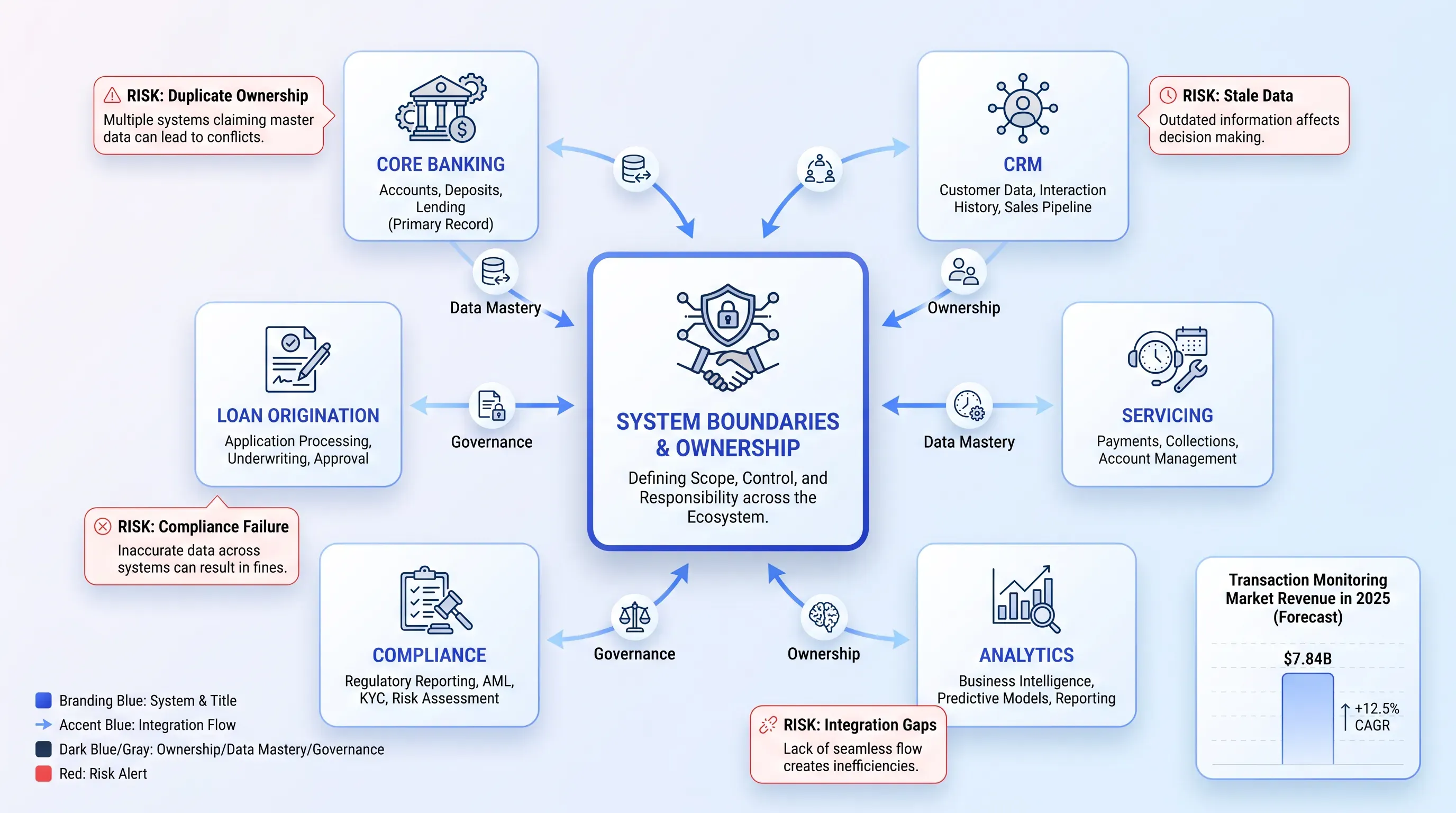
Once the role of core banking systems is defined, turn that definition into an ownership map for the wider banking operations backbone. For every adjacent platform, answer four questions. Which system starts the work? Which one applies the decision? Which one stores the authoritative result? And which one only reads the data?
These boundaries shift from one institution to the next, and that's fine. What isn't fine is duplicate ownership that nobody chose. When two systems both claim to master the customer record, you didn't decide that. It happened because the boundary was never drawn, and the banking operations backbone quietly grew a second source of truth.
The categories below expose those gaps before a vendor draws the architecture around its own product suite. The order matters, because a provider that owns the channel will argue it should own the customer master too. Decide that yourself, in advance, so the banking operations backbone reflects your governance rather than their sales incentive.
Digital banking and CRM
Web and mobile experiences live in the channel layer, as do Unstructured Supplementary Service Data (USSD) services. Agent and branch experiences sit there as well. They read balances from core banking systems and submit instructions to them. They don't own the balance. When a customer moves money in the app, the app asks the core to post, and the core decides whether the post succeeds.
CRM is a different animal. It holds relationship activity and the sales pipeline. Its interaction history provides service context. It's the home for what you know about the customer, while the core holds the authoritative account balance. Confusing the two is how a CRM ends up quietly holding a stale balance that a branch officer then quotes to a customer.
So decide where customer profile data is mastered and how a change propagates when someone updates an address or a phone number. And hold every channel to the same standard for authorization and availability, with response-time requirements defined separately. A balance that's correct on the web and wrong on USSD is still a wrong balance.
Origination and loan servicing
Application capture and underwriting belong to the loan origination system (LOS). The LOS also handles credit scoring and documents as it moves an application through approval and issues disbursement instructions. Account booking and ongoing financial servicing belong to core banking systems. That's the clean split.
Some providers combine origination and servicing in one product, and for MFIs that packaging can make sense. But require them to show the boundary anyway. Ask them to trace one approved loan from the LOS into the core, then follow its repayments through restructuring. Continue the trace through a delinquency episode and closure.
That trace does two jobs at once. Operations learns exactly where staff will work at each step, and IT identifies every handoff that needs an integration built and tested. A handoff nobody drew on the map is a handoff nobody will test.
KYC and AML controls
Within the banking operations backbone, specialist systems handle identity verification and screening, while their risk scores drive case management. They also run transaction monitoring, even when the core enforces the account restrictions or transaction limits those systems demand. In 2025, transaction monitoring alone ranked as the largest slice of the financial crime compliance market and was reported as generating around $7.84 billion in revenue. That scale tells you how much specialized machinery sits outside a typical core.
Draw the line clearly. Decide which platform owns Know Your Customer (KYC) status and which owns Anti-Money Laundering (AML) alerts. Then define how the core receives an actionable decision, such as a block or a limit, rather than raw screening output it can't interpret.
Cover the full customer lifecycle so the boundary doesn't leak, from onboarding through periodic review. Include both sanctions-list updates and suspicious-activity workflows. And press hard on failure handling. If the compliance service is unavailable, what does the core do? Ask the provider to explain both the auditability of each decision and the fallback when a dependency goes dark.
Analytics and reporting
Separate two things that vendors like to blur. Operational inquiries and statutory outputs are one job. Enterprise analytics and dashboards are another job. Forecasting belongs there because it draws on historical analysis. The first belongs close to the transactional core. The second belongs in a governed data platform.
Heavy analytical queries running against the transactional core compete with the posting engine for resources, which is exactly the workload you don't want to slow down. That's why cross-system reporting and long historical analysis sit apart from the core, on a platform built for it.
Define the contract between the two layers before you buy anything by setting expectations for data freshness and lineage. The contract should also cover reconciliation and retention. Document how a correction in the core flows through to reporting. A slick vendor dashboard shows one system's data and leaves your broader data needs unresolved. Your reporting spans all of them.