Why technology defines modern microfinance
The old picture of a microfinance bank, with loan officers riding motorbikes to weekly group meetings and ledgers stacked in a back office, is quietly being retired. Reach and risk control now sit inside software rather than inside the branch network. IFC researchers who followed nine commercial microfinance institutions across Sub-Saharan Africa for four years found that transactions through agent networks cost 25 percent less than the same transactions inside a branch.
That shift forces a different question on operators. Instead of asking how many branches to open this year, executives have to ask whether their stack can carry more customers and more channels without breaking. The answer exposes gaps the old structure hid.
This piece walks through the layers a modern microfinance bank needs to run efficiently and serve customers remotely. We'll move from the system of record at the bottom up to the channels customers touch, and finish with how to read your own setup honestly.
Layers of the microfinance bank technology stack
Think of the stack as a layered architecture where each layer has a specific job and feeds the next one with clean data. At the bottom sits the system of record. Above it, lending and onboarding produce and maintain the customer relationship. Higher still, the channels deliver service to people who never walk into a branch.
The layers we'll cover are:
-
The core, which holds accounts, deposits, ledgers, and transactions
-
Loan management, where origination and collections live
-
Onboarding and digital Know Your Customer (KYC), the entry point for new customers
-
Customer-facing channels, including mobile and agent networks
-
Payments and integrations that connect the institution to the outside world
-
Reporting and compliance, which turn operational data into oversight
What ties these together is integration. M2P Fintech's benchmarking work across African microfinance and mid-tier banks shows that institutions now prioritise deployment flexibility and modular rollout over deeply customised implementations. Application Programming Interfaces (APIs) carry data between layers, and the quality of those connections decides whether the stack behaves as one system or as a set of disconnected tools the operations team has to patch over manually.
Core banking for MFIs
The core is the system of record. Every account opened, every shilling deposited, every loan disbursed, and every interest accrual eventually lands here. If the core is wrong, everything downstream is wrong, which is why core banking for MFIs is the first place to look when an institution starts hitting limits.
A microfinance-grade core needs configurable support for group lending, joint liability, weekly or biweekly repayment cycles, and small-ticket product variations without custom code. The Consultative Group to Assist the Poor (CGAP) studied digitization across MFIs and noted that Microfund for Women in Jordan upgraded its core in 2016 and added a cloud-based business productivity layer linked through APIs to reengineer every loan workflow. That layering is the pattern that works.
Deployment is the next decision. Gartner's market guide for the region found that 92% of core banking installations in the Middle East and Africa remain on-premises, mostly because of regulatory friction around cloud. That picture is shifting as composable, cloud-native cores enter the market and as regulators publish clearer cloud guidance. Multi-entity and multi-currency support also matter for any microfinance bank operating across borders or planning to, since retrofitting those later is painful.
The role of core banking for MFIs is to anchor the rest of the stack. When core banking for MFIs is configured well, the loan system and the reporting layer both read from a single source of truth, and reconciliation stops being a daily firefight.
Loan management and credit operations

The loan management system is the engine of the institution. It handles origination, disbursement, repayment schedules, restructuring, top-ups, and write-offs, and it does so at volumes that traditional bank platforms were never designed to absorb. A microfinance portfolio can easily contain hundreds of thousands of active small-ticket loans, each with its own schedule.
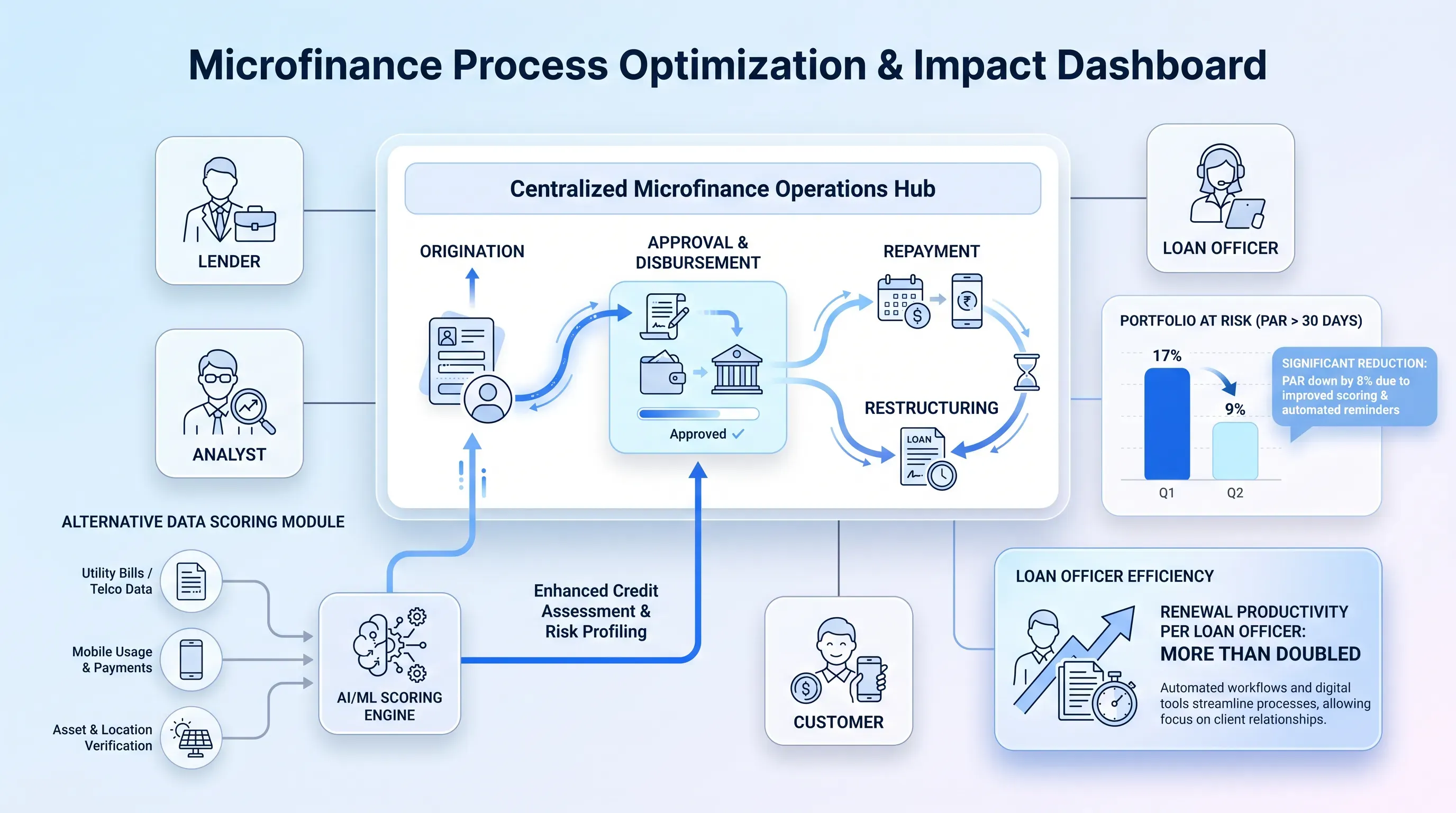
Credit scoring is where modern loan systems earn their keep. Accion's work with Peace Microfinance Bank showed that after rolling out a renewal scorecard, portfolio at risk for renewals fell from 17% to 9% within six months, while renewal productivity per loan officer more than doubled. Alternative data widens the pool further. The Alliance for Financial Inclusion notes that telco and wallet signals let lenders score thin-file borrowers who would otherwise be turned away, which lowers default rates by diversifying risk exposure.
The operational gains come from workflow automation and tight integration with the core and with payment rails. When a disbursement instruction flows from the loan system into a mobile money payout without manual intervention, two things happen. Reconciliation stops eating analyst hours, and the customer gets funds the same day rather than the same week. Portfolio quality monitoring then sits on top, with PAR30/90 dashboards and early warning indicators that flag a deteriorating cohort before it turns into a provisioning problem.
Customer onboarding and digital KYC
Onboarding is where remote service delivery either becomes real or quietly stays a slide in a strategy deck. If a customer still has to visit a branch to open an account, every other digital investment is capped at the speed of that branch visit.
Digital KYC and biometric verification pull the process onto a phone or an agent's tablet. India's Aadhaar system is the textbook case. The World Bank documented that Aadhaar-based eKYC reduced verification cost from Rs. 1,500 to roughly Rs. 20 per customer. A separate study found that biometric-enabled eKYC also cut average verification cost by $15 to $0.50 and compressed verification time from five days to seconds in markets where the national ID infrastructure is available.
The operational payoff is twofold. Onboarding feeds clean, structured data straight into the core and the loan system, so a new customer can apply for a first loan without re-entering details. And it sets the compliance baseline for everything that follows. Where national digital ID is patchy, a tiered KYC approach lets institutions open low-limit accounts quickly and step up due diligence as the relationship grows, which the Financial Action Task Force has explicitly endorsed for underserved segments.
Customer-facing channels
Channels determine how the customer actually experiences the microfinance bank. They shape reach and trust, and they are where institutions either differentiate or look the same as every competitor. Two channels carry most of the weight for MFIs, so we'll take them in turn.
Mobile banking for customers
Mobile banking is now the primary channel for most microfinance customers across emerging markets. The Global Findex 2025 found that 40% of adults in Sub-Saharan Africa held a mobile money account in 2024, the highest level of any world region. A microfinance mobile offering has to cover balance checks, transfers, loan applications, repayments, and savings goals at a minimum, available through both a smartphone app and Unstructured Supplementary Service Data (USSD) for feature phones.
Design matters more here than in commercial banking. Low-literacy users and low-end devices are the baseline assumption, and patchy connectivity has to be built into the design. The same Global Findex round noted that about 30% of mobile money account holders in Sub-Saharan Africa cannot transact without help; in Malawi, the figure is 46%. That number is a product decision waiting to be made about icons and offline-tolerant flows.
When the channel works, it pulls cost out of the system fast. FINCA Tanzania reported that a mobile transaction through a Mobile Network Operator (MNO) agent costs USD 0.50 versus USD 1.21 at a FINCA branch. That spread, repeated across millions of transactions, is what makes branch-light operations financially viable.
Agent banking operations
Agent networks extend the institution into communities where a branch would never pay for itself. The shopkeeper and the kiosk operator become the cash-in and cash-out points for a microfinance bank that no longer has to build physical infrastructure for every catchment. Done well, agent banking operations also become the primary acquisition channel.
The technology behind agent banking operations is more demanding than it looks. Agent onboarding, device provisioning, real-time transaction visibility, commission engines, and liquidity monitoring all need to run continuously, because an agent who runs out of float at midday loses customers for the institution along with transactions. Letshego's LetsGoBlueBox model in Mozambique, launched in 2016, is one documented example of an MFI building agent banking operations on smartphones with biometric capture, designed specifically for rural low-income segments.
Fraud risk and service quality monitoring complete the picture. Agent banking operations sit closer to cash than any other channel, which makes them the natural target for collusion and identity abuse. Modern platforms flag device anomalies and agent-customer collusion in near real time, which is the only way to scale agent banking operations beyond a few hundred outlets without losing control. The payoff is reach. The IFC Partnership program brought formal financial services to populations across Sub-Saharan Africa by treating banking agents as the front line of customer acquisition.
Payments and integrations
Payments are where the microfinance bank meets the rest of the financial system. The payments layer connects to mobile money providers, card schemes, national switches, and instant payment rails, and it decides whether moving money in and out of a customer's wallet feels instant or feels like a complaint waiting to happen.
The rails are also widening. AfricaNenda's State of Inclusive Instant Payment Systems report counts four IPS that already include banks, MMOs, MFIs, and non-bank PSPs as direct participants, with GIMACPAY in the CEMAC region uniting 105 participants, of which 14 are microfinance institutions. The Mojaloop Foundation pushes the same logic further with open APIs so that a customer of the smallest MFI can transact instantly with a customer of the largest bank.
Good payment architecture is open by default. APIs and clear settlement and reconciliation workflows are what let the institution plug into new rails as they appear without rebuilding the stack each time. Poorly designed payment flows show up as failed transactions and suspended balances, which directly erodes stickiness. The opposite is also true. When payments work, customers route more of their financial life through the institution because it's where their money actually moves.
Reporting, analytics, and compliance
The top layer turns everything below it into something a regulator or a credit committee can act on. Central bank reporting, Anti-Money Laundering (AML) monitoring, audit trails, portfolio analytics, and board dashboards all live here, and they all depend on the data being clean at the source.
A unified data layer is what makes this section work. When the core, loan system, channels, and payments all feed a single warehouse, the credit team and the finance team stop arguing about whose numbers are right. WSBI's case study work on African banks makes the point bluntly: institutions that built a dedicated analytics function and let customer data lead product decisions outperformed those that didn't.
Compliance is the operating baseline. Regulators expect on-time, accurate filings, and they increasingly expect AML monitoring that runs continuously rather than as a monthly batch job. Above that floor, analytics is where growth lives. Cohort behaviour, channel mix, segment profitability, and early-warning credit signals are all readable from the same data, and the institutions that read them well find growth opportunities the rest miss.
Running a branch-light operation
Bring the layers together and a branch-light microfinance bank starts to look concrete. A customer in a rural area meets an agent who captures her biometrics and ID on a tablet. The onboarding layer pushes her record into the core. She applies for a small working capital loan through Unstructured Supplementary Service Data (USSD) on her feature phone, and the loan system runs an alternative-data score in seconds. Funds land in her mobile money wallet the same morning. She repays weekly through the same wallet or by handing cash to the agent who onboarded her.
The process avoids a branch visit and a paper file while keeping the loan officer from driving 40 kilometres for a signature. Redian Software's deployment with ABC Finance in Cameroon documents what this can do in practice: an 85% reduction in loan processing time, from 14 days to 2, alongside a 60% drop in operational cost per transaction within 12 months of moving to a digital core with integrated mobile money.
The technology is only half the change. Branch staff become remote support and agent supervisors. Credit committees move from paper packs to dashboards. Risk teams shift from spot checks to continuous monitoring. Organisations that try to bolt branch-light operations onto an unchanged operating model find the savings disappear into shadow processes, which is why the process work matters as much as the platform work.
Evaluating your current stack
The practical question for any executive reading this is simple. Does your current setup actually support the growth and reach you're aiming at, or is it quietly capping both?
Map your current systems against the layers in this article and mark where each one sits. The gaps that matter most are the ones blocking remote service delivery, because those are the ones capping reach. A microfinance bank with a core banking for MFIs platform that cannot expose APIs will hold itself back from the customer numbers the board is asking for. The same constraint appears when the loan system cannot ingest alternative data or agent banking operations lack real-time visibility.
Doocat builds banking software for microfinance bank operations, with core banking for MFIs, lending, mobile, and agent banking operations in a single integrated platform. If you're auditing your stack against the layers in this article and want a second view from a team that has done this work with other microfinance bank clients, reach out to Doocat to start that conversation.