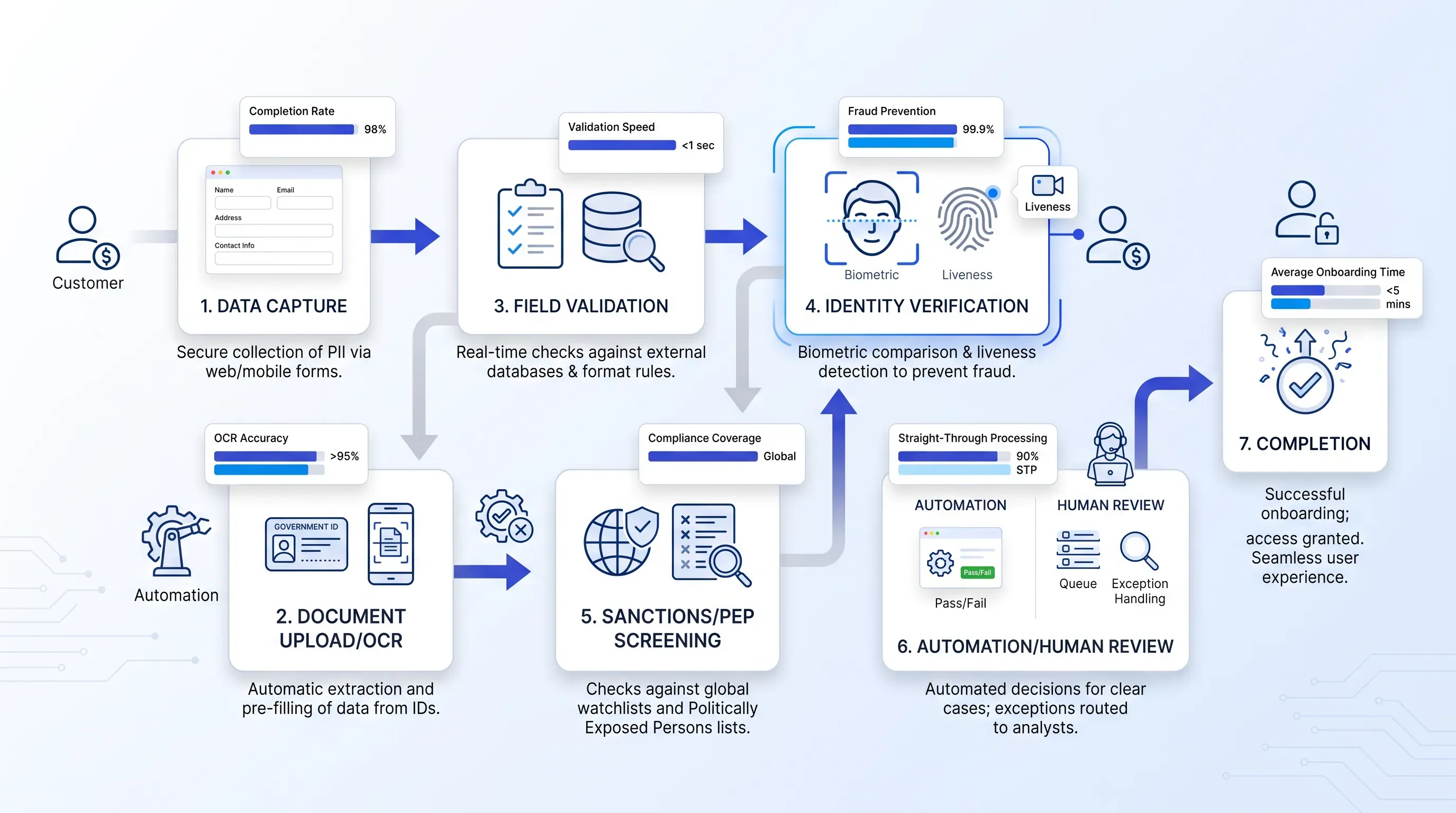
Handling exceptions without blocking everyone
Ask any onboarding team where the workflow hurts most and they point to the same place: exceptions. A minor mismatch or incomplete field that a rule flagged but no human needed to see. These bloat the manual queue until real risk sits behind hundreds of trivial cases, and the analyst assigned to investigate a genuine red flag spends the afternoon clearing typos.
Queue design is the fix. Every exception queue needs three things settled in writing:
-
Clear ownership, so each case has a named team responsible for resolving it
-
A resolution timeline, so a case that stalls past its window triggers a follow-up instead of aging silently
-
An escalation path, so a case that one analyst cannot resolve moves up defined steps
Do this and the math changes. Each manual review runs roughly $25 to $50 in analyst time, so every case you clear automatically is money back and a queue that stays short. Route only genuine red flags to people. Let everything else clear on its own, and your analysts spend their judgment where judgment actually matters.
Approval and core banking activation
The decision point is the moment a screened customer who passed verification and scoring becomes a live account. Once the checks pass, approval triggers account setup and automatic status updates. The customer's details move into the core system from the onboarding record, where they already sit.
This stage is also where you build the answer to a question regulators will ask later: how and why was this customer onboarded? A consolidated, auditable decision record captures the assigned tier and the checks that ran; it also shows any exceptions raised and the sign-off. When an examiner arrives two years on, that record is the difference between a clean audit and a scramble through email threads.
The common failure point is integration, or the lack of it. When your KYC banking workflow and your core banking system do not talk, someone re-keys approved customers by hand, and gaps open between compliance status and account status. A customer can be live in the core while their file shows an unresolved flag, or cleared in compliance while their account stays frozen. Roughly 60% of large banks still run COBOL cores without modern interfaces, which is why this seam breaks so often. How tightly you connect the two decides whether activation is a button or a backlog.
Keeping KYC banking current after onboarding
Approval is not the finish line. The file you built at onboarding starts drifting the moment the customer becomes active, and ongoing review is what keeps it accurate. This is refresh and monitoring, a planned discipline, distinct from the reactive scramble of remediation after something has already gone wrong.
Two models exist, and most institutions run a blend. Fixed periodic refresh cycles review a customer on a schedule regardless of what changed. Event-driven triggers react to something specific, such as a fresh sanctions hit. They also cover ownership changes and document expiry, with unusual activity handled through the same trigger logic.
The sensible hybrid ties the cadence to the tier you set at onboarding:
-
Low-risk customers get trigger-only monitoring, with review tied to events
-
High-risk customers get scheduled refresh plus continuous monitoring, because the exposure justifies the effort
This is where risk-based onboarding pays off a second time. When your refresh cadence inherits the tier from onboarding, you avoid the mass remediation projects that swallow whole compliance teams for months. Only about a third of periodic KYC reviews in KYC banking are automated on average, which is why so many institutions onboard well and then let files go stale. The customer identity verification you ran at the start is not permanent. Ownership shifts, and documents expire; a name clears the list one year and appears on it the next.
Map your workflow before adding tools
The fastest wins come from seeing the whole flow before you buy more software. Draw your current KYC banking journey stage by stage. Mark where cases wait and where teams re-enter data; note when a clean customer sits behind a complicated one. Only then does it become obvious where automation earns its place and where it only papers over a broken handoff.
Doocat builds banking software for exactly this kind of workflow mapping and integration, with digital capture and configurable approval workflows connected to a core that keeps compliance status and account status in sync. If you are ready to map your process and connect the stages of your KYC banking operation, book a call with the Doocat team.