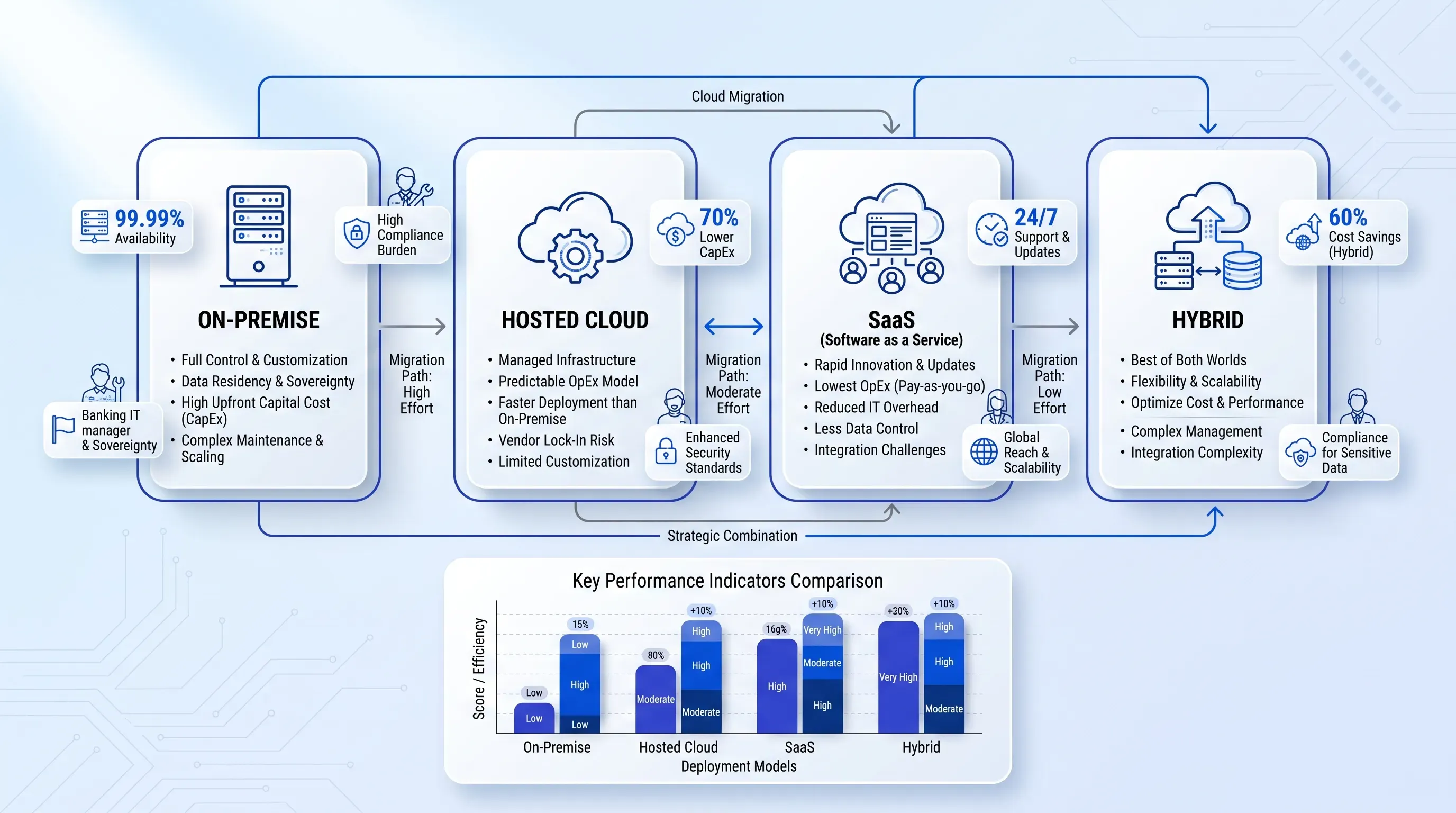
When cloud is premature
Now the counterargument, and it deserves weight. Core banking transformation programs fail 70% of the time, with average overruns of 189% on timeline and 148% on budget across McKinsey's 2025 analysis of 147 bank modernization efforts. National Bank of Greece's €450M program collapsed in 2023 after attempting to migrate all products simultaneously inside 24 months. Data quality is the reason to wait on a cloud banking deployment. Migration failures stem overwhelmingly from incomplete or poorly governed data, which is why banks now treat data migration as its own workstream with dedicated cleansing and reconciliation.
Hold off if any of these describe your position:
-
Connectivity at branches or in the field can't support the availability the new cloud core banking platform assumes
-
Ownership of the program sits in IT with no executive sponsor who can arbitrate between business units
-
Deep process customization exists because the business genuinely requires it
Karl im Brahm of Objectway, who works on core migrations, puts the governance failure plainly: "Often, clear responsibilities and coordination between business units and IT are lacking the project is not strategically anchored." Phased modernization is the safer path when that anchor is missing.
Security and governance
Outsourcing infrastructure never outsources accountability, and regulators have made that explicit. Under the shared responsibility model, the provider secures the infrastructure while you remain responsible for data and configuration. Gartner has long projected that at least 95% of cloud security failures through 2025 trace back to customer error.
The European Union's Digital Operational Resilience Act (DORA) sharpened the obligations further. Regulation (EU) 2022/2554 applied from 17 January 2025 across 20 categories of financial entity, and Articles 28 through 44 govern how you select and exit ICT third-party relationships. On 18 November 2025 the European Supervisory Authorities designated 19 critical ICT providers for direct oversight, among them the hyperscale cloud platforms.
Exit planning is where most institutions are weakest. DORA Article 30 requires contractual mandatory transition periods during which the provider keeps delivering service while you switch to another provider or move back in-house. The European Banking Authority's outsourcing guidelines go further and expect exit strategies to be tested. Concentration risk deserves board attention as well, since the European Systemic Risk Board has flagged that the top three cloud providers support over 70% of cloud-based financial services infrastructure in the EU. Engage your supervisor early. A regulator who learns about your migration from your notification register is a regulator who will slow you down.
Build the business case
Savings claims are the weakest part of most cloud proposals, because the honest comparison covers more lines than infrastructure and licenses. Implementation investment for cloud-native migration to a cloud core banking platform runs $15 million to $80 million for mid-size institutions, with professional services accounting for 60% to 70% of total project cost.
Count the dual-running period, which is the largest hidden item. BancoEstado ran both platforms in parallel while shifting 14 million customers over several years, and that means paying twice for the duration. Add migration tooling and the cost of exit if the arrangement ends. Then weigh what the numbers can't hold on their own. Cost per transaction matters, but so does the ability to launch a product in weeks. FinOps discipline is not optional here, because 84% of financial institutions without formal FinOps practices see cost overruns exceeding 30% of initial estimates.
Plan migration and rollout
Map the dependency graph and every digital channel before you choose an approach, because the sequence is determined by what depends on what. Only 20% of core banking migrations succeed, and data quality determines the outcome.
Four approaches exist, and each carries a different risk profile. Rehosting moves the workload with minimal change. Phased replacement retires functions one at a time. Parallel operation runs old and new together with reconciliation between them, which is how League Data migrated credit unions in under 48 hours each while integrating more than 20 ecosystem partners. Full cutover is fastest and least forgiving. Whichever you choose, the operational disciplines are the same. Reconcile balances daily against the legacy ledger. Performance-test at projected peak volume. Write a rollback plan with a decision deadline and the authority to invoke it named in advance.
Staff readiness gets underestimated consistently. In the National Bank of Greece post-mortem, 73% of critical issues had been identified by front-line staff and suppressed by middle management who feared blame. Your tellers and field officers see problems first, so build a path for what they report to reach the people who can act.
Assess cloud readiness
Before you commit to a target model, get an honest read on data quality and the connectivity your channels actually have. Doocat builds a cloud core banking platform for banks and microfinance institutions, with migration tooling and playbooks for moving off Flexcube and other legacy cores, and greenfield deployments go live in 12 to 20 weeks. Book a call with the Doocat team to assess your architecture and costs.