Why the definition matters before procurement
Most procurement teams treat a core banking platform as software you license and switch on. That assumption is where the trouble starts. The meaning of core banking solution is much wider than the product demo, and the scope ambiguity between the buyer and the vendor is the single biggest reason these projects miss their deadlines. According to IBM research cited by Richard Turrin, 94% of core modernization projects exceed their deadlines, and more than half of CIOs report cost overruns.
Regulators aren't making life easier either. Frameworks like the EU's Digital Operational Resilience Act (DORA) and tiered KYC rules for MFIs in markets like Kenya and Uganda keep pushing institutions to modernize whether they're ready or not. So before you sign anything, you need a shared definition of the meaning of core banking solution and what you're actually buying. Think of this article as the pre-procurement briefing you wish your last vendor had given you.
The meaning of core banking solution
A core banking solution is the full bundle that makes the system of record actually work inside your institution. It's the software, yes, but it's also the deployment, the integrations, the data migration, the governance, the support, and the operating responsibilities that come with running the thing day to day. The software alone is a product. The complete package is the solution.
That distinction sounds academic until your first invoice for "out of scope" integration work lands on the CFO's desk. Karl im Brahm, CEO DACH at Objectway, puts the stakes plainly: "Around 80 percent of all migration projects fail," he told The Wealth Mosaic, "usually due to incomplete or incorrect data." When buyers confuse software with solution, they underestimate the budget and schedule while also misjudging the internal effort their own teams will have to put in.

Core banking vs core banking solution
Core banking is the underlying function: the ledger, the accounts, the transactions, the system of record. A core banking solution is what a vendor delivers to make that function operate inside your specific institution, with your products and channels under your regulator's reporting templates.
The same software can be sold either way. Oracle's FLEXCUBE, for example, can be licensed as a product where the buyer handles deployment, or wrapped into a managed solution where the vendor or a partner runs the whole stack. The contract language, not the brochure, decides which one you're getting. Read it twice before you sign.
What buyers commonly misunderstand
Many implementation challenges do not originate from technical failures. They originate from assumptions made during procurement and planning that remain unchallenged throughout the project lifecycle. Teams often interpret vendor proposals differently, assume certain features are standard, or expect responsibilities to sit with external providers without defining ownership early. These misunderstandings usually remain hidden during implementation and only become visible after deployment, when changing scope becomes significantly more expensive.
The assumptions that bite hardest after go-live are the same ones across institutions:
-
Integrations to payment switches and credit bureaus, as well as regulatory reporting connections, are included by default (they aren't)
-
Data migration from the legacy core is the vendor's job (it's a shared job, and the buyer owns the cleansing)
-
Support covers customizations made during implementation (most vendor SLAs exclude them)
-
The price quoted includes infrastructure and third-party database licenses, with disaster recovery inside the same price (it doesn't)
These surface after go-live, when the budget is sunk and the leverage is gone. Clarity on the meaning of core banking solution at the definition stage is cheaper than clarity after the cutover.
Core banking architecture layers
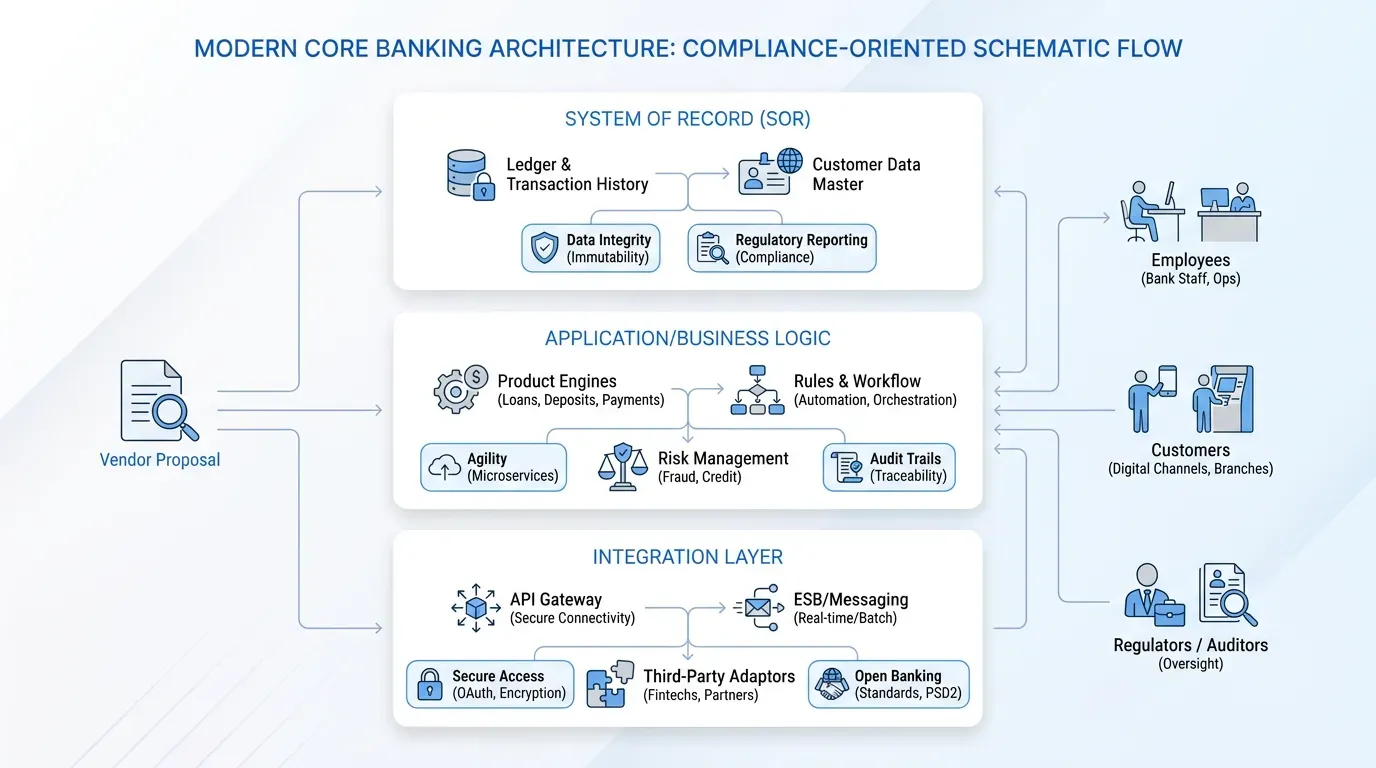
A modern core banking architecture is a stack, so you need to confirm scope layer by layer. Mapping a vendor proposal against the architecture is how you spot what's missing before the missing thing becomes a change request. The core banking architecture conversation is also where your IT team and your procurement team finally start speaking the same language about the meaning of core banking solution.
Keep it accessible. Executives need to know which layers are priced and which assumptions sit outside the contract.
Database and core ledger layer
This is the system of record where account balances and transactions live. It runs on a relational database like Oracle Database or PostgreSQL, or on cloud-managed equivalents. The database layer is rarely negotiable in functionality, but the commercial terms around it are wildly misunderstood.
Confirm in writing who pays for the database license and who hosts the environment, with backup and restore testing responsibility named in the same document. A vendor proposal that quotes "core banking software" without specifying Oracle license costs is hiding a six- or seven-figure line item. This is the foundation of the core banking architecture, so treat the cost breakdown with the same rigor you'd treat a loan covenant.
Application and business logic layer
This is where products, interest rules, fee structures, and approval workflows live. It's also where contracts go vague. Who configures a new microloan product? Who tests it? Who signs it off as compliant with the local regulator's interest cap?
In the implementation responsibility matrix, every product variant should have a named owner for build and test, with approval responsibility stated separately. If the vendor's proposal says "standard products included," ask which exact products and parameter sets are covered, and ask what counts as a customization. A group lending product with weekly repayments and a co-borrower guarantee is not the same as a vanilla term loan, even though both are "loans" on the brochure.
Channel and integration layer
This layer is where APIs and middleware live, along with connections to mobile banking, agent networks, ATMs, payment switches, and regulatory reporting. It's also where most scope disputes happen. The On-Point analysis of core banking projects recommends scheduling 50 to 100 percent of the implementation effort just for integration work. Most buyers budget a fraction of that.
Before signing, list every external system your institution touches. Payment switches, SWIFT, national instant payment rails, credit bureaus, tax authorities, KYC providers, SMS gateways, and your existing CRM. For each one, specify who builds the connector and who owns the test cases, with payment responsibility set for any third-party API change. This is the layer where the core banking architecture meets the meaning of core banking solution in reality, and reality is expensive.
Modules included and excluded
Vendors package modules differently, and the included list almost never matches your operating reality. "General ledger included" can mean a basic chart of accounts without the multi-entity consolidation your group structure needs. "Loans module" can mean term loans while excluding specialized cases such as group lending with joint liability and Islamic financing with profit-sharing; the rescheduling workflow your collections team actually uses can also be outside scope.
Read the module list like a contract lawyer reads warranties. Ask the vendor to list, in writing, every product type and report that's covered as standard, with workflow coverage stated separately. Then ask what happens to the items that aren't. The American Bankers Association's 2024 Core Platform Survey found that 35% of US banks are dissatisfied with their current core process, and a large share of that dissatisfaction traces back to modules that sounded right in the demo and disappointed in production.
Don't assume general categories cover institution-specific variations in the meaning of core banking solution. They rarely do.
Integration ownership and the implementation responsibility matrix
Integrations are the single biggest source of post-contract disputes. The vendor assumed the buyer would deliver the payment switch API spec. The buyer assumed the vendor would handle it. Neither did. Six weeks before go-live, the project manager discovers the gap, and the change request lands.
This is what an implementation responsibility matrix prevents. It's a structured table based on the RACI framework that lists every task in the project and assigns one of four roles to each party: Responsible, Accountable, Consulted, Informed. Jamilyn Trainor, senior project manager at Müller Expo Services International, told Project-Management.com that RACI matrices "force owners of the project to clear timelines for approvals, provide clarity, push decisions faster, and call out gaps before they become failures."
For a core banking project, the implementation responsibility matrix should cover every integration point, every test cycle, every regulatory submission, and every handover from build to operations. And it must include third parties. If your national payment switch operator needs to certify the connection, put their name on the matrix. If the credit bureau requires a 90-day testing window, that goes on the matrix too.
A few rules for using the implementation responsibility matrix well:
-
One Accountable role per task, never two. Shared accountability is no accountability.
-
Update the matrix whenever scope changes.
-
Get the third parties to sign their rows along with the vendor and the buyer.
Vendors who push back on signing an implementation responsibility matrix are telling you something. Listen.
Data migration requirements
Data migration sounds like a technical chore. It's actually the work that decides whether the project succeeds. Realistic migration covers extraction from legacy systems, cleansing, mapping, transformation, reconciliation, and parallel runs before cutover. A Tata Consultancy Services white paper on core banking migration describes rollout strategies such as big bang and phased delivery, with parallel run posting transactions to both source and target until reconciliation passes.
Vendors almost always expect the buyer to deliver clean source data. That expectation is rarely realistic. If your legacy core has been running since 1998, you have duplicate customer records and addresses in three formats, and at least one collateral field has been used to store SMS reminders. Cleansing that takes months and dedicated people, and "the bank will provide clean data" in a contract is a clause that quietly transfers tens of thousands of hours of work to your operations team.
Confirm the following in writing before signing:
-
Who owns cleansing of source data, with named teams on both sides
-
How many migration rehearsals are included in the price (three in staging is a sensible minimum, as recommended by vLink Info's migration guide)
-
The reconciliation threshold that triggers a halt, and who has authority to call it
-
Who signs off on cutover, and what the rollback plan looks like if cutover fails
If the vendor's response to any of those is "we'll figure it out during the project," you have a software license with a hopeful project plan attached.
Support model and operating responsibilities
Support models look similar on the cover page and differ enormously in practice. Break-fix support means the vendor responds when something breaks, full stop. Managed services means the vendor runs day-two operations, with patching and monitoring included. Shared operating models split the work, which is where most disputes start.
Read the Service Level Agreement (SLA) line by line. What's the response time for a Priority 1 incident? What's the resolution time? Does the SLA pause during business hours or run 24/7? What's the escalation path when the first-line team can't fix it? And critically, what happens to the customizations your project team built during implementation? Many vendor SLAs exclude custom code from support, which means your most important workflows are the ones the vendor won't touch when they break.
Day-two operations are the quiet cost center. Patching, vulnerability management, monitoring, capacity planning, and disaster recovery testing all need owners. The core banking architecture you signed off on assumes someone is running it. If your contract is silent, that someone is you. The implementation responsibility matrix should extend past go-live into the operating phase, so the handover from project team to run team has clear lines.
Vendor validation checklist
This is your minimum due diligence for the early stage of evaluation. Get written commitments on each item before signing. Vendors who hesitate on any of these are flagging future risk, and you should price that risk into the negotiation or walk away.
Organizations should verify several critical areas before moving from evaluation to implementation:
-
Scope document listing every module and product variant, with included reports named
-
Layer-by-layer breakdown of the core banking architecture with license and hosting responsibility named, and backup responsibility stated separately
-
Full list of integrations with third parties identified by name
-
Implementation responsibility matrix covering build, test, migration, cutover, and operations
-
Data migration plan with cleansing ownership and rehearsal count, plus reconciliation thresholds
-
SLA with response times and escalation path, plus explicit treatment of customizations
-
Governance model with steering committee composition and decision rights
-
Exit terms covering data export format and transition assistance, with intellectual property addressed
The checklist looks long because the meaning of core banking solution is long. That's the point. Short checklists hide expensive surprises.
Request a written scope and responsibility matrix
The meaning of core banking solution only becomes real when every line item has a named owner. A polished sales deck is not a scope document. A handshake on integrations is not an implementation responsibility matrix. If a shortlisted vendor cannot or will not produce both before contract signature, that's your answer about how the project will be managed once your signature is on the page.
Make the written scope and responsibility matrix a non-negotiable part of procurement when you define the meaning of core banking solution. Not nice-to-have, not later, not after the kickoff workshop. Before signing. Walk through every layer of the core banking architecture with the vendor, line by line, and watch where they hesitate. That's where the scope gap is.
At Doocat, we build core banking for banks and microfinance institutions, and the meaning of core banking solution is something we negotiate with buyers in writing on every deal. If you're starting vendor conversations, audit one customer journey end to end and mark every point where your current digital banking breaks today. Then contact our team to request a sample written scope and responsibility matrix template before your next procurement cycle. It's a much better starting point than the vendor's template.