Doocat

Customer Experience in Banking Industry: How to Fix Friction Across Digital and Branch Channels

Content authorBy DoocatPublished onReading time13 min read
A customer and bank advisor collaborate at a modern desk, focused on a tablet, in a bright, spacious bank branch.

This article treats customer experience in banking industry work as an operational problem that lives in the handoffs between your digital and branch channels. It uses customer journey mapping to walk through where friction accumulates during onboarding and when support or compliance work crosses channels, then gives you a way to map it with owners so you can prove that a fix worked.

Why friction hides between channels

Most banks measure customer experience in banking industry performance one touchpoint at a time. The mobile team watches app ratings while the branch team watches teller queues, and every dashboard looks fine on its own. Customers experience a sequence, and the pain lives in the seams where one channel hands work to the next.

Think about the moments that actually break trust. A transfer that fails and gives no reason. A loan application that stalls with no status. An account someone opens online on Sunday night before a Monday branch visit that ends with "I don't see anything here." Those failures happen at the point where two systems or two teams were supposed to pass context and lost it.

That's why chasing a single culprit rarely works. The failure sat in the handoff: the digital origination system never sent the branch a usable record, and ownership was missing. McKinsey found that end-to-end journey metrics predict satisfaction and willingness to recommend more than twice as accurately as individual touchpoint metrics. So if your customer experience in banking industry reporting is organized by channel, it's built to miss the exact place where experience decays. Fixing that starts with seeing friction as a question of connected systems and clear ownership.

What customer experience in banking really means

Before the rest of this lands, your teams need one shared definition. Customer experience is the sum of every interaction a person has with your bank across digital and branch channels, filtered through how they felt and what they expected, and that definition anchors customer experience in banking industry work. It's the emotional residue the interface and process leave behind.

Here's the distinction worth arguing about internally. The customer journey is the set of steps your bank designs and controls, like the screens in an application or the script at a branch desk. The experience is how those steps feel to the person moving through them. In customer experience in banking industry work, you can own the journey completely and still deliver a poor experience, which is exactly why fixing one channel rarely moves the number. A faster app doesn't help the customer whose problem is that the branch can't see what the app already captured.

Banking raises the stakes in a way retail doesn't. Money and identity are involved, so a single bad moment carries more weight. Zendesk's CX Trends research found that 73% of financial service consumers will switch to a competitor after multiple bad experiences, and more than half leave after one. J.D. Power reported that 13% of U.S. bank customers say they're likely to change their primary bank within a year. Add regulation, and every journey carries verification and disclosure steps that other industries never touch. That combination of trust and compliance is what makes customer experience in banking industry work harder to fix and more expensive to get wrong.

Where friction shows up across the journey

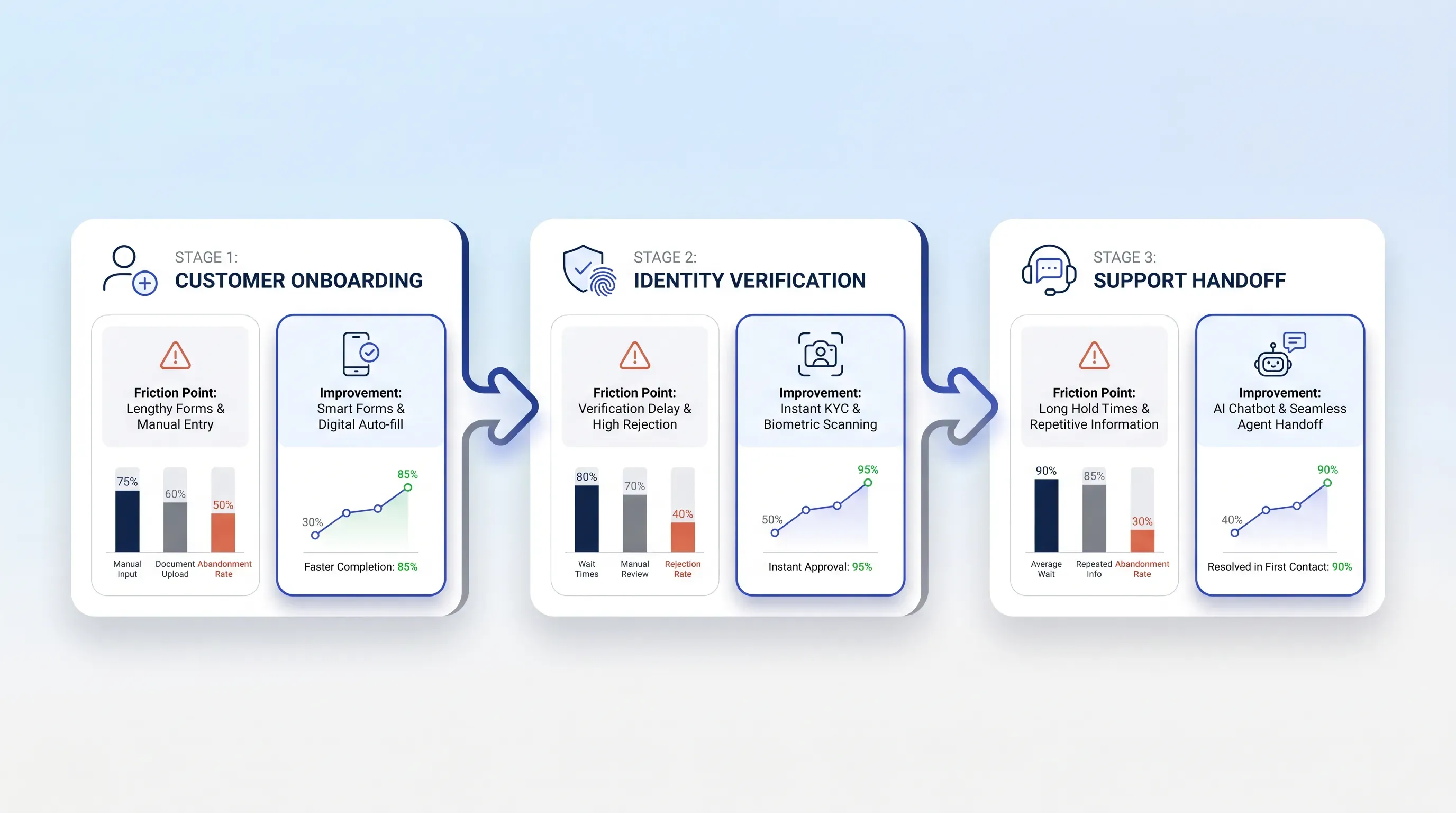
Professional infographic UI illustrating a horizontal customer journey flow for banking, featuring onboarding, verification, and support steps with friction …

In customer experience in banking industry work, friction clusters in a handful of zones you'll recognize, and each one traces back to disconnected systems or undefined ownership. The sections below name the common failure modes so you can locate your own weak points and act on them separately.

Digital onboarding and KYC

The first 90 days decide whether a new customer stays. Signicat's research on remote account opening found that 63% of customers abandoned the process in 2020, a sharp climb from 38% three years earlier. The drop-off follows the clock: Account opening abandonment exceeds 50% once the process runs past three to five minutes.

What drives that? Repetitive identity checks and forms that ask for information the bank already has drive it, especially when accounts open on screen but freeze at verification. In customer experience in banking industry programs, the pattern almost always comes down to Know Your Customer (KYC) and compliance steps colliding with a self-service flow that was never wired to them. The customer clears identity checks in the app, then the funding step demands the same proof again because the two systems don't talk.

The connected version removes that repetition. Pre-filled forms and digital ID cut the drop-off, with instant funding as part of the same connected flow. MX reported that eliminating micro-deposits in favor of instant account verification pushes onboarding drop-off from as high as 49% down to 1%. The friction came from a compliance requirement stacked on top of the flow.

Ready to digitise your financial institution?

Talk to our team about your roadmap and discover scalable digital banking solutions tailored to banks, fintechs and microfinance institutions.

Request a Demo

Branch and call center handoffs

This is the classic broken seam. A customer who starts an application online has to start over when they contact the bank to finish because the person helping can't see any of the digital activity. In customer experience in banking industry work, every repeated question is a small withdrawal from the trust account, and this is where banks drain it fastest.

Branch and agent systems run on separate records from the digital channel, so the person helping has no real-time view of what the customer already did. First contact resolution suffers as a result. The financial services benchmark sits around 70% to 80%, which means one in four or five contacts requires the customer to come back.

A connected handoff gives branch and agent staff a shared, live view of the customer, so the transition preserves context instead of erasing it. Doocat's retail platform, for example, keeps account state consistent across digital and branch channels so teams and customers "see the same truth," and lets a customer resume a journey started in one channel from another. Ownership of this seam is undefined, which is why it stays broken until someone is named to fix it.

Mobile banking and self-service limits

Mobile is now the front door. The American Bankers Association found that 55% of U.S. consumers use mobile as their primary way to manage accounts; the share reaches 64% of Gen Z and 68% of Millennials. The app handles what people need. The friction shows up at the edge, when self-service hits a limit and the customer needs a human.

That handoff moment is what matters here. When someone taps "contact support" mid-task, the escalation carries everything they just did into the next channel so they can continue without explaining it all again. For customer experience in banking industry teams, clean error states and clear status updates keep customers self-serving longer, and when they do need help, a context-preserving escalation is the difference between a minor delay and a lost account.

Support cases and agent networks

Some problems can't be solved in one contact. Disputes and complex loan questions require follow-up, especially when a request touches a third-party agent network. The failure mode is what happens between those contacts, when a case sits waiting on manual action or bounces between departments with no one clearly holding it.

Untracked ownership turns one problem into repeated effort for the customer. Each transfer means re-explaining, and each manual coordination step adds a day. In customer experience in banking industry terms, the customer measures the whole thing as one long, exhausting episode, even when each individual agent was helpful.

Routed, context-carrying case handling fixes this. The case moves through a defined workflow that records ownership and status:

  • Every case has a named owner at each stage, so nothing waits in an unassigned gap

  • Context travels with the case, so no agent starts from zero

  • Status is visible to the customer, so waiting doesn't feel like being ignored

How compliance friction creeps in

Regulatory steps are the most visible face of friction because they're bolted on as afterthoughts. A verification screen here and a disclosure there get added to satisfy a requirement without any thought for where each lands in the flow. The result is a journey that feels like an obstacle course, and staff end up apologizing for steps they didn't design.

In customer experience in banking industry debates, the reflex is to treat compliance and good experience as opposites, as if every control you add must cost you a customer. That framing is wrong, and the onboarding numbers prove it. The banks that moved to instant verification kept KYC and designed the required check into the flow so it ran once and stayed invisible to the customer. The requirement stayed. The friction left.

The better way to think about a regulatory step is as a workflow to orchestrate. These compliance requirements are tasks with owners and outputs, and they can be sequenced into the journey so they fire at the right moment with data the bank already holds. Capgemini's research found that documentation and compliance work consumes 91% of onboarding teams' time, which shows how much of that effort is manual coordination the customer feels as delay. Design the step in, and compliance stops being the villain of the story.

Ready to digitise your financial institution?

Talk to our team about your roadmap and discover scalable digital banking solutions tailored to banks, fintechs and microfinance institutions.

Request a Demo

Connecting systems with service orchestration

Everything above points to the same fix. Friction lives across channels, so the answer is a connected operating layer that coordinates work across your systems and teams so context survives every handoff. That layer is what service orchestration provides.

In plain terms, service orchestration does three things. It routes tasks automatically to the right system or person instead of relying on someone to forward an email. It maintains a single customer view so every channel reads from the same record. And it removes the manual coordination that turns a two-day process into a two-week one. When a customer opens an account on mobile, service orchestration makes sure the branch and verification system see that event, and it triggers the funding step without anyone re-keying data.

The fear is that this means ripping out and replacing your core, a multi-year project no one wants to sign off on. Service orchestration avoids that core-replacement path. Service orchestration connects your existing systems of record and sits above them to coordinate the work they already do. The value shows up in the seams, which is exactly where the friction was hiding. Even for cases that touch external agent networks, service orchestration is what carries ownership and context across the boundary instead of dropping it.

This is where Doocat fits. Its platform is built to keep account state consistent across digital and branch channels on a shared core, with workflow and notification tooling for approvals and case handling across customer events. For a bank trying to connect digital and branch channels and orchestrate service across them, that's the operating layer the diagnosis has been pointing to.

How to improve customer experience in banking

Knowing where friction lives is only useful if it turns into a sequence you can run. Improving customer experience in banking industry performance means prioritizing the moments that matter first. The goal is to find the moments that cost you the most and unify what your teams can see so someone owns every handoff.

Here's the order that works:

  1. Identify your highest-friction moments with real data. Drop-off rates and repeat-contact patterns point straight at the seams that hurt.

  2. Unify the customer view so frontline and digital staff read from the same record. Most broken handoffs die here.

  3. Assign a named owner to every handoff, because a seam with no owner will never improve on its own.

  4. Set consistent service standards across digital and physical channels, so a customer gets the same answer whether they use the app or speak to staff.

Ownership is the piece banks skip, and it's the one that decides whether anything changes. A LinkedIn discussion of McKinsey's CX operating model research put it bluntly: "If no one owns the customer experience, your org chart does." That's the trap. When accountability follows the org chart, every team optimizes its own touchpoint and the seams stay orphaned. Naming owners is what breaks the pattern, and it's why service orchestration matters as the layer that makes those owners' work connect. Effective customer journey mapping surfaces the handoffs in the first place, and it makes the whole sequence concrete.

Measuring customer experience in banking

A fix you can't prove is a fix nobody will fund again. Three metrics do the measurement work, and each has a distinct job. Customer Satisfaction (CSAT) captures how someone felt after a specific interaction. Customer Effort Score (CES) measures how hard a task was to complete. Net Promoter Score (NPS) tracks long-term loyalty and willingness to recommend.

Of the three, effort is the one to watch in digital banking. The original CEB research behind the metric found that 96% of high-effort interactions make customers more disloyal, against only 9% for low-effort ones, which makes CES a sharper predictor of stickiness than satisfaction alone. Since the whole argument of this piece is that friction lives in the handoffs, effort is the number that exposes them. A customer can rate a call 4 out of 5 and still churn because getting to that call took three transfers.

Tracking customer experience metrics that matter

The combination is what makes measurement diagnostic. Tie each metric to a specific journey stage and handoff in your customer journey mapping, and the data tells you whether a change actually worked.

Benchmarks give you a reference point:

Customer journey mapping earns its keep here too, because effort measurement at each mapped handoff confirms that the seam fix moved the number.

Map one journey and assign owners

Start with one journey. Pick one journey that you know generates friction, such as digital onboarding, and do customer journey mapping across every channel it touches, from the first tap to the support case. Then, for each point where the work passes from one system or team to the next, assign a named owner. Assign the handoff to a person.

That single exercise turns scattered complaints into a plan, and it's the move that makes connected systems and clear ownership real instead of aspirational. Service orchestration is what holds those handoffs together once you've named them, and Doocat is built to orchestrate that work across your digital and branch channels. After you map the journey and assign the owners, you'll have the first concrete step toward better customer experience in the banking industry. Book a call with Doocat to see how it connects.

Ready to digitise your financial institution?

Talk to our team about your roadmap and discover scalable digital banking solutions tailored to banks, fintechs and microfinance institutions.

Request a Demo

Repeated identity checks usually happen when onboarding, KYC, and funding systems don't share verified data. The customer completes one check, but the next system treats the person as unknown. Banks can reduce this by storing verification status once and passing it across each step in the account-opening journey.

Start with the journey that has the highest measurable customer effort or drop-off. For customer experience in banking industry teams, onboarding, failed payments, and support escalations are practical starting points because they affect trust and cost. Map one journey first, assign handoff owners, then measure the change before expanding.

Yes, compliance checks can be easier when banks design them into the workflow instead of adding them as extra steps. The control still runs, but the customer doesn't repeat data entry or upload the same document twice. Clear timing, saved verification status, and staff visibility reduce friction while keeping required checks in place.

Yes, branch staff should see relevant digital activity in real time when they handle the same customer journey. Without that view, staff ask customers to repeat steps the bank already captured. A shared customer record helps staff continue the process, explain delays, and resolve issues with less back-and-forth.

Doocat helps connect banking channels by keeping account state and workflow context consistent across digital and branch interactions. This gives teams a shared view of where the customer is in a process. Banks evaluating this type of operating layer can book a call with Doocat to review channel handoffs and ownership gaps.

Schedule a Meeting

Book a time that works best for you

You Might Also Like

Discover more insights and articles

A banking advisor assists a customer with KYC onboarding on a tablet in a bright, modern office with natural light.

KYC Know Your Customer Guide for Banks and MFIs: Checklist, Workflow, and Controls

This article turns KYC know your customer from a scattered set of manual checks into a documented, repeatable workflow you can run across your onboarding team. You'll get a KYC checklist template to adapt and the controls that make the whole thing defensible in an audit, with a clear split between individual and business requirements.

A customer advisor assists a client with the KYC onboarding process on a tablet in a bright, modern office setting.

KYC Banking Workflows: How Banks and MFIs Can Scale Onboarding and Compliance

This article treats KYC banking as an operational workflow you can map. It walks the full journey a customer takes from first data capture through ongoing review, and shows where your handoffs and exception queues leak time or risk.

A finance professional reviews documents and reports at a modern office desk, taking notes while using a laptop in warm daylight.

Fintech Payment Infrastructure for Banks, MFIs, and Wallet Providers

This article breaks payment systems into their real parts and shows how rails and wallets hand off into settlement, while reconciliation and exception handling keep the record straight. It is written for wallet providers and for fintech payment teams inside banks or microfinance institutions who already run a payment product but keep hitting the same operational walls as volume grows.

A diverse team collaborates in a bright meeting room, discussing a mobile banking app and business dashboard at a natural wood table.

Bank Customer Experience in Mobile-First Markets: How to Improve Digital Journeys

This article is a mobile-first guide to finding and fixing the operational blockers that break the banking customer journey in markets where the phone is the only channel customers have. It walks through where journeys fail in bank customer experience and who owns the fix, with measurement tied to whether people actually complete what they came to do.