Why the definition still matters
Almost every bank and MFI claims to be "doing digital banking" now. Walk into any leadership meeting, though, and you'll hear the head of retail, the CTO, the compliance officer, and the CEO each describe something different when the topic comes up. One person is talking about an app, another about a core replacement, a third about open APIs, and the fourth about a marketing campaign. Defining what digital banking means inside your institution is now a prerequisite for budgeting, roadmap planning, and conversations with regulators who increasingly expect precise language.
This piece is an alignment tool. By the end, you'll be able to articulate the difference between online, mobile, digital, and open banking, with a clear view of where digital banking shows up across the customer lifecycle and which systems have to talk to each other for any of it to work. We'll also cover the assumptions that quietly drain budgets and the metrics that tell you whether your effort is actually paying off.
What digital banking means today
At the operating level, digital banking means a connected model that spans onboarding, channels, payments, core data, servicing, and the journeys that tie them together. It is the institutional choice to design products, decisions, and customer interactions so they can run through software from start to finish, with humans stepping in by exception rather than by default.
Digital banking means a business model decision dressed up as a technology project, which is partly why so many programs stall. A surface-level definition (we have an app, we have an internet portal) lets executives check a box. A deeper definition forces uncomfortable questions about org charts, P&L ownership, and which legacy processes get retired. The Deloitte Digital Banking Maturity 2024 study, which surveyed 349 banks across 44 countries, found that leading institutions have shifted from racking up features to redesigning core processes around hyper-personalisation and customer experience. That shift only happens when the definition goes beyond the interface.
For the rest of this article, when we say digital banking means something specific, we mean this: a connected operating model where channels, core, payments, and servicing share state and the customer never has to repeat themselves.
Digital banking as a digital finance model
In this context, digital banking means a digital finance model where products, risk decisions, and customer interactions are designed to run through software end to end. That is different from digitising paper. A digital finance model originates a loan through a flow that pulls bureau data, scores the applicant, disburses funds to a wallet, and schedules repayments without a human touching the file.
The difference shows up on the P&L. In a real digital finance model, the cost of serving a customer drops because software handles the routine work, and revenue per customer rises because cross-sell happens contextually. Risk behaves differently because data is fresh rather than stamped at origination. McKinsey reported that AI applied across banking workflows lifts profitability by up to 20%, and most of that lift assumes the underlying digital finance model is already in place. Bolt AI onto a paper-based process and you get a faster paper-based process. The economics don't change.
This is also where the digital finance model parts ways with the brochure version of digital. A digital finance model treats software as the primary delivery channel for the product itself.
Connected end-to-end banking journeys
The other half of the operating definition is that digital banking means end-to-end banking journeys. A journey moves a customer from discovery through onboarding into daily use and on to lifecycle events, and the system carries context the whole way. When end-to-end banking journeys work, opening an account in the app and walking into a branch the next day to ask about a card produces one continuous conversation across both touchpoints.
Most "digital" banks fail this test. Customers feel the handoffs. A 2026 survey cited by Unblu found that 64% of consumers rely on branches for conflict resolution but face fragmented data when they get there, which is a polite way of saying the branch can't see what the app just did. End-to-end banking journeys are about removing those seams. Channels, core systems, and servicing have to share state in close to real time, or the experience falls back to analog at the worst possible moment.
This is also why end-to-end banking journeys are the unit of measurement for digital maturity. Counting features tells you what you've built. Walking a journey tells you whether any of it works together.
Online, mobile, digital, and open banking
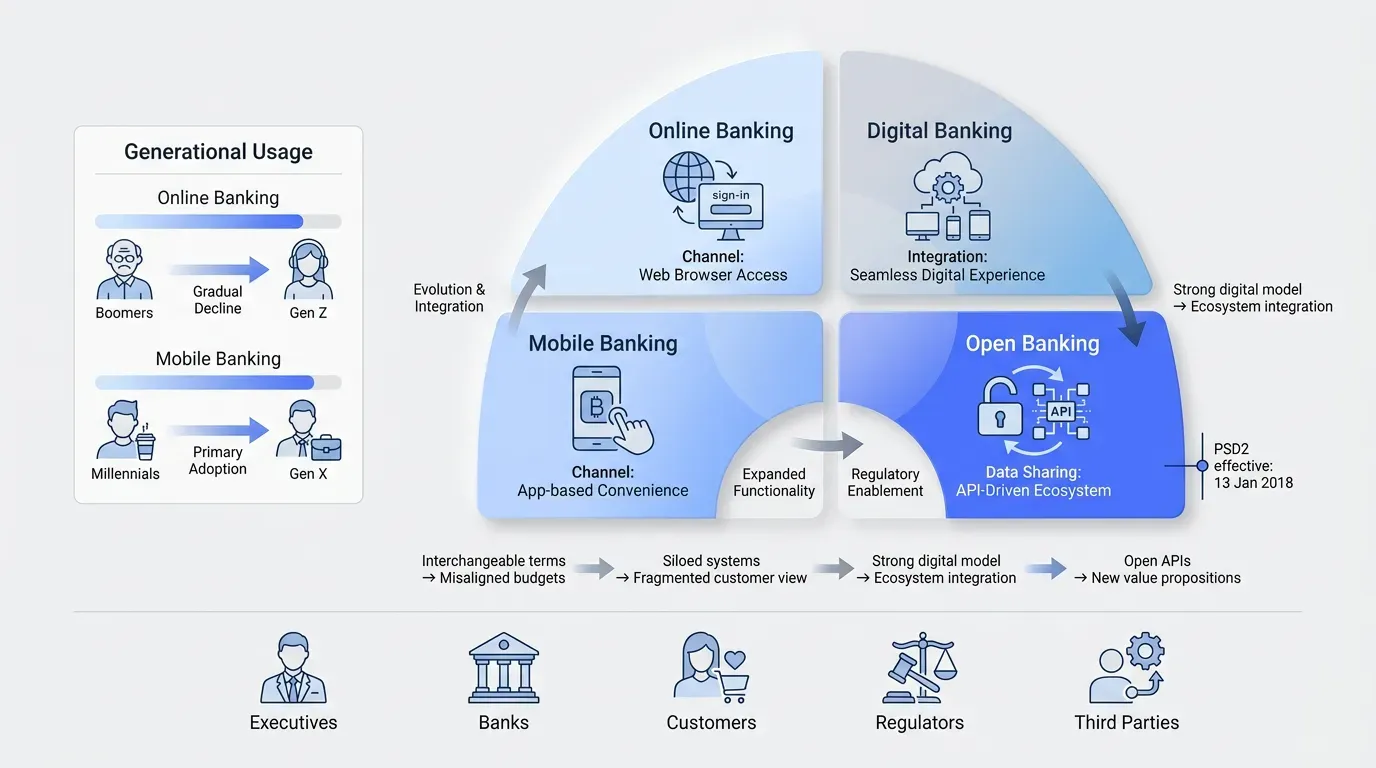
Executives use these four terms interchangeably, and it costs them. Each one implies a different budget and a different owner, with its own regulatory conversation. Treating them as synonyms is how an institution ends up funding a mobile redesign when the actual problem is core integration, or commissioning an open banking program before the underlying digital banking model is in place.
Here is the practical separation:
-
Online banking is a channel: browser-based access to existing accounts.
-
Mobile banking is a channel: smartphone-based access through a native app.
-
Digital banking means the institution-wide operating model that sits above and governs the channels.
-
Open banking is a regulatory and data-sharing layer that extends the perimeter of a digital bank outward to third parties.
An institution can be strong in one and weak in the others. A bank with a polished mobile app and a paper-driven back office is mobile-strong and digital-weak. A bank with PSD2-compliant APIs but a fragmented customer experience is open-banking-compliant and digital-immature.
Online banking
Online banking is browser-based access to existing accounts and transactions. It was the first digital channel most banks deployed in the late 1990s, and for many institutions it remains the workhorse for older customers. The American Bankers Association's 2024 consumer survey found that 41% of Baby Boomers still use online banking via laptop or PC as their primary banking method.
The limits of online banking are scope and experience. It exposes a fixed set of account servicing functions through a web page. It rarely originates products and rarely handles complex servicing; context almost never carries to other channels.
Mobile banking
Mobile banking is smartphone-based access through a native app, with features shaped by what the device can do, like biometric login and camera-based check deposits. Adoption is now broad rather than generational. The same ABA survey found that 64% of Gen Z and 68% of Millennials use mobile banking apps most often, and even 38% of Baby Boomers now prefer mobile apps over online banking on a PC, according to Unblu.
A strong mobile app is necessary and not sufficient. It's the front door of a building. If the building behind it is laid out badly, the front door doesn't save you. Plenty of institutions have shipped beautiful apps that crash into manual back-end work the moment a customer tries to do anything beyond checking a balance.
Digital banking
Digital banking means the connected operating model across onboarding, channels, payments, core, and servicing. It is the thing that decides how the mobile app, the online portal, the branch teller's screen, the contact center's CRM, and the core ledger behave as one system. It sits above any single channel.
When executives say "we need a digital strategy," what they need is an operating model decision at this level. Choosing a new app vendor without that decision is choosing a paint color before you've decided on the building.
Open banking
Open banking is the regulated or voluntary sharing of customer data and payment initiation with third parties through Application Programming Interfaces (APIs). In Europe, it sits on top of the Second Payment Services Directive (PSD2), which came into force on 13 January 2018 and obliged banks to grant licensed third parties access to payment accounts with customer consent. Australia uses the Consumer Data Right. The U.S. has taken a more decentralised path.
Open banking expands the perimeter of a digital bank rather than replacing it. If your digital finance model is solid, open banking lets you plug into a wider ecosystem. If it isn't, open banking just exposes the gaps faster.
How digital banking works across the customer journey
Digital banking is judged at the journey level. Here is what each stage of the lifecycle looks like in practice, and where most institutions still drop the ball.
Acquisition is where prospective customers find the institution and form an intent to apply. In a connected digital finance model, marketing attribution and product eligibility are already wired together when the application starts, and pre-fill data is ready at the same point. Most banks still treat the marketing site and the application form as two disconnected projects.
Onboarding is the single most leak-prone stage. Signicat's Battle to Onboard research found that 68% of consumers abandoned a digital banking application mid-process in 2022, up from 40% in 2016. The reasons are familiar: too much information requested and too much time required, with identity verification that punts the customer to a branch. In a real digital banking model, digital banking means Know Your Customer (KYC) and core account creation happen in one flow, with identity verification handled inside it. In a fake one, the customer is asked to mail in a copy of their passport.
Customer activation and lifecycle management
Activation is the first week or two after the account opens. Did the customer fund it? Did they make a first transaction? End-to-end banking journeys treat activation as a designed flow. They prompt, nudge, and remove the next obstacle before the customer notices it.
Daily use is the boring middle of the relationship, and it's where mobile dominance now shows up. The ABA reported that 54% of Americans now cite online and mobile banking apps as their primary banking method. The question for the institution is whether the app is the same brain as the rest of the bank.
Servicing and lifecycle events are where things break. A customer disputes a transaction or asks about a card replacement, and the journey hits a back-end system that was never wired into the front end. The 64% of consumers who rely on branches for conflict resolution do so because the digital path runs out.

Systems that must connect behind the scenes
Digital banking maturity is determined by how well a set of internal systems exchange data.
At an executive level, these are the categories that have to be integrated:
-
Core banking, the system of record for accounts, balances, and ledger entries.
-
Onboarding and KYC, including identity verification and Anti-Money Laundering (AML) checks, with sanctions screening built into the same process.
-
Payments rails, both domestic (instant payments, automated clearing) and cross-border.
-
Card systems for issuing, authorisation, and dispute handling.
-
Customer Relationship Management (CRM) and servicing tools used by branches and contact centres.
-
Data and analytics platforms that feed risk, marketing, and product decisions.
-
Channel front ends, meaning the mobile app, the online portal, and any partner surfaces.
The gaps between these systems are what customers experience as "bad digital." A batch handoff that runs overnight between the onboarding system and the core means a new customer can't transact until the next morning. A CRM that doesn't see real-time card data means a contact centre agent can't help with a disputed charge. The Alliance for Financial Inclusion's report on digital transformation of microfinance named legacy systems and the difficulty of integrating mobile-device data with core banking as one of the main obstacles to financial inclusion through digital services.
Specific vendors and architecture belong downstream, as do cloud choices. Those are downstream choices. The upstream choice is acknowledging that integration quality determines maturity. A bank with seven brilliant systems and no clean integration between them is less digital than a bank with five modest ones that share state cleanly.
Common misconceptions to retire
A handful of beliefs keep showing up in digital banking conversations, and each one quietly misallocates budget. Worth naming them so you can spot them in your own meetings.
A new app equals digital banking
Launching or redesigning a mobile app does not transform an institution if the back-end journeys, data flows, and servicing remain unchanged. This is the single most expensive misconception in the sector. A new app on top of the same plumbing produces the same plumbing, just with prettier wallpaper. Institutions that keep rebuilding the front end without touching the back end see diminishing returns with each release, which the CGAP team at the World Bank has observed as a recurring pattern among MFIs pursuing digital transformation.
If the digital finance model underneath isn't connected, the app becomes a complaint channel rather than a service channel. Customers use it to find out what's wrong faster.
Digital is only for younger customers
The assumption that digital banking means a youth strategy is wrong and getting more wrong. Finder UK's 2026 banking survey found that 30% of Baby Boomers (those aged 60 to 78) have opened a digital-only bank account, and 13% more plan to. Older customers adopt digital channels for the same reasons everyone else does: branch closures, accessibility, and convenience. Treating digital as a generational segmentation play means under-designing for the segment that holds the deepest deposits.
Digital banking replaces branches and staff
Digital banking changes the role of branches and staff. Branches shift toward advisory work and complex servicing, with trust-building moments like first mortgages or business banking conversations handled deliberately. For MFIs in particular, the field officer relationship is part of the product. The Alliance for Financial Inclusion's research stresses that low digital literacy among clients in many markets requires sustained human engagement to build trust, even as the systems behind the conversation get digitised.
The practical question is "what should branches and staff now be for, given that routine transactions have moved?"
How to measure digital banking success
If digital banking means a connected operating model, then the metrics have to measure the model. App downloads and login counts in isolation are vanity metrics. They tell you customers showed up while leaving the outcome unclear.
A more honest measurement set groups indicators into five buckets:
-
Adoption: share of active customers using digital channels as their primary touchpoint, with active defined by transaction frequency rather than login.
-
Journey completion: end-to-end rates for onboarding, loan origination, dispute resolution, and product changes, measured from intent to outcome rather than step to step.
-
Cost-to-serve: fully loaded cost per active customer, segmented by channel mix, so you can see whether digital is actually displacing manual work or just adding to it.
-
Revenue per digital customer: cross-sell rate and product penetration for customers acquired and serviced digitally, with balance growth tracked over the same period.
-
Risk and compliance indicators: fraud losses, KYC quality, dispute volume, and regulatory finding rates on digital flows specifically.
These tie back to the operating definition. If digital banking means a connected model, then measurement should show fewer broken handoffs and lower cost per transaction, with revenue lift per customer visible in the same view. If those numbers aren't moving, the front-end metrics don't matter.
One caution. A bank can post impressive adoption while its onboarding leaks two-thirds of applicants, which is the Signicat finding in a different frame. Always pair an adoption number with a journey completion number, or you're celebrating the visible half of a broken process.
Getting your leadership team aligned
The definitions, the journey view, the system map, and the metrics in this article are meant to function as a shared internal reference. Before approving the next digital investment, run a short alignment session with this framing. Have each member of the leadership team write down what digital banking means to them in two sentences, then compare. The gaps in the room are the gaps in your roadmap. If digital banking means five different things to five executives, the program funded this quarter will mean five different things too.
Doocat builds the digital banking platform that sits behind this kind of connected operating model for banks and microfinance institutions and connects onboarding, channels, payments, and servicing as one system rather than a stack of disconnected tools. If you want to put this framework to work, pick one customer journey and walk it end to end inside your institution, then identify exactly where digital banking means "hand off to a human and hope." That audit is the most useful next step you can take, and our team is here to help you run it. Reach out for a working session with Doocat to map your current state against the definition in this article.