Doocat

What MFIs Should Check Before Choosing Technology for Mobile and Agent Banking

Content authorBy DoocatPublished onReading time10 min read
A bright corporate office with a touchscreen table displaying a minimalist process flow, where diverse professionals collaborate.

Before choosing mobile or agent banking technology, verify that it handles your actual field conditions: real customer journeys and offline transaction behavior. Then prove every claim in a pilot with your own devices and agents.

What should MFIs define first?

Define your own journeys before you look at a single product feature. Map how a customer repays and how an agent settles cash. Document transaction volumes and the exception cases that consume your staff's time.

This groundwork decides whether you evaluate or get sold to. Institutions that skip it pay later, and the pattern holds across the industry: IBM's Institute for Business Value found that 94% of core banking programs exceed their original timelines, with business rule opacity among the six failure modes.

Timelines slip because nobody wrote down how the institution actually works before signing. So the requirements document you produce in week two is worth more than any demo you'll see in month three. Write the exception cases down first, because those are where configuration costs hide.

Can channels handle field conditions?

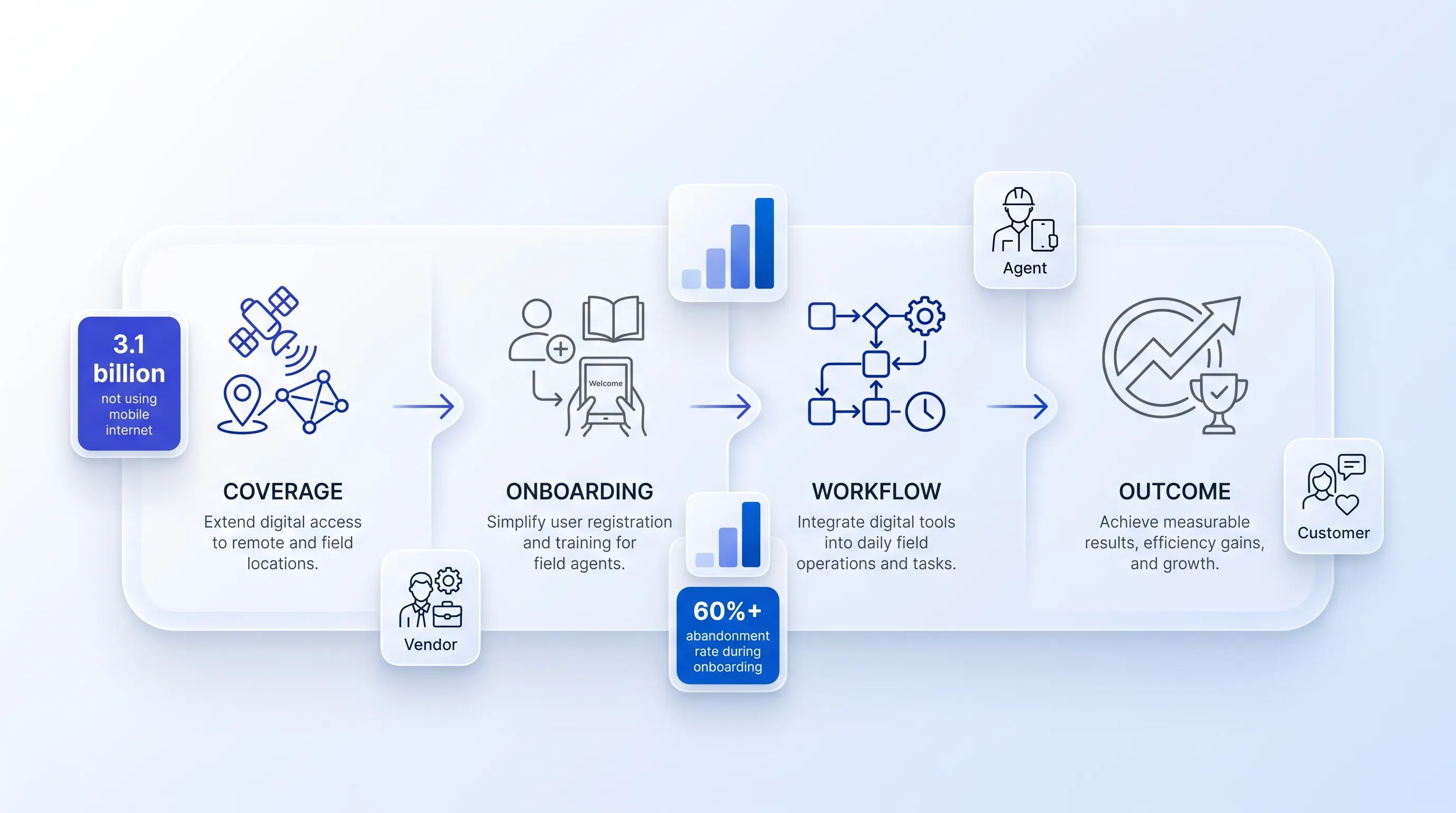
Professional infographic visualizing digital channel adoption journey with phases, icons, and statistics on a light gradient background.

A channel that works in a vendor's conference room proves nothing about a market town on a Thursday afternoon. Test both the customer app and the agent workflow on the handsets your customers own, over the networks they use. Ask the vendor to run the demo on your device.

The gap between coverage and use is where most digital channel plans overreach. The GSMA's State of Mobile Internet Connectivity report shows that 3.1 billion people live in areas with mobile internet coverage and still don't use it, which is 38% of the world's population.

Coverage is not adoption, and a smartphone-only channel strategy quietly excludes the customers an MFI exists to serve. That's why the evaluation has to run in parallel across both channels.

Is the mobile app customer-ready?

An app is customer-ready when someone who has never used one can register and make a repayment without help. Walk through onboarding and the recovery path when a customer forgets a personal identification number (PIN) or changes phones.

Identity verification is where these journeys break. Digital banking research compiled by User Intuition puts abandonment in mobile-first account opening flows at more than 60%, driven by document photography problems and uncertainty about which documents count.

If that's the drop-off among customers who chose a digital bank, expect it to be worse for a first-time smartphone user repaying a group loan. Count the taps in each journey and treat every extra screen as a cost you will pay in call center volume.

Do agent workflows match operations?

Agent workflows match your operations when an agent completes cash-in and a loan repayment without calling the branch. Test commission calculation and reversals. Supervisors need visibility into agent activity without adding steps that slow the person standing at the counter.

Poor workflow design shows up as inactive agents. CGAP's work with AMK in Cambodia found agent stores staffed by family members who were untrained, which produced poor customer experience and lower transaction volumes than the institution expected.

Untrained substitutes will operate your agent points whether you plan for it or not, so the interface has to be learnable by someone who never attended your training session. Judge each workflow by how it performs in the hands of the least-prepared person who will use it.

Ready to digitise your financial institution?

Talk to our team about your roadmap and discover scalable digital banking solutions tailored to banks, fintechs and microfinance institutions.

Request a Demo

What happens when connectivity fails?

Ask the vendor to list exactly which functions work without a live connection, and get it in writing. Offline behavior needs transaction queuing and duplicate prevention on resync. Then test it by putting the device in airplane mode mid-transaction.

Rural conditions justify the paranoia. GSMA's spectrum analysis reports that rural populations are 28% less likely to use mobile internet than urban ones, with network quality remaining a barrier even where coverage exists.

Intermittent connectivity is more dangerous than none, because a half-completed transaction creates a dispute where a blocked one creates only a delay. Make duplicate prevention a written acceptance criterion.

Does technology control every transaction?

Convenience at the channel must not weaken control at the ledger. Every transaction an app or agent initiates needs to land in the core with the right value and an audit record naming who did it. If the platform can complete a transaction that the ledger never sees, you have built a reconciliation problem instead of a channel.

The control layer starts with access design. Wolters Kluwer's internal control guidance lists role-based access control as granting the minimum system permissions needed for each job, alongside audit logs and periodic user access reviews.

Minimum permission is harder in agent banking than in a branch, because agents are third parties with commercial incentives and no employment relationship. That's the asymmetry to test for: whether the system constrains an outsider as tightly as it constrains your own teller.

Does the core update reliably?

Confirm whether posting to the core is real time, and if it isn't, find out exactly how long the gap is and what happens inside it. Ask how a failed integration recovers and who sees the queue when the core is unavailable. Application programming interfaces (APIs) must read and write your existing customer and loan records without a manual bridge.

Core-to-channel integration deserves its own workstream. ERP Research's banking guidance calls for explicit decisions on real-time versus batch posting and error handling when a posting fails.

Most vendors answer the real-time question and skip the failure question. Ask the second one twice, because the recovery path is what your operations team will live inside on the day the link drops.

Are roles and limits configurable?

Configurable means you can change a limit or a permission yourself, without a vendor ticket. Check role-based permissions for customers and agents. Look at maker-checker approvals on sensitive actions and per-transaction limits.

Regulators are tightening this ground. The Central Bank of Nigeria issued revised Guidelines for the Operations of Agent Banking in a circular dated October 6, 2025, with agent location and exclusivity rules taking effect April 1, 2026.

Rules like exclusivity and location limits translate directly into system configuration, which means a platform that can't enforce them in software will force your compliance team into spreadsheets. Ask which of your current regulatory limits are configuration and which are code changes.

Ready to digitise your financial institution?

Talk to our team about your roadmap and discover scalable digital banking solutions tailored to banks, fintechs and microfinance institutions.

Request a Demo

Can teams reconcile every channel?

Reconciliation has to be automated across the app and the core ledger, with exceptions raised as assignable items. Reversals and duplicates each need their own queue and an owner.

Volume makes the case for automation. Osfin's benchmarking describes its platform processing up to 30 million records in about 15 minutes across ACH and SWIFT files, with matching rules and auto-tagged exceptions.

Reconciliation is a labor cost, so the number worth demanding from any vendor is the hours your team spends on exceptions each morning. Set that as a measurable target before signing, because it's the figure that determines whether the channel pays for itself.

Can agents manage liquidity effectively?

The platform must show each agent's cash and electronic float in real time and forecast a shortage before it happens. Commission visibility belongs in the same view, because agents who can't see what they earn stop promoting your services.

Liquidity failure is measurable and large. Oxford Policy Management reports that in traditional mobile money, one in five transactions fails because the agent lacks e-float or cash. Here's why this hits MFIs harder than mobile network operators. Loan repayment flows are one-directional, so agents serving your customers accumulate cash and drain e-float continuously, without offsetting withdrawals to rebalance them.

Check these two things:

  • Whether the system forecasts float needs from each agent's own transaction history

  • Whether it supports agent credit or super-agent rebalancing, which is how NMB Tanzania keeps agents from abandoning their shops to fetch float

Does reporting guide daily decisions?

Reporting earns its place when a branch manager changes something on Tuesday because of what a report showed on Monday. Require operational and regulatory reporting on collections and agent performance. Every figure needs a drill-down to the underlying transactions and an export that isn't a locked PDF.

Real-time data changes what supervision can catch. Mordor Intelligence documents one large Indian lender reporting 98% digital retail transactions by October 2025, which enabled earlier detection of delinquency risk and proactive customer contact. Early delinquency detection is the financial argument for these channels, and it only works if the reporting layer reaches field supervisors.

Ask for three things in the demo:

  1. A named report showing agent-level activity for a single day, with drill-down to individual transactions

  2. The failed-transaction report with the reason code for each failure

  3. Whichever regulatory return your central bank requires monthly, generated from live data

Can the vendor support rollout?

Judge the vendor on implementation ownership. Establish who configures the system and who trains agents and field staff. Localization and regulatory configuration should be their work.

Execution risk is documented. Analysis cited by Dataintelo indicates roughly 34% of large bank core banking migration programs experience significant schedule delays or budget overruns.

References matter more than case studies, and they have to come from institutions with comparable agent networks and connectivity conditions. A reference from a tier-one urban bank tells you nothing about how the vendor behaves when 400 rural agents need retraining. Ask each reference what the vendor did badly.

How should MFIs validate claims?

Validate with a pilot that uses your real devices and the exception scenarios you documented at the start. Include a reversal and an offline transaction that syncs late. Set measurable acceptance criteria before the pilot begins.

Testing discipline pays off at conversion. Hartman Executive Advisors recommends performing at least two mock conversions to confirm data migrates as expected and interrelated systems still operate.

Two mock runs work because the first one finds problems and the second one proves the fixes hold. Apply the same logic to your channel pilot: run it twice, and make the second run the one that determines whether you sign. Set numeric thresholds for transaction completion rate and core posting accuracy, then hold the contract to them.

Map workflows with Doocat before selection

Start by putting your field workflows next to the platform capabilities they depend on, then find the gaps. Doocat builds banking software for microfinance operations, with mobile and agent banking in one integrated platform, and the team has run this kind of mapping with other microfinance clients.

That review is where configuration requirements and control gaps become visible while you can still change your mind about them. It's cheaper to discover a missing offline receipt or an unenforceable agent limit during a workflow review than during a live rollout across your branch network.

Bring your documented journeys and your regulator's current requirements to that conversation. Reach out to Doocat to map your mobile and agent banking workflows before you commit to a vendor.

Ready to digitise your financial institution?

Talk to our team about your roadmap and discover scalable digital banking solutions tailored to banks, fintechs and microfinance institutions.

Request a Demo

Require device-level security before deployment. Each agent device should use a unique login and an automatic session timeout. Encrypt local storage and enable remote disablement after loss or theft. Shared accounts should be prohibited because an audit log can't identify the responsible person when multiple people use one credential.

Put operational commitments in the contract, rather than relying on the proposal. Define how uptime is measured and how quickly support must respond. State how incidents are reported. The contract should also establish data ownership, export rights, and the support available if the agreement ends.

Yes, if the agreement requires usable data exports. Require a documented export of all institutional records, including transaction and audit history. Test an export during procurement, then confirm another system can read it. A vendor-controlled format leaves the institution dependent on that vendor after implementation.

An offline receipt should show a unique transaction reference and the payment amount. It should state that the payment awaits synchronization when the core hasn't confirmed it. Customers can use the reference in a dispute, and staff can trace the queued record during follow-up.

Compare the full three-year operating cost, rather than the license price alone. Include implementation work and device replacement. Calculate transaction charges at your expected volume, because a low entry price can become costly over time. Request written prices for support, upgrades, and data exports.

Schedule a Meeting

Book a time that works best for you

You Might Also Like

Discover more insights and articles

Modern executive office workspace featuring an organized desk with a laptop, documents, and natural elements, illuminated by golden-hour light.

Microfinance Software for MFIs: Core Banking, Lending, Mobile, and Reporting

This article explains what a unified system for a microfinance institution actually has to do, capability by capability, from client records through regulatory reporting. It also lays out how to test product fit against your own workflows before you sign anything.

A senior African bank executive presents a mobile-first banking rollout plan in a bright, modern office, highlighting the 'Pilot Launch' stage.

How African Financial Institutions Can Plan a Mobile-First Banking Rollout

Plan a mobile-first rollout by confirming the core platform handles real-time mobile transactions before any customer sees them. Release capabilities in sequence that begins with onboarding and high-frequency payments, then pilot with one defined segment against thresholds you set in advance. Expand only when adoption and reliability clear those thresholds.

A finance professional reviews documents and reports at a modern office desk, taking notes while using a laptop in warm daylight.

Cloud Core Banking Platform: When Banks and MFIs Should Move Beyond Legacy Systems

This article explains how to judge whether your institution has genuinely outgrown its legacy core, or whether it just has a maintenance problem wearing a modernization costume. It compares cloud banking deployment models and the migration sequences that keep a bank running while its ledger moves.

A bright, modern office with a collaborative banking team around a large table, focused on a floating digital comparison matrix.

Core Banking Systems: What Banks and MFIs Should Compare Before Choosing a Provider

This article gives your cross-functional team a way to agree on scope before vendor demonstrations begin. It explains what the core should own and how to compare providers against a shared picture once its boundaries are clear.