Title:
SME Lending Systems: How Banks and MFIs Can Scale Credit Workflows

Meta description:
Grow your SME lending book safely. This guide shows you how to automate manual tasks and build better credi

SME Lending Systems: How Banks and MFIs Can Scale Credit Workflows

This article is a working guide for heads of lending and credit teams who want to grow their small and medium enterprise book without losing control of risk. It walks through the full credit lifecycle and points out where manual handoffs slow you down, with attention to the systems underneath.

Content authorBy DoocatPublished onReading time11 min read

Why SME lending is hard to scale

SME lending sits in an awkward middle ground. The borrowers are too varied for retail-style scorecards and too small to justify the deep, hand-built analysis that corporate teams perform on a single deal. Financials are thin or unaudited, and the document trail rarely lines up the same way twice across shifting business profiles and sectors. The MSME finance gap reached $5.7 trillion across emerging markets in 2019, a figure that signals real demand and real difficulty in meeting it.

Adding underwriters to a manual process multiplies the inconsistencies you already have. What scales is the system around the underwriter, which is where this article spends most of its time.

The SME credit lifecycle at a glance

Before drilling into any one stage, it helps to see the whole arc. An SME loan moves through intake, verification, underwriting, scoring and pricing, credit committee or automated approval, offer and e-signature, disbursement, servicing, and finally collections or recovery. Each handoff between these stages is where files stall and risk creeps in as data gets re-keyed.

Think of every handoff as a control point. The quality of the workflow at that point decides whether a loan moves in hours or weeks. The 2024 FDIC Small Business Lending Survey found that more than half of large banks can approve a small, simple loan in one business day, while only 29% of small banks can. The plumbing explains the difference.

The rest of this article walks each stage in order, with attention to what good system design looks like at each one.

Intake and verification

Intake is where most SME lending operations quietly lose time. If the front door collects unstructured PDFs, including scanned ID cards, through free-text emails, the underwriter ends up doing data entry instead of credit work. Capturing structured fields from the first touch, like turnover bands, sector codes, ownership structure, and beneficial owners, removes a layer of rework that otherwise pollutes every stage that follows. Verification belongs in the same conversation. Know Your Customer (KYC) and Know Your Business (KYB) checks are a regulatory baseline under global Financial Action Task Force standards, and they shape the credit decision because ownership and control questions affect risk.

A digital intake pipeline pulls from multiple sources without breaking:

  • Direct applications from a web or mobile channel

  • Partner and broker referrals via API

  • Relationship managers entering data from branch visits

  • Embedded finance journeys from accounting or e-commerce platforms

When all of those routes deposit data into the same structured schema, the underwriter opens one file instead of reconstructing one. That single design choice is the difference between SME loan automation that works and SME loan automation that adds another inbox to monitor.

Underwriting, scoring, and pricing

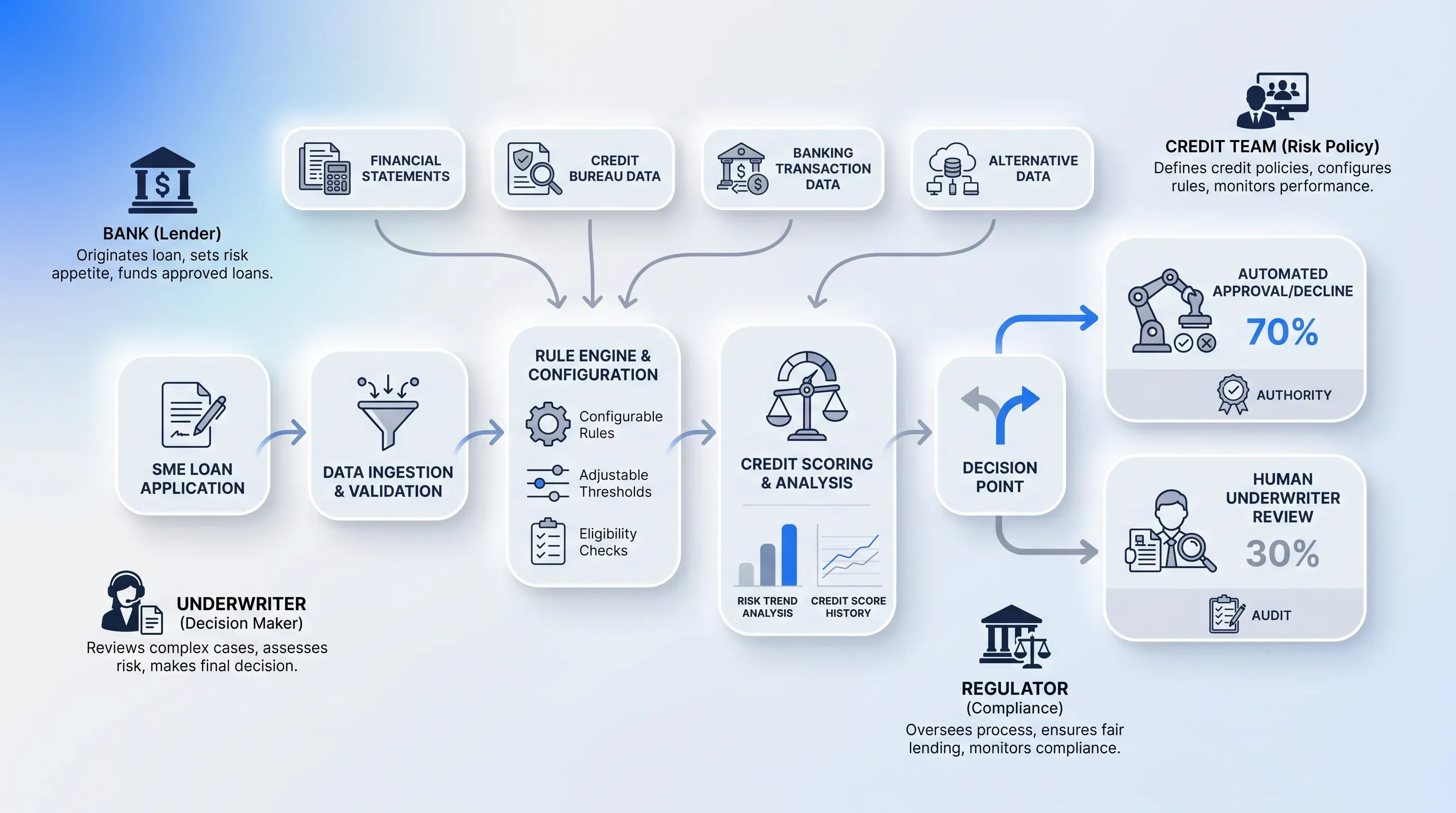
Infographic UI illustrating the SME loan underwriting journey with a horizontal pipeline, icons, and two branches for approval processes.

Underwriting is the engine room. This is where bank statement parsing, bureau data, financial statement analysis, and behavioral signals come together into a credit view. McKinsey research on digital credit risk transformation showed one institution improved its SME prediction of late payments by 70 to 90 percent six months before delinquency, by combining nontraditional data with expert judgment.

The scorecards and policy rules that sit on top of all this data have to be configurable. If a credit team has to file an engineering ticket every time it wants to adjust a threshold for, say, restaurants in a stressed region, the policy will drift out of date. Risk-based pricing depends on the same flexibility, because tenor and exposure need to be priced together with collateral rather than as independent levers.

Data sources and scoring models

An SME score pulls from a small but varied set of inputs. Bureau pulls give you repayment history on the business and its principals. Bank statements, parsed by automated analyzers, reveal cash flow patterns that financial statements miss. Tax filings and Goods and Services Tax (GST) data confirm declared revenue. Alternative data from utility payments to e-commerce settlements fills the gap when conventional records are thin, an approach the Bank for International Settlements documented in its review of digital innovation for SME credit.

Statistical models give you discrimination. Rule-based policies sitting on top give you control and explainability, which matters because credit committees and regulators need to understand why a file was declined. Both layers belong in the same system so the audit trail is unified.

Approval matrices and four-eye checks

Delegated authority is where SME lending operations live or die at scale. The FDIC found that nearly three in four banks have at most three levels of approval even for larger, more complex loans, which means the matrix has to be precise. Hard-coding those rules into application logic is fragile, because every product launch or branch addition becomes a release cycle.

Configurable matrices, by contrast, let credit operations adjust signature authority by amount, segment, branch, or risk band without code changes. Maker-checker controls and exception queues route the edge cases to the right desk without losing audit context. Because the system is making the routing decision, every approval carries a clean trail of who saw what, when, and why.

SME loan automation in decisioning

SME loan automation works best when it is honest about what it can and can't do. Clean files that hit every policy rule cleanly go straight through. Files that fail any hard limit receive an automatic decline with a clear reason. Everything in the middle, which is most of the book, routes to a human underwriter with the analysis already done.

A practical threshold structure looks like this:

  1. Auto-approve when the score and policy rules clear without exception, with KYB results confirmed

  2. Auto-decline when a hard knockout is hit, like fraud flags or sanctions matches

  3. Refer to credit when any soft exception fires, with full reasoning attached to the file

SME loan automation amplifies judgment. The underwriter spends time on the 30% of files that need a person and stops spending time on the 70% that don't.

Disbursement and servicing controls

Approval is not the finish line. Between the credit decision and the money leaving the bank, there are offer letters, e-signatures, conditions precedent, security registrations, and final disbursement checks. Each one is a chance for things to go wrong, and disbursement is the moment where weak controls turn into direct losses rather than just delay.

The same system that handled underwriting needs to handle servicing events. Repayments, restructures, top-ups, fee waivers, and write-offs all change the loan's state, and they need to flow through the same controlled environment with the same audit trail. When servicing lives in a separate spreadsheet or a side database, reconciliation becomes a job in itself. Digital credit workflows that cover the whole post-disbursement life of the loan lifecycle keep operations honest and give finance a clean source of truth.

Collections and portfolio monitoring

Collections gets treated as a recovery function. Treating it as a feedback engine is more useful. Early-warning systems that flag clients before they miss a payment can cut loan-loss ratios by 10 to 20 percent, according to Alvarez & Marsal's work with banks deploying such frameworks. The signals come from bank balance volatility, payment patterns, sector indicators, and bureau refreshes, all of which already flow through the lending platform.

Bucket-based collections strategies and restructure outcomes belong in the same data layer that underwriting consumes, alongside field collections data. Otherwise the credit team is making next quarter's decisions without knowing how last quarter's loans actually performed. Portfolio dashboards that segment by sector, geography, vintage, and product reveal concentration risk well before it shows up in default numbers. Moody's analytics team has noted that portfolio concentration risk rarely announces itself and instead compounds quietly until correlation becomes a crisis.

That feedback loop, from collections back to scorecards, is what turns SME lending from a series of one-off decisions into a learning portfolio.

System requirements for scalable sme lending

If there is one theme running through the stages above, it is that the platform decides the ceiling. A rigid, monolithic core system caps product range and channel reach while slowing policy changes.

Modern SME lending platforms need to offer:

  • Configurability of products, rules, fees, and SLAs without code releases

  • Open APIs for bureau, payment, accounting, and core banking connections

  • Role-based access aligned to the approval matrix

  • Full auditability of every decision, override, and document

  • Multi-segment support so micro, small, and medium products can coexist

None of these are optional once the book grows beyond a few thousand active loans. The 2024 IFC MSME Finance Factsheet puts SME loans by IFC clients at $385 billion in a single year, which is the kind of scale that only systems-led lenders can reach.

Configurable digital credit workflows

Digital credit workflows are the connective tissue between policy and operations. When a credit head decides to tighten exposure on a sector, the change lands in production the same day through a configuration screen. When operations wants to add an SLA timer to the document collection step, the same thing applies.

Digital credit workflows also support product experimentation across differently sized enterprise segments, which behave differently and need different journeys. A micro-loan to a sole trader doesn't need the same documentation as a working capital line to a mid-sized manufacturer, and the workflows reflect that without forcing the smaller product through the bigger product's controls.

Lenders running these journeys in email and spreadsheets carry a real operational risk. Versioning breaks and the audit story falls apart at the worst moment when exceptions go unrecorded. Digital credit workflows running on a configurable platform fix this by making the process itself the record. When digital credit workflows are owned by credit and operations rather than by IT, the lender can move at the speed of the market. That ownership shift is what separates SME lending shops that grow predictably from those that hit a ceiling every time policy changes. Digital credit workflows, in other words, are governance turned into software.

Integrations and data plumbing

The integration surface for a modern SME lender is wide. Bureau APIs, bank statement analyzers, e-signature providers, payment rails, accounting platforms, and the core banking ledger all need to talk to the lending system in close to real time. The Hong Kong Monetary Authority's white paper on alternative credit scoring catalogues how varied these data sources have become and why a platform approach beats one-off connections.

Point-to-point integrations look cheap at first and become a maintenance tax later. Each new bureau or payment rail means another bespoke connector to keep alive, with tax authority schema changes adding more maintenance. A platform with a clean integration layer absorbs those changes once, then exposes them to every product. That's how SME loan automation stays usable as the data landscape keeps shifting.

Map your process before you buy software

Before committing to a new platform, walk your current SME lending process stage by stage. Mark every place where work gets re-keyed and every queue that holds files for more than a day, with manual spreadsheet updates noted on the same map. That map is the brief for whatever you buy or build next, and it tells you where SME loan automation will pay back fastest.

Scaling SME lending is a systems problem before it is a staffing problem. The lenders winning ground in this segment treat their lending platform as a strategic asset.

Doocat builds core banking and digital credit workflows specifically for microfinance institutions and digital lenders working the SME segment, and its microservices architecture supports configurable loan and servicing modules with collateral controls. If you are mapping your current SME lending process and looking for a platform that can support SME loan automation end to end, book a demo with the Doocat team to see how the modules fit your existing operation.

Collect the fields that drive identity, eligibility, and credit risk before any scoring starts. That means legal business details, beneficial owners, turnover, sector, bank statements, tax identifiers, loan purpose, collateral, and customer consent for checks. Use fixed fields wherever possible so teams don’t retype data later.

Auto-approve only files that pass every required policy rule and identity check. Set clear limits for score, exposure, sector, repayment history, and sanctions results. Any file with a soft exception should go to an underwriter with the system’s reason attached, so the decision stays traceable.

Yes, alternative data can improve sme lending decisions when it’s verified and tied to repayment capacity. Bank transaction patterns, tax records, utility payments, and platform sales can fill gaps left by unaudited financial statements. The lender still needs policy rules and human review for exceptions.

Replace spreadsheets when loan files need repeated manual updates, approvals sit in email, or audit trails depend on staff memory. Those signs mean the process has outgrown informal controls. A workflow system gives each loan a record of data changes, approvals, exceptions, and servicing actions.

You can ask a lending technology provider to review the current process from intake through servicing. Doocat works with microfinance institutions and digital lenders on core banking and digital credit workflows. If you’re comparing system options, book a consultation with Doocat to assess fit against your operating model.

Schedule a Meeting

Book a time that works best for you

You Might Also Like

Discover more insights and articles

Title:
Fintech Banks in Europe and Africa: Infrastructure, Compliance, and Scaling Decisions

Meta description:
To run fintech banks in Europe and Africa, you must understand infrastructure. This guid

Fintech Banks in Europe and Africa: Infrastructure, Compliance, and Scaling Decisions

This article explains what fintech banks actually are once you look past the consumer-facing app and study the operating model underneath. It walks through the infrastructure and compliance decisions that shape how fintech banks grow across European and African markets.

Title:
Microfinance Bank Technology Stack: Core, Lending, Mobile, and Agent Banking

Meta description:
Build your microfinance bank technology stack to reach remote customers and cut your operational

Microfinance Bank Technology Stack: Core, Lending, Mobile, and Agent Banking

This article maps the full technology stack a modern microfinance bank needs to scale beyond the branch. It walks through each layer, from the system of record to customer-facing channels, and shows how the pieces fit together to support remote service delivery.

executive-boardroom-strategy-meeting-corporate-decision-making

Meaning of Core Banking Solution: What Banks and MFIs Should Confirm Before Buying

This article unpacks what the meaning of core banking solution actually covers when a bank or microfinance institution signs a contract, and where the scope gaps hide. You'll get a layer-by-layer view of the architecture, the modules, the migration work, and the ownership questions to settle in writing before money changes hands.

Three-panel collage showing a mobile banking app, online account verification process, and a customer holding a payment card, illustrating the end-to-end digital card issuance and banking onboarding journey.

What Digital Banking Means for Financial Institutions Beyond Mobile Apps

This article unpacks what digital banking actually means for banks and microfinance institutions (MFIs) today, beyond the assumption that it equals a slick mobile app. It is written for executives, product owners, and transformation teams who need a shared, working definition before they sign the next budget line.