Compliance checks and disbursement
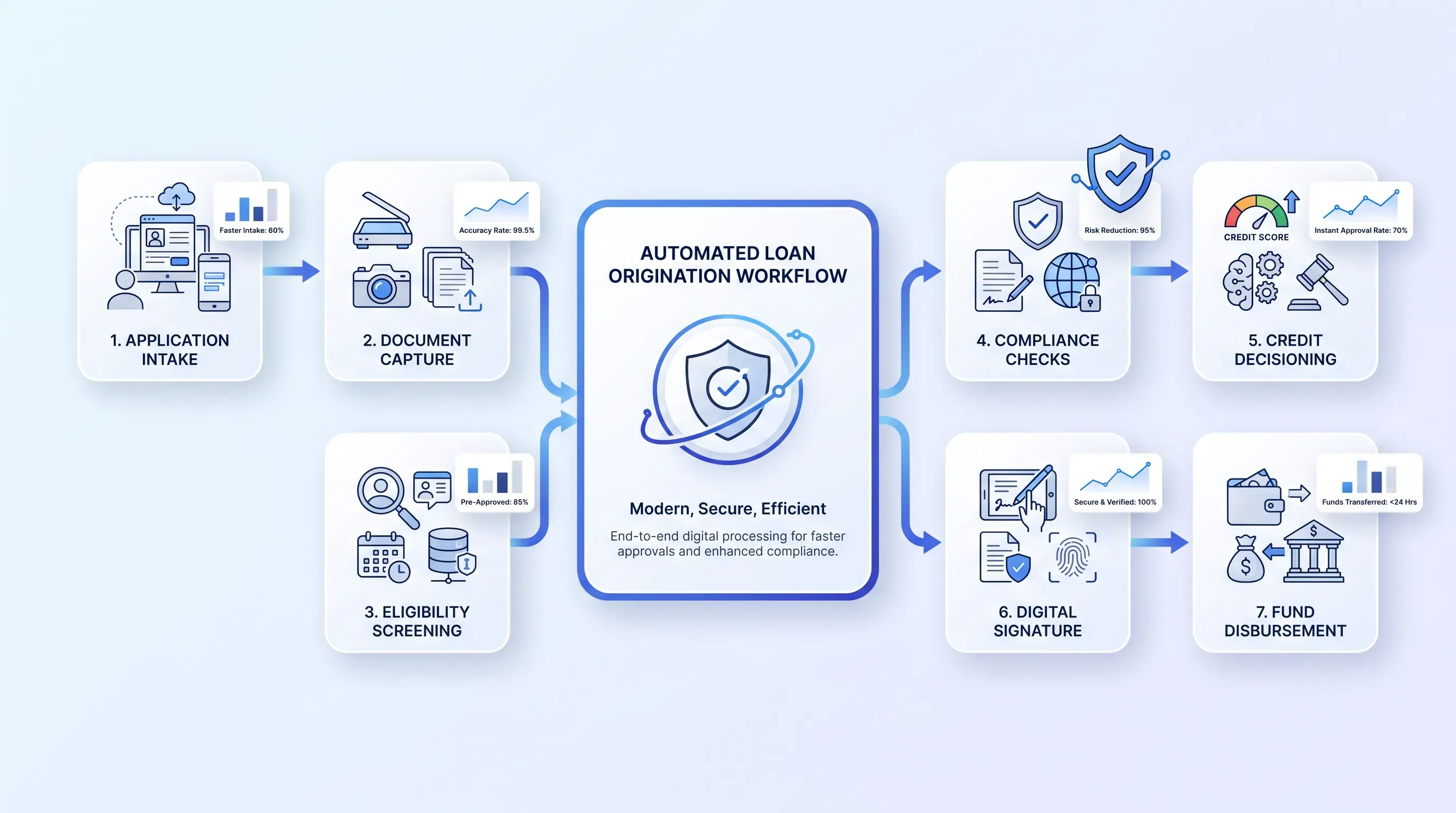
Compliance runs inside the credit decision workflow rather than as a separate manual layer bolted on before funding. Regulatory screening against sanctions and politically exposed person lists happens as the file moves, and required disclosures are generated at the point the borrower needs them. Under the US Bank Secrecy Act, OFAC imposes strict-liability civil penalties for sanctions violations, which is why real-time screening embedded in the flow is a practical necessity rather than a nice-to-have. The loan origination system checks continuously, so a compliance failure surfaces before approval.
Once a loan is approved and clears its checks, the system moves to close it out:
-
It generates the loan agreement from the approved terms, so the document matches the decision exactly.
-
It supports digital signatures, so the borrower signs remotely without a branch visit.
-
It triggers fund disbursement through core-banking integration once the signed agreement is in place.
That disbursement step is the endpoint of origination. The loan origination system has done its job the moment funds move. Everything after belongs to servicing software. Keeping compliance enforced throughout the workflow, rather than saving it for a final gate, is what lets you fund with confidence that the file is clean.
Connecting the LOS to core systems
The integration question decides whether your project ships on time or drags for quarters. A loan origination system connects to your core banking platform to post the loan and move funds. It connects to your Customer Relationship Management (CRM) system so borrower records stay in sync. It also connects to payment rails for disbursement and to credit bureaus and KYC or identity services for the data that drives decisions. Each connection is a dependency, and dependencies determine sequence.
The legacy core is where projects stall. Many older core platforms were built for batch processing and offer limited Application Programming Interface (API) support, which makes real-time data exchange difficult. LoanPro cites FinTech Futures data that 64% of banks admit slow digital transformation has cost them new customers, and legacy connectivity is a large part of why transformation moves slowly. When a core can't expose its functions as clean API calls, you're forced into middleware or file-based workarounds that add development time and fragility.
This is the reasoning that should drive platform selection. A loan origination system with pre-built integrations to common cores and providers of bureau and identity data shortens implementation, because someone has already done the connection work you'd otherwise build from scratch. So before you shortlist any platform, map your integration dependencies. Identify what your core can and can't expose and which bureaus and KYC providers you rely on. Determine where a middleware layer will be needed to bridge a legacy gap. The sequence you build around those answers is what keeps the project from slipping.
Planning a phased rollout
The fear that keeps institutions on legacy tools is simple: replacing origination while loans are actively moving feels like changing an engine mid-flight. The way through is a phased rollout, and the industry has settled on this for good reason. As 10x Banking notes, big bang replacement is no longer the norm, and phased, coexistence-led approaches now dominate.
Start by defining your target future state rather than only patching today's pain points. If you design the new workflow purely to fix current annoyances, you'll rebuild the same limitations in new software. Decide what good origination looks like for your institution first, then sequence the rollout toward it. Contain risk by rolling out one slice of the workflow at a time, so a problem stays small and local instead of taking down all lending at once.
The practical mechanics come down to a few disciplined moves:
-
Run the new loan origination system in parallel with the old one. The new system shadow-processes live applications while the legacy system stays the system of record. Forbes describes how parallel operation and phased migration reduce disruption and maintain continuity through the transition.
-
Validate the new system's decisions against known outcomes. Feed it applications you've already decided and confirm it reaches the same call, so you trust the credit decision workflow before it touches a real borrower.
-
Train staff on the live system during the parallel period, so the switch is a change of primary tool rather than a first encounter.
Only after a slice has proven itself in parallel do you cut it over fully, then move to the next slice. This is the playbook that lets you replace origination without a single day where lending stops. The sequence is defensible because every step is validated before it carries weight.
Map your bottlenecks before choosing a loan origination system
Before you sit through a vendor demo, map your own origination flow stage by stage. Walk it from intake to disbursement and mark exactly where time piles up and staff re-key data by hand. Also identify where two officers would decide the same file differently. That map is your specification. The right platform fixes your specific bottlenecks and scales with your growth.
Doocat has built banking and lending software for financial institutions since 2012 and works with banks and MFIs on exactly this kind of origination modernization. If you want a partner to map those bottlenecks with you and plan a phased path to a modern loan origination system, book a call with the Doocat team and start the mapping exercise.