Doocat

How Banks Can Launch Digital Channels Faster Without Building Everything In-House

Content authorBy DoocatPublished onReading time18 min read
A busy project team collaborates at a glass table in a sunlit office, reviewing dashboards for 'In-house Build' and 'Hybrid Approach'.

Banks and MFIs hit a fixed digital-channel deadline faster when they narrow the launch to a few priority customer journeys and use a proven platform, with custom development reserved for competitive advantage. This hybrid path cuts delivery risk because integration with your core sets the real schedule.

Faster launches begin with narrower scope

Before you estimate a launch date, define a minimum viable channel around the priority customer journeys and target users, with a measurable outcome that proves it worked. Speed comes from limiting dependencies and exceptions. Every extra branch you try to replicate on day one adds another integration and approval, along with another test cycle.

The evidence on this is blunt. A 2021 Project Management Institute survey found that 34% of projects experienced scope creep in the past year, and poorly defined initial scope is what lets that growth run unchecked. The number understates the damage for a bank, because each uncontrolled feature drags a regulated dependency behind it, so scope creep in banking multiplies compliance and testing work.

That's why the first decision is subtraction. Pick the journeys that carry the most value and write down what "done" means in numbers. Then freeze the list. A smaller scope you can defend beats a complete one you can't deliver on time.

Which journeys belong in version one?

Version one should carry a small set of complete, high-value journeys, with onboarding as one option and bill payment as another. Balance viewing can also qualify. Base the choice on customer demand and operational value, then account for regulatory readiness and how few dependencies each journey drags in. A journey that needs three core-system writes and a new fraud check costs far more than balance viewing, which mostly reads data.

Mobile-led habits reward this focus. In 2025, GSMA reported that mobile money transactions reached $2 trillion, with active 30-day accounts up 15% to 593 million. That concentration tells you customers reward a few reliable transactions over a wide, shaky menu, so a tight first release earns more adoption than a broad one that stalls mid-transaction.

Should mobile and web launch together?

Launch mobile and web together only when shared services and designs are ready for both, with adequate testing capacity and support processes in place. Otherwise, ship the channel with the strongest user need first and build reusable APIs and workflows so the second launch runs faster on the same foundation.

The channel choice is rarely close. In 2025, mobile banking reached 2.5 billion active users globally against roughly 1.9 billion for desktop internet banking. That gap means sequencing mobile first is the safer bet for most institutions, because you serve the larger audience sooner while the web build reuses the same authentication and payment services you already proved.

The fastest model is hybrid

Most institutions move faster by configuring proven channel capabilities and reserving custom development for genuine differentiation. The build-versus-buy question is a delivery tradeoff between control and lifecycle cost. Talent and maintenance burden shape that tradeoff, as do vendor dependence and compliance effort. Building everything gives you maximum control and maximum exposure to schedule risk.

The cost math favors the hybrid default. Neontri's 2024 analysis found that hidden integration and training work can add roughly 150 to 200% on top of a buy license fee over a five-year total cost of ownership. Read that the other way and it still cuts against a full custom build, because the platform's integration surface is smaller and its maintenance is shared across every client, while your bespoke code carries all of its own upkeep alone.

So the practical stance is to buy the plumbing and build the parts customers actually notice. That keeps your scarce engineers on work that competitors can't copy from a vendor catalog.

What should the bank still build?

Build the things that create competitive advantage, such as proprietary products and distinctive workflows. In-house analytics can also qualify, as can integrations tied to your specific market. Everything else is channel plumbing that consumes engineering capacity without differentiating you.

The distinction matters because talent is the real constraint. Ziphq's procurement guidance argues you should only build software that delivers a unique competitive advantage, since anything else duplicates something a vendor already runs. Applied to a channel, that means a signature lending flow justifies internal work, while a login screen does not, because rebuilding commodity components spends your best people on problems already solved elsewhere.

What should a platform provide?

A platform should remove repeated work from authentication and account views. It should also cover payments and notifications, along with administration and auditability. Reusable channel components should come with it. Verify platform readiness by checking configurability and security evidence. Review deployment options and API coverage, then confirm upgrade paths and source-code ownership terms.

The stakes on that verification are high. The On-Point analysis cited by Doocat recommends scheduling 50 to 100 percent of the implementation effort just for integration work, and most buyers budget a fraction of that. So a platform's real value is measured by how much of that integration surface it covers out of the box.

How should teams compare true effort?

Compare both options across the full lifecycle, starting with requirements and integration. Include testing and certification, then account for infrastructure and release management. Support and upgrades also belong in the comparison. So do change requests. Internal developer availability and banking-domain expertise constrain the schedule.

That framing changes the timeline conversation. IFRS Tech's TCO analysis found vendor solutions complete implementation in 3 to 6 months versus 6 to 18 months for custom builds. The wide spread on the build side is the tell, because it reflects the domain expertise and rework that appear only after you commit, which means a build estimate carries more schedule uncertainty than a configured platform does.

Integration sets the real launch date

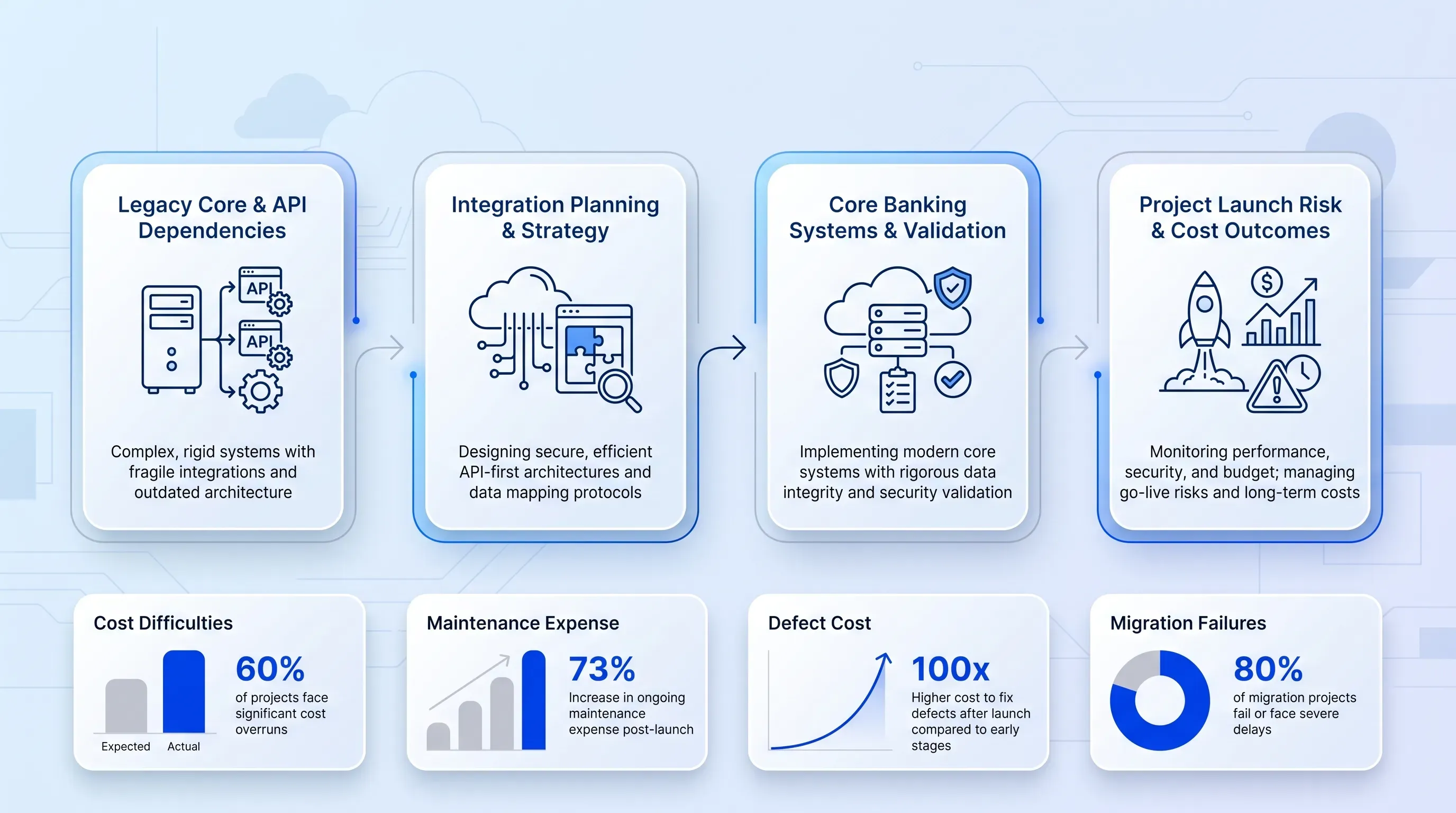
Professional horizontal flow infographic UI depicting the banking technology project journey, with metrics and icons on a light gradient background.

Connecting channels to your systems of record controls the schedule more than front-end development does. The dependency map that matters runs through core banking and identity. Payments and fraud form another part of it, while KYC and notifications add further dependencies. Reporting completes the map. You can finish a polished app weeks early and still miss the date because one core write transaction won't behave.

The modernization data confirms where the pain sits. Market.us reports that 60% of banks cite cost-related difficulties in core initiatives, with 73% facing rising maintenance expense. Those figures point at the core as the bottleneck, which means the honest way to protect a launch date is to schedule backward from your hardest integration.

Get the interface work sequenced first and the rest of the plan holds. Leave it late and every downstream estimate becomes fiction.

Ready to digitise your financial institution?

Talk to our team about your roadmap and discover scalable digital banking solutions tailored to banks, fintechs and microfinance institutions.

Request a Demo

Which interfaces must be proven first?

Validate the highest-risk read and write transactions against real interface behavior before you polish anything. Cover API availability and legacy protocols, then resolve data mapping and transaction limits. Define error handling and reversals. Confirm batch windows and clear ownership of each endpoint.

The reason to front-load this is cost. IBM Systems Sciences Institute research shows a defect found in production costs up to 100 times more to fix than one caught during design. A broken reversal or a mismapped balance discovered after go-live sits at the expensive end of that curve, so proving the riskiest write transactions early is the cheapest insurance you can buy.

When is an integration layer needed?

An API or orchestration layer earns its place when channels would otherwise create brittle point-to-point connections or inherit limitations from a legacy core. The layer has to provide security and translation. It must also support resilience and observability, with versioning built in.

The channel-and-integration layer is where trouble concentrates. Doocat's analysis notes it's where most scope disputes happen, because APIs and middleware meet switch connections there. That concentration is the argument for a dedicated layer, because absorbing translation and resilience in one managed place stops each new channel from re-negotiating the same fragile connections to your core.

How can legacy cores stay in place?

A bank can launch new channels without replacing its core, provided the required products and transactions can be exposed safely and reliably. The limits are real: missing real-time capabilities and poor data quality still force remediation or a reduced first release. Undocumented interfaces have the same effect.

The migration risk is why keeping the core is attractive. Karl im Brahm, CEO DACH at Objectway, told The Wealth Mosaic that around 80 percent of migration projects fail, usually from incomplete or incorrect data. That failure rate reframes "keep the core" as the lower-risk path, so exposing your existing system through clean APIs beats a rip-and-replace you don't have time to de-risk before the deadline.

A phased plan shortens time-to-value

Organize delivery so usable capabilities reach customers sooner without turning the launch into an uncontrolled pilot. The progression begins with discovery and integration proof. A minimum release comes next, followed by a controlled customer rollout. Evidence then drives expansion. Each stage has an exit gate you either clear or you don't.

Smaller stages win on their own. The Standish Group's CHAOS research found small projects succeed at roughly 90% versus under 10% for large ones, which makes size the strongest predictor of success. Phasing converts one large, failure-prone program into a sequence of small, high-odds releases, so it provides a structural fix.

European banks already run this way. BBVA and Deutsche Bank have used phased rollouts for mobile features to keep releases agile and customer-driven.

What happens before channel development?

A short readiness phase confirms journeys and architecture before anyone builds a screen. It also verifies data and security controls, then resolves regulatory obligations and vendors. Environments and decision rights complete the check. The goal is early technical proof and signed scope.

Skipping this phase is where projects quietly die. BITKOM found that 75% of IT projects fail due to errors in the set-up phase, before a line of code is written. That statistic argues for spending your first weeks proving the riskiest integration and freezing scope, because the setup decisions you defer now become the redesigns that blow the deadline later.

How should the first release roll out?

Start with staff or a limited customer cohort before broader release. A single-region rollout is another option. Define entry and exit gates using transaction success and crash rates. Track response times and fraud signals. Add support volume and customer completion, then confirm rollback readiness.

This soft-launch pattern is now standard practice. Quipu notes that Revolut and N26 built their apps through phased soft launches, and Monzo followed the same approach. They released to a limited audience for initial testing and refinement. The lesson for an incumbent is that a controlled cohort is a risk control because the defects you catch with a few hundred users cost a fraction of the ones you'd catch with your whole base live.

When should the next channel follow?

The second channel should reuse validated services and proceed once shared back-end operations are stable. Evidence from the first rollout should refine journeys and controls before you widen the footprint. It should also update support scripts and capacity assumptions.

BCG's digital banking work is direct on where the effort belongs. It advises that early MVPs focus on back-end features so teams can de-risk the back end before launch. Applied to sequencing, that means the second channel is safe to start once the shared back end is proven, since the hard, reusable work is already done and the new channel mostly re-skins it.

Most delays happen beyond coding

The schedule risks that sink launches rarely live in the codebase. They sit in procurement and third-party due diligence. Legal review and security remediation add delay. Compliance approval and content and localization do too. Certificates and data preparation also belong on the critical path. So do app-store review and environment access. Put these items on the critical path with named owners and decision deadlines, or they surface the week you planned to go live.

Decision speed decides the outcome. The Standish Group found teams with low decision latency reach 63% success rates against 18% for high-latency teams. That contrast tells you the delay is organizational, so the fastest lever you have is shortening the time between raising a question and getting an authoritative answer.

Name the owner for each non-code dependency now. An unowned certificate or vendor contract waits for no sprint.

Ready to digitise your financial institution?

Talk to our team about your roadmap and discover scalable digital banking solutions tailored to banks, fintechs and microfinance institutions.

Request a Demo

Which dependencies need early decisions?

Call the long-lead decisions early, beginning with deployment model and identity provider. Settle payment rails, then choose the KYC and fraud vendors. Decide data residency and device support, then establish app-store accounts. An unresolved dependency here forces redesign and retesting even when application development looks on schedule.

App-store review is a concrete example teams underestimate. Financial apps take 5 to 14 days in Apple's review, far longer than a simple utility, and each rejection adds another cycle. That single dependency can consume a fortnight you didn't budget, which is why the store account and submission assets belong on the plan from week one.

How can governance prevent waiting?

Stand up a small cross-functional launch group with delegated authority and a visible dependency log. Give it fixed review windows and a clear escalation route. The aim is to cut approval latency without bypassing risk or regulatory controls.

The payoff scales with size. The CHAOS 2020 data shows good decision latency lifts success to 75% against 21% for slow-deciding teams. A launch group with real authority is how you buy that 75% figure, because it removes the escalation chain that turns a two-hour decision into a two-week wait while a fixed review window keeps risk sign-off inside the schedule.

Testing must prove complete customer journeys

A channel is launch-ready only when end-to-end journeys work across devices and integrations, with controls and operational processes also proven. That means functional and integration testing, with security and accessibility covered as well. Budget performance and resilience testing before you start. Do the same for user-acceptance and regression testing, including the people and environments each requires. Testing a screen in isolation proves nothing about whether a customer can finish a transfer.

The cost curve rewards catching problems early. IBM's research puts the multiplier at 1x in design rising to 60 to 100x after release, and a mid-market production defect at $15,000 to $25,000 against about $1,000 in code review. For a bank, the downstream cost also includes stranded customers and support load, so the true multiplier on a channel defect runs above the generic software figure.

Budget the environments and the people together. Under-resourced testing is how a defect you could have caught for a thousand dollars becomes a live incident.

Which failures deserve priority testing?

Prioritize failures that could lose money or expose data. Give the same priority to failures that could breach a control or strand a customer mid-transaction. That list includes duplicate submissions and interrupted sessions. Delayed responses and failed reversals also qualify. So do stale balances and authentication issues. Traffic spikes complete the list.

These are the Tier 1 defects that carry the worst bills. Globalbit classifies checkout and payment failures as revenue blockers costing $10,000 to $1,000,000 per incident when they escape to production. That range is the case for spending your scarcest test hours on money-movement and reversal paths first, because a failed reversal or a duplicate debit sits at the top of both the cost curve and the regulator's attention.

What makes testing production-like?

Production-like testing needs realistic data shapes and live integrations. It also requires real devices and actual network conditions. Production access controls and expected transaction volumes complete the environment. Mocks help during early development, but they can't be the final evidence for operational approval.

The reason is that mocks hide the failures that matter. Since a defect found in production costs up to 100 times more than one caught during design, the whole point of a realistic environment is to move core-integration failures to the left of that curve. A mock that always answers cleanly guarantees you learn about your batch window or timeout behavior only after customers do.

Who signs off before release?

Sign-off is a shared decision across product and technology. Security and risk must also approve, as must compliance and operations. Customer support completes the group. Require explicit acceptance criteria and open-defect thresholds. Monitoring and incident response must be defined, with rollback procedures and an accountable approver.

User involvement is what makes that sign-off meaningful. Across 30 years of CHAOS reports, the Standish Group cites user involvement as the top factor in project success. That's why customer-facing operations and support belong in the sign-off room, because the people who handle live transactions catch journey gaps that a defect count on a dashboard never shows.

Operational ownership starts before go-live

Decide who runs the channel after launch before you build it, because that decision shapes delivery. Ownership has to be assigned for product changes and platform administration. Monitoring and incidents need named owners, as do fraud operations and customer support. Assign vendor management and releases as well. Security patches and regulatory updates also need owners. An unowned channel drifts the moment the launch team disbands.

Regulators are explicit that responsibility remains with you when you delegate the work. The Central Bank of Ireland's enforcement position states that outsourcing is no defence for regulatory failings and ultimate accountability remains with the firm. That principle should shape your operating model from the start, because a contract that hands over hosting without defining oversight leaves you accountable for outcomes you can no longer see.

Settle these boundaries during delivery. The go-live date is the wrong moment to discover who answers the phone at 2 a.m.

What should remain bank-owned?

The institution keeps accountability for product policy and customer outcomes, even when a third party supplies the technology. Compliance and risk acceptance also remain with the institution. So do data governance and vendor oversight. Delegating execution is fine. Outsourcing accountability is not, and regulators treat the two as different things.

The rulebooks are consistent on this. The CBUAE Outsourcing Regulation states that banks are fully responsible for the risks arising from any activity they outsource. That means your governance has to include active monitoring of the provider, because a supervisor will hold your board answerable for a vendor's failure regardless of what the service contract says.

What can a provider operate?

A provider can take hosting and platform maintenance when the contract and deployment model allow it. It can also handle upgrades and technical monitoring. Specialist support can sit with the provider as well. Before launch, document the service levels and incident roles. Define release controls and exit provisions, then settle data access and handoff boundaries.

Data access is the clause teams forget until they need it. The CBUAE rules require outsourcing agreements to guarantee the bank unfettered access to all its data through the agreement and on termination. Nail that down pre-launch, because without a written exit and data-access provision you inherit a dependency you can't unwind if the relationship sours.

Which metrics govern expansion?

Run a compact scorecard for adoption and journey completion. Track transaction success and availability. Monitor latency and fraud. Add support demand and cost-to-serve. Monitor release frequency as well. These measures decide whether you broaden the rollout, fix foundations, or add features next.

Completion is the number that reveals the truth. Since transaction volume is what keeps users returning, GSMA's finding that active accounts rose 15% to 593 million in 2025 shows that sustained use is the signal of a working channel. A high download count with low journey completion means you should fix the foundation before you expand, because scaling a broken journey scales the complaints with it.

Compare rollout readiness with Doocat

If you're weighing whether your team has the capacity for a custom channel build against a fixed deadline, Doocat is a modular banking infrastructure option built for banks and MFIs facing exactly that question. It gives you configurable online and mobile banking capabilities on a microservices architecture, with SaaS or on-premises deployment, so you configure the standard functions and reserve your engineers for what differentiates you.

The honest way to make the decision is to compare, side by side, what you'd carry internally against what a platform covers. Put your scope and integrations next to Doocat's capabilities. Compare deployment requirements and testing resources there as well. Assess your operating model to see where your real gaps sit.

Start with a requirements-based rollout assessment. Bring your priority journeys and core-system interfaces. Add your deadline to get a concrete read on which work poses the greatest risk of delaying your launch and how a configured platform changes that timeline.

Ready to digitise your financial institution?

Talk to our team about your roadmap and discover scalable digital banking solutions tailored to banks, fintechs and microfinance institutions.

Request a Demo

Yes, if balance and transaction-history access meet a defined customer need and the bank can secure the data. A read-only release avoids money-movement reversals and payment controls, so it reduces integration risk. It still requires identity and session testing. Privacy controls and support processes must also be ready.

Request current API documentation and an architecture description. Ask which core systems it has connected to, plus how it handles interface failures. Review security-test evidence and relevant audit reports. Then examine service levels and data-processing terms. Check the upgrade policy and exit provisions before making a decision.

Use an idempotency key for every payment request, so the bank processes a repeated request only once. The app should show a pending status after submission and block a second tap until it receives a result. Reconciliation must identify exceptions for operations staff to resolve.

Postpone the rollout when a critical journey lacks end-to-end proof or the bank can't reverse a failed transaction safely. Delay is also appropriate if monitoring, incident ownership, or customer support escalation isn't ready. A limited cohort reduces exposure, but it can't compensate for missing controls.

Give support staff access to transaction status and a documented escalation path before the first cohort goes live. Train them on identity checks and common failure messages. Publish customer guidance for login recovery and payment status, then test the handoff to operations during a rehearsal.

Schedule a Meeting

Book a time that works best for you

You Might Also Like

Discover more insights and articles

A bright, modern office with a collaborative banking team around a large table, focused on a floating digital comparison matrix.

Core Banking Systems: What Banks and MFIs Should Compare Before Choosing a Provider

This article gives your cross-functional team a way to agree on scope before vendor demonstrations begin. It explains what the core should own and how to compare providers against a shared picture once its boundaries are clear.

Modern mission-control hub for loan management with multi-screen dashboards, focused operators, and a blue-lit environment.

Loan Management System Software for Banks and MFIs: From Origination to Servicing

This article maps what happens to a loan after approval, and why the servicing side of the lifecycle carries most of the operational weight. It walks through eight capabilities you can use as an evaluation checklist, then closes with an audit you can run against your own platform.

A bright, modern office with a large checklist at a white meeting table, where diverse teams collaborate in natural daylight.

What Banks Should Prepare Before Replacing Legacy Core Infrastructure

Before comparing core platforms, a bank should have a shared modernization case backed by verified current-state evidence and mapped process and integration dependencies. Accountable leadership should establish clear decision rights and measurable migration guardrails. Core replacement is an enterprise change that affects the bank throughout, from products and controls to operations, employees, and customers, so treat it as an enterprise change.

A loan operations manager works at a modern executive office desk, using a laptop with a workflow dashboard and organized documents.

Loan Origination System for Banks and MFIs: Workflow, Automation, and Implementation

This article explains how a loan origination system handles the front half of lending, including loan application automation that removes manual work, and how to plan a rollout that doesn't disrupt active lending.