How does Kenya illustrate local requirements?
Kenya shows how control mapping attaches to a specific template, and nothing more than that. Deposit-taking microfinance banks are licensed under the Microfinance Act and supervised by the Central Bank of Kenya, which prescribes the returns and formats that apply to each category of institution. As of 2025, the CBK lists 14 licensed microfinance banks operating in the country.
Fourteen institutions sharing one supervisor and one template still produce different internal mappings, because the template defines what is reported while each MFI decides which account ranges feed it. That gap is where your control table earns its keep.
Verify the current template and instruction set directly with the supervisor before each cycle, since field definitions and submission channels change without a public announcement. And treat none of this as a continental rule. Uganda and Ghana each set their own categories and filing calendars, so a Kenyan mapping transfers as a method rather than as content.
How should late adjustments be controlled?
Late adjustments need an approval threshold and a written assessment of whether the change touches returns you've already filed. Without those, a correction becomes indistinguishable from an unexplained restatement.
Build the policy around four decisions:
-
Who approves what, by amount and by return line, with a named alternate for each threshold.
-
Which reason code applies, drawn from a fixed list such as misclassification or system error.
-
Whether the prior period requires restatement, and under which criteria.
-
Whether the supervisor must be notified, and within what timeframe.
International Accounting Standard 8 requires prior period errors to be corrected retrospectively by restating comparative amounts, unless doing so is impracticable.
Supervisory returns don't offer the impracticability escape that accounting standards do. If the figure you filed was wrong, the regulator wants the corrected figure and the explanation, which means your rerun procedure has to reproduce an old period exactly with the mappings and rules that applied then rather than the ones you use now.
Is the institution ready to submit?
You're ready when every item below is complete and documented. Checklists work because they externalize memory under time pressure, and the evidence for that is strong outside finance entirely. The World Health Organization surgical safety checklist study published in the New England Journal of Medicine in 2009 found inpatient death rates fell from 1.5% to 0.8% across eight hospitals after a 19-item checklist was introduced.
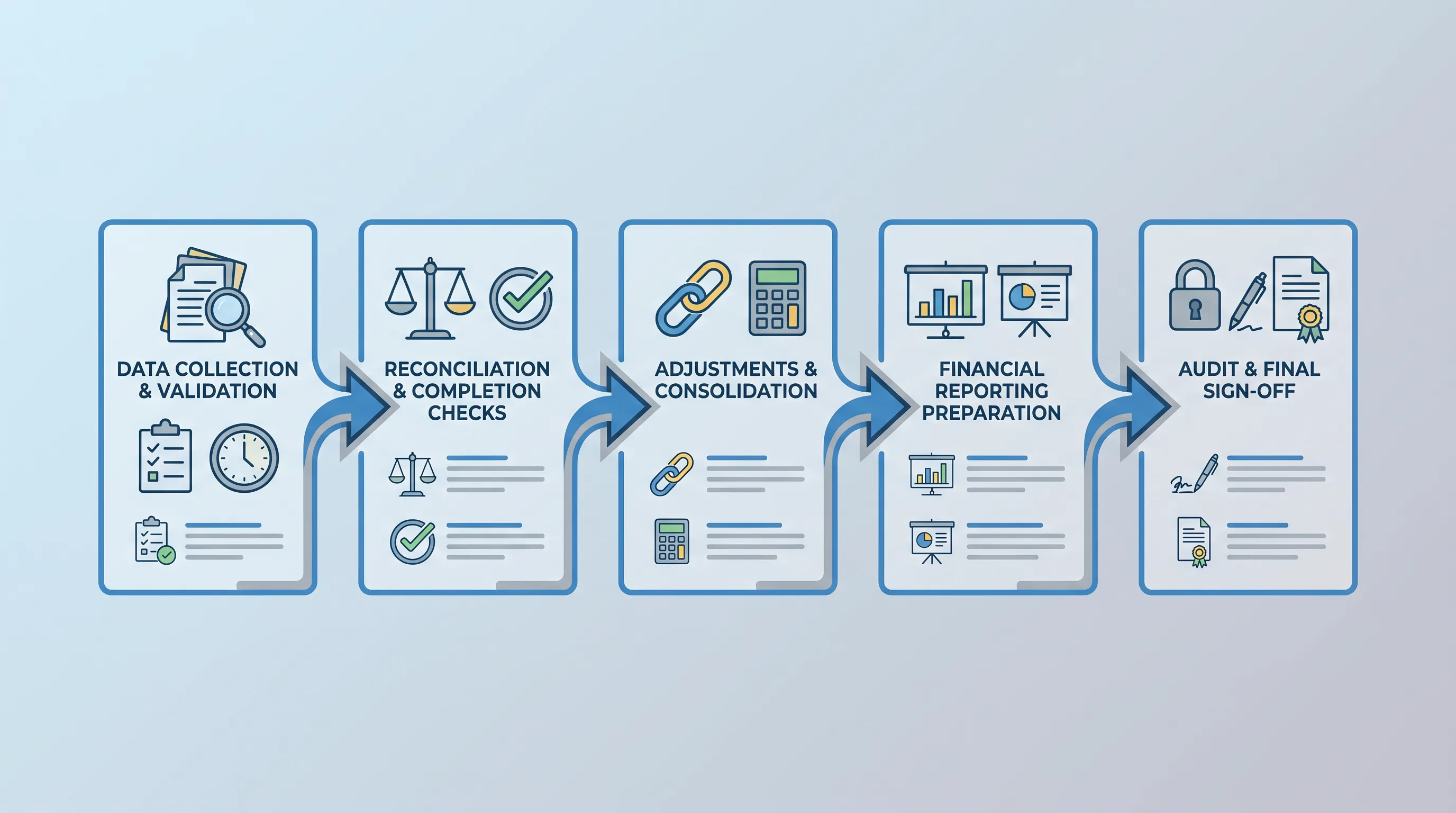
Work through these before filing:
-
Definitions and product codes standardized and current in the data dictionary
-
Extracts complete for every branch, with record counts confirmed against the source system
-
Return totals reconciled to the general ledger and subsidiary ledgers
-
Exceptions investigated and cleared, with resolution notes recorded
-
Adjustments approved at the correct threshold and coded
-
Management sign-off obtained from a reviewer independent of the preparer
-
Evidence archived, and the local template confirmed as the current version
The hospital result came from trained surgical teams who already knew every step. Your reporting team does too, which is exactly why the list matters.
What should technology providers prove?
Ask a provider to run your own reporting scenario in front of you and show the trail from a single reported figure back to the originating transaction. Demonstrations built on the vendor's sample data prove nothing about your product codes or your branch structure.
Require evidence of field-level traceability and reproducible extracts for a closed historical period. The Financial Conduct Authority and Bank of England's Digital Regulatory Reporting phase 2 work concluded that machine-readable reporting is technically feasible but depends on firms first resolving inconsistent internal data definitions.
That conclusion sets the order of operations for you. A system cannot infer which balance definition your branches intended, so a provider that promises to fix data quality through automation is selling you a faster path to the same disagreement. Buy traceability first and ask about automation second.
Could Doocat strengthen reporting controls?
Doocat is a configurable core banking platform with reporting capability, which makes it a candidate for centralizing branch operational data in one system rather than reconciling across several. When loans and the general ledger share a single data model, the mapping work described earlier gets shorter, because fewer definitional boundaries exist to govern in the first place.
That's a structural advantage. Sub-Saharan Africa recorded over 1.1 billion registered mobile money accounts in 2024 according to the GSMA, so any core system you select has to carry wallet and agent channel data into the same reporting pipeline as branch transactions, or your returns will understate activity.
Before committing, run your own supervisor's current return through a proof of concept and confirm that the template is supported as filed and that a closed period reproduces exactly. Ask Doocat to demonstrate it with your data. Contact Doocat to discuss the requirements.