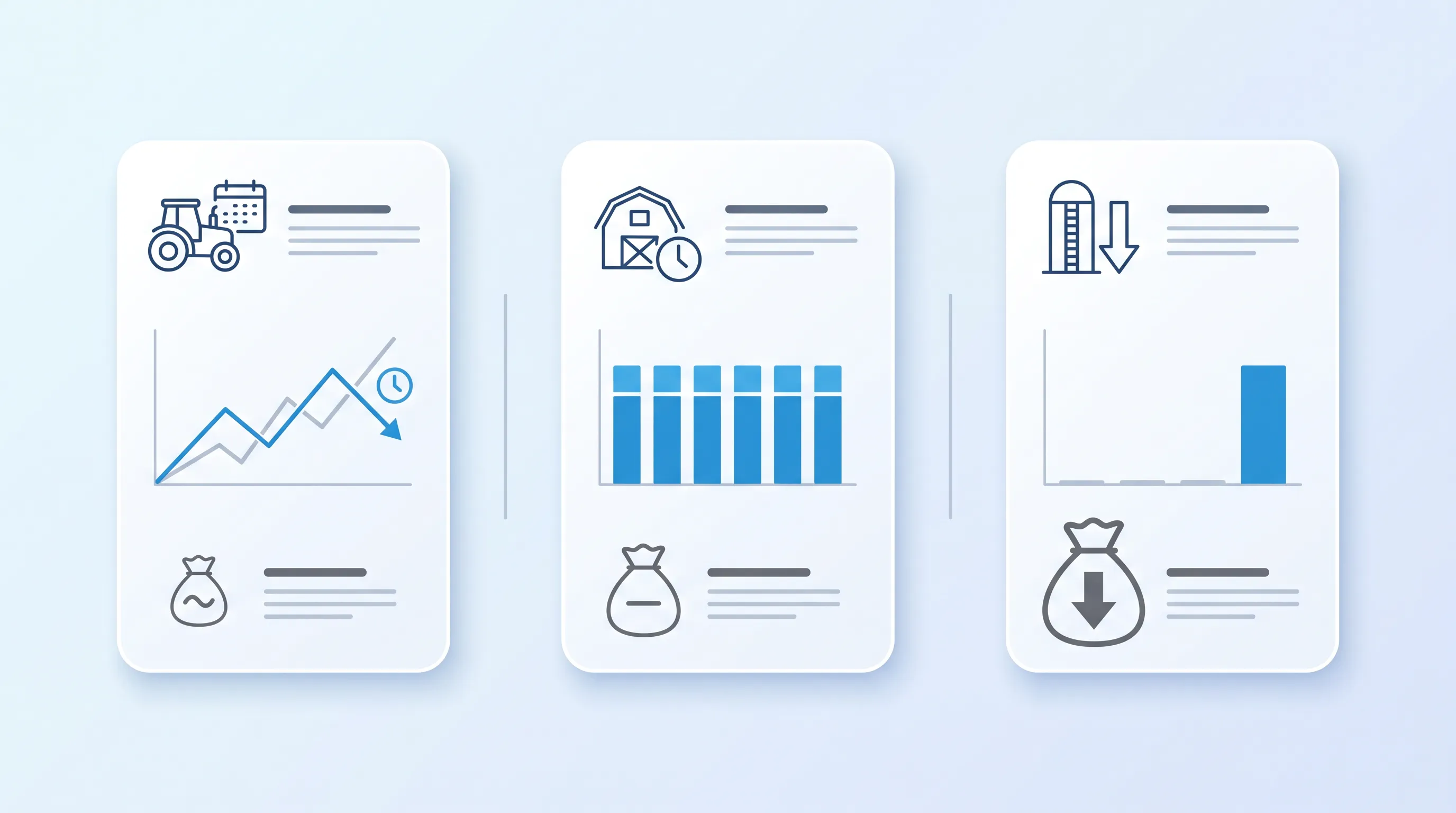
How would a seasonal schedule calculate?
The seasonal version of this K25,000 loan produces three payments totaling K30,920, with interest at 2.5% monthly on the declining balance. Disbursement runs K7,000 in mid-October 2026 and K12,000 in late November, with a further K6,000 in early January 2027. Interest accrues from each tranche date, not from approval, which is why staggering also cuts the borrower's finance cost.
Interest accrued to the first payment date comes to roughly K4,270. The schedule then runs K10,270 on June 15, 2027 and K5,950 on August 15, with K14,700 due on October 15.
Price those against the crop. At the Food Reserve Agency's 2026 floor price of K347 per 50kg bag, 124 marketable bags are worth K43,028, and each sale lot covers its payment with margin left for the household.
The monthly equivalent demands K2,440 every month from November, with K14,640 due before the first sale exists. Same principal and same rate. Only the dates change, and the dates are what decide whether this loan performs. A configurable loan system can represent those uneven dates without forcing the product into a monthly template.
What if expected cash flows change?
Shock the schedule before you sign it, because the gap between a manageable shortfall and a dead loan is narrow. Four stresses matter here, and each one hits a different payment.
-
Yield down 30%: output falls to 101 bags, 81 of them marketable after household needs, worth K28,107. Shortfall against K30,920 is about K2,800, closable by releasing the 20 reserved bags or extending the final payment.
-
Price down to K300 at a private trader instead of the depot floor: 81 bags bring K24,300, and the shortfall widens past K6,600.
-
Buyer settlement delayed eight weeks: the June payment misses and the August payment doubles up, while repayment capacity stays the same.
The scale of the first risk is not hypothetical. In 2024/25, Zambian farmers harvested only 685,000 of 2.22 million hectares planted to maize.
Here's the line that separates a timing fix from a solvency problem. If projected gross revenue still exceeds the outstanding balance, reschedule. If it doesn't, you're facing a full reassessment of repayment capacity, and rolling the balance into next season just finances the loss twice.
When is a missed payment overdue?
A contractual grace period written into the signed schedule keeps the account current. A due date that passes unpaid is arrears, whatever the season. The distinction lives in the contract, and your system has to read it the same way your credit committee does.
Zambia's prudential framework makes the cost explicit. Under the Banking and Financial Services Act, a loan in arrears on principal or interest for 90 to 119 days is classified substandard and carries a minimum 20% provision, which becomes 50% at 120 days.
So informal tolerance has a price, and somebody pays it at year-end. When a branch manager decides that seasonal nonpayment is normal and no one flags the account, the classification still applies and the provision still lands.
The fix is structural. If the farm product genuinely needs no payment until June, put that in the schedule at origination, and let the system treat every date after it as binding.
How should schedule changes be recorded?
Record a modification as a new, approved event layered on top of the original contract, never as an edit to it. The original terms and the full payment history have to survive intact, because that's what an examiner reconstructs when asked why a loan stopped reporting as delinquent.
A complete modification record carries:
-
The approval authority and the named approver, with the credit committee minute reference.
-
Documented borrower consent and the reason, stated as a cash-flow fact.
-
The effective date and the revised schedule, with the recalculated cash flows reviewed by finance for accounting treatment.
-
An audit trail linking the new schedule to the superseded one.
The European Central Bank's guidance to banks on non-performing loans sets a 12-month minimum cure period before a forborne exposure counts as cured.
Applied to seasonal lending, that means a restructured farm loan has to clear a full crop cycle before you treat it as healthy again. One good payment in October proves nothing.
Can your loan system service seasonality?
Test the system against the schedule you actually plan to sell, with dates and amounts from your own product rules. Most core platforms handle monthly amortization well and reveal their limits the moment a loan has three disbursement dates and uneven installments.
Doocat builds core and digital banking software for banks and microfinance institutions, with loan servicing and tamper-evident audit logging across its core banking platform. Run your own scenarios through it:
-
Staggered disbursement with interest accruing from each tranche date.
-
Uneven seasonal installments, plus a partial payment posted between scheduled dates.
-
A mid-term modification that preserves the original schedule and arrears history.
-
Arrears reporting that separates a contractual grace period from a genuine overdue account.
Bring your agricultural product rules and one real borrower file to a demonstration, and ask the team to configure the schedule in front of you. If it can't reproduce your worked example exactly, you'll find out in an hour instead of a season.