Doocat

Cash Management Solutions for MFIs and Agent Networks in Emerging Markets

Content authorBy DoocatPublished onReading time10 min read
A wooden home office desk with organized financial paperwork, a laptop, and personal items, illuminated by soft natural daylight.

This article walks through how cash management solutions built for microfinance institutions and agent networks control branch cash and agent float while keeping loan activity tied to mobile money settlement. It covers the problems that make distributed cash operations so hard and how to roll out fit-for-purpose workflows in phases without stalling daily operations.

Why cash is harder for MFIs

You already know the problem in your bones, because cash management solutions for a microfinance institution have almost nothing in common with the corporate treasury playbook. A corporate treasurer watches a handful of bank accounts. You watch physical cash and electronic float sitting across dozens or hundreds of branches and agent points, each one able to run dry or overflow on its own, on any given day, without warning you first.

And the imbalance runs deeper than volume. Research on bank-led networks keeps surfacing the same skew: agent transactions lean heavily toward deposits and loan repayments, while withdrawals lag well behind. A World Bank study of digitizing institutions found the median cash-in share was 76%, which means only 24% of cash transactions were cash-outs. So your agents pile up e-float and run short of physical cash, or the reverse when a payday hits. The composition breaks even when the total looks fine.

That structural tilt is why visibility and control fall apart at scale. A branch manager can eyeball one till. Nobody can eyeball two hundred. The rest of this article shows what purpose-built cash management solutions have to do about that.

What breaks in distributed cash operations

The symptoms below show up separately in your day, a declined transaction here, a reconciliation backlog there. They are one connected problem. A fit-for-purpose system has to solve each of these, so it helps to name them before we talk about what cash management solutions own.

Blind spots in agent liquidity management

The core weakness in most networks is that you can't see, in real time, how much cash and e-float each agent holds. You learn about a shortfall the way the agent does, after a customer has already been turned away. And a turned-away customer is a trust problem. FINCA puts it plainly: when an agent lacks liquidity, cash-in and cash-out transactions are denied, which cuts agent commissions and damages customer trust in the service.

Agents struggle to fix it themselves because the rebalancing point is far away and leaving the shop costs them sales. A how-to note from the Savings at the Frontier program found that agent liquidity is the top challenge second only to network downtime, driven partly by agents' inability to predict swings in client demand. Peak days make it worse. Float that looked adequate on Thursday is gone by Friday afternoon when salaries land. Strong agent liquidity management starts with closing this blind spot, because it is the single biggest driver of failed transactions across your network.

Branch cash sitting idle

Now the opposite problem, which costs you just as much. Cash accumulates at branches and agent points beyond what the day actually needs, and that trapped liquidity is working capital doing nothing. Worse, it raises your exposure to theft. A study by the Getulio Vargas business school in Brazil found that 41% of agents had been robbed over three years, which pushed banks to set hard cash-on-hand limits and force agents to visit the bank several times a day.

Without visibility into thresholds, your operations team lives at one of two bad extremes. Either you over-provision cash everywhere to avoid stockouts and tie up capital while raising robbery risk, or you under-provision and cause the shortfalls from the section above. There is no middle ground when you're managing by guesswork. You own the cost of both the idle liquidity and the risk that rides along with it.

Ready to digitise your financial institution?

Talk to our team about your roadmap and discover scalable digital banking solutions tailored to banks, fintechs and microfinance institutions.

Request a Demo

Reconciliation that eats hours

Then there's the work that quietly consumes your analysts. Manual reconciliation between the mobile money side and the core banking system produces backlogs and mismatches; agent ledgers create another layer of entry-error risk. A Grameen Foundation study documents a small MFI that assigned a single employee to reconcile the mobile money platform against the core system manually. Within weeks the employee was overwhelmed and sat on a three-week backlog in transactions, while new mobile clients kept enrolling at 300 per week. Catching up alone, by hand, was never going to happen.

Unreconciled settlement leaves suspended balances hanging in your books. That erodes audit confidence and feeds inaccurate portfolio data straight into decisions you make on real customers. And notice this is a workflow problem. Throwing a second analyst at a broken process buys you a slightly longer runway before the same backlog returns. That's exactly why automation earns its place later in this article.

What cash management solutions must do

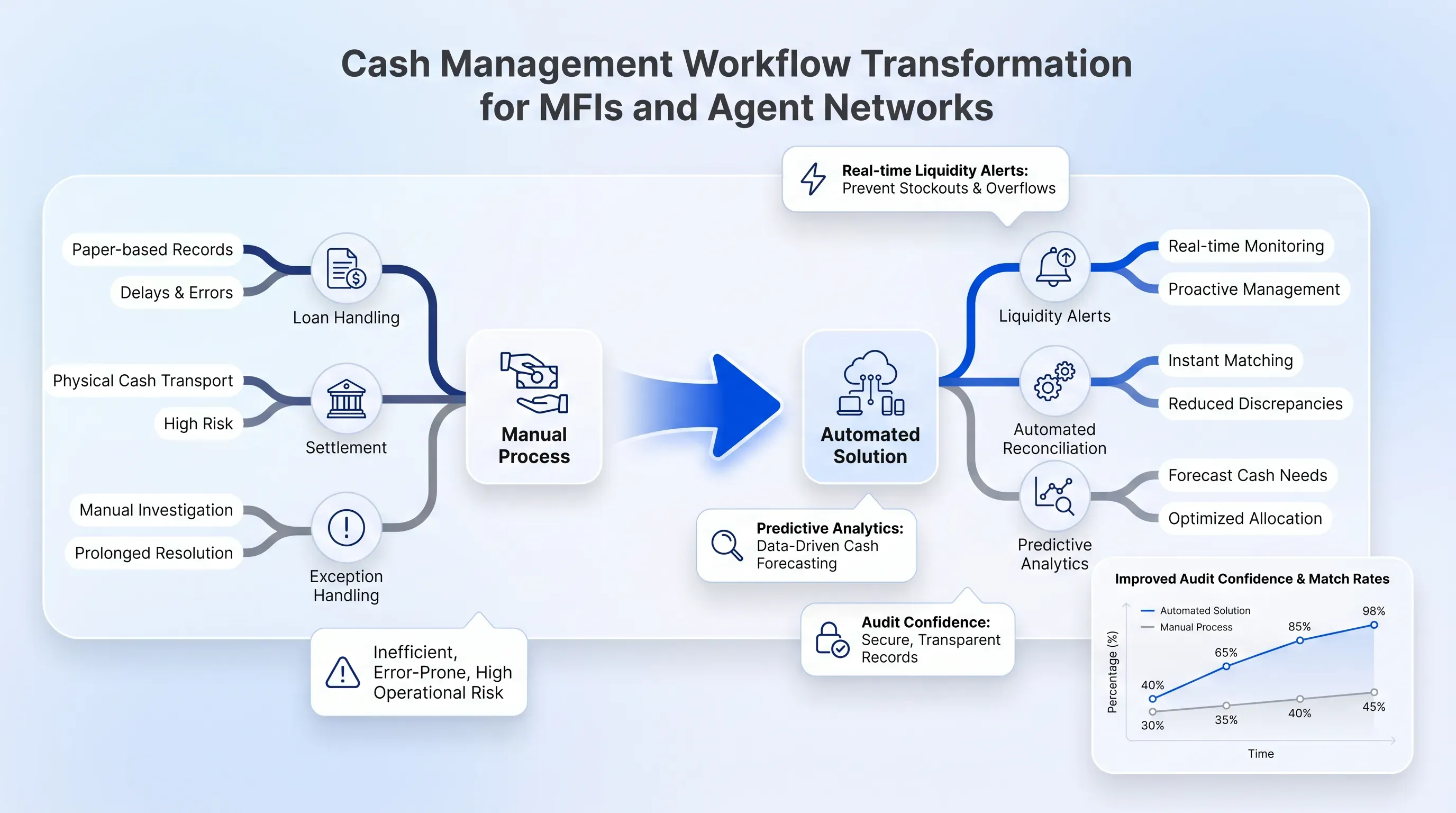
Infographic illustrating the shift from manual to automated cash management workflows for MFIs, featuring a flowchart and key action icons.

With the diagnosis clear, the question becomes what to demand from a system. Cash management solutions built for MFIs and agent networks have to own a specific set of workflows end to end, and the right way to read this list is as a test against your own operations rather than a set of features to admire.

Here is what cash management solutions have to cover:

  • Real-time visibility into physical cash at every branch and e-float in every agent wallet, on one screen, so you stop learning about shortfalls after the fact

  • Liquidity thresholds per location with alerts that fire before an agent or branch runs dry or overflows

  • Loan disbursement and repayment flows that post straight through to the core, without a manual re-entry step in the middle

  • Mobile money settlement that ties each transaction back to the core and the agent ledger

  • Exception handling for the moments when balances or records don't match, treated as a queue rather than a scramble

The point of that list is coverage of the actual workflow you run. A system that does forty things adjacent to your operation is worth less than one that does these five the way your network needs them. Fit beats breadth, and the next sections go deeper on the two capabilities you'll act on first.

Ready to digitise your financial institution?

Talk to our team about your roadmap and discover scalable digital banking solutions tailored to banks, fintechs and microfinance institutions.

Request a Demo

Setting liquidity thresholds and alerts

Thresholds are the control most operations leads reach for first, because they turn liquidity from a daily fire drill into a rule the system enforces. You set a minimum and maximum float level per location, then the platform watches balances against those bands and signals when a point is about to breach one.

The levels belong per location and per demand pattern, with higher bands around peak periods. MicroSave argues that providers should push their analytics to predict agent liquidity requirements from historical transaction data, then plan for high demand by encouraging higher float and pushing SMS reminders before paydays. A simple field rule sits underneath this. The Savings at the Frontier note describes agents holding 1.5 times the previous day's deposits and withdrawals in cash and e-float, which keeps a buffer for surges without stockpiling more than needed.

Alerts and predictive signals are what let a small central team run a large network. You configure the bands once, and the system tells you which of your two hundred locations needs attention today. That's the difference between managing a network and chasing it. Good agent liquidity management is mostly this: rules that act before a customer ever hears the word "no."

Handling exceptions and reconciliation

Capable cash management solutions treat reconciliation mismatches as a managed workflow and apply the same discipline to failed settlements and suspended balances. The system matches transaction IDs and amounts across the mobile money platform and the core; timestamps and agent-ledger records support the same check. Everything that lines up clears on its own. Only the genuine exception lands in front of a human, in a clear queue with the context needed to resolve it.

That design directly attacks the backlog from earlier. The Grameen Foundation account showed how manual matching collapses under volume, and how the MFI in the end had to invest in an automated system after customers had already had a bad experience. Automating the match is how the hours-eating work actually shrinks, because your analysts stop touching the 95% that reconciles cleanly and spend their time on the cases that need judgment.

Here's why that matters beyond the timesheet. Every resolved exception is a suspended balance cleared off your books, which is audit confidence you can stand behind. It's accurate portfolio data feeding your decisions. And it's a customer whose repayment posted where it should, which is the trust you can't buy back once it's gone. Reconciliation done right closes the loop that agent liquidity management opens.

Rolling it out in phases

The instinct to ease in gradually is right, but there's a trap in how MFIs do it. The Grameen Foundation research found that institutions which tried to stagger with manual reconciliation to save money ended up with entry errors and slower transactions; portfolio at risk rose temporarily, and loan officers lost buy-in. So phasing means sequencing the capabilities and the locations while the automation is on from day one.

A sensible order builds each phase on the last:

  1. Establish real-time visibility across branch cash and agent float first, so you can see the network before you try to steer it

  2. Add liquidity thresholds and alerts, and use the early visibility data to set the bands per location

  3. Turn on straight-through loan disbursement and repayment, and remove the manual re-entry step

  4. Bring full mobile money settlement and automated reconciliation online across the network

Run each phase on a pilot cluster of branches and agents before you expand outward. The aim is to protect daily distributed cash operations and earn buy-in from the loan officers and agents who have to live with the change. When they see the pilot cut their reconciliation hours or stop a stockout before it happened, the next cluster is an easier conversation.

Choosing by workflow fit

Weigh any option by how well it fits your MFI and agent-network workflows. Score a candidate against your real operations. Does it handle your disbursement-heavy repayment imbalance, the one that leaves agents flush with e-float and short on cash? Does it settle on your mobile money rails and reconcile against your core the way your books actually work? Cash management solutions that answer those questions are worth more than systems that list twice the features and fit half as well.

Doocat builds banking software for microfinance institutions across core banking and agent operations, with lending and mobile workflows built into that operating model, so its approach to distributed cash operations in emerging markets starts from microfinance operations first and corporate treasury second. If you want an outside read on how a system would map to your actual network, book a call with the Doocat team to evaluate cash management solutions against your own workflows.

Ready to digitise your financial institution?

Talk to our team about your roadmap and discover scalable digital banking solutions tailored to banks, fintechs and microfinance institutions.

Request a Demo

You need recent transaction history by location before setting agent float limits. Use daily cash-in and cash-out values, e-float balances, loan repayment dates, payroll dates, and local market days. This data shows where demand changes by weekday or season, which helps set minimum and maximum limits that fit each agent point.

Liquidity thresholds should be reviewed after each pilot phase and after any demand pattern changes. A monthly review works for stable branches, while payday-heavy or market-linked agent points need checks around those events. Compare alerts, failed transactions, and idle cash levels before changing the bands.

Yes, cash management solutions can support low-connectivity agent locations if they include offline capture and controlled sync rules. The system should timestamp each transaction, prevent duplicate posting, and flag records that don't match after sync. Agents also need a clear fallback process for approvals when the network is down.

A named operations or treasury role should approve cash movements, with branch staff limited to requests and confirmations. This separation reduces the risk of untracked transfers. Set approval limits by amount, location, and frequency so routine rebalancing moves quickly while unusual movements receive extra review.

Prepare current process maps, sample reconciliation files, agent float reports, and mobile money settlement reports before speaking with Doocat. Add exception examples from the past month, including failed repayments or delayed postings. These records help the review compare the software workflow against how your MFI operates today.

Schedule a Meeting

Book a time that works best for you

You Might Also Like

Discover more insights and articles

A banking advisor assists a customer with KYC onboarding on a tablet in a bright, modern office with natural light.

KYC Know Your Customer Guide for Banks and MFIs: Checklist, Workflow, and Controls

This article turns KYC know your customer from a scattered set of manual checks into a documented, repeatable workflow you can run across your onboarding team. You'll get a KYC checklist template to adapt and the controls that make the whole thing defensible in an audit, with a clear split between individual and business requirements.

A customer advisor assists a client with the KYC onboarding process on a tablet in a bright, modern office setting.

KYC Banking Workflows: How Banks and MFIs Can Scale Onboarding and Compliance

This article treats KYC banking as an operational workflow you can map. It walks the full journey a customer takes from first data capture through ongoing review, and shows where your handoffs and exception queues leak time or risk.

A finance professional reviews documents and reports at a modern office desk, taking notes while using a laptop in warm daylight.

Fintech Payment Infrastructure for Banks, MFIs, and Wallet Providers

This article breaks payment systems into their real parts and shows how rails and wallets hand off into settlement, while reconciliation and exception handling keep the record straight. It is written for wallet providers and for fintech payment teams inside banks or microfinance institutions who already run a payment product but keep hitting the same operational walls as volume grows.

A customer and bank advisor collaborate at a modern desk, focused on a tablet, in a bright, spacious bank branch.

Customer Experience in Banking Industry: How to Fix Friction Across Digital and Branch Channels

This article treats customer experience in banking industry work as an operational problem that lives in the handoffs between your digital and branch channels. It uses customer journey mapping to walk through where friction accumulates during onboarding and when support or compliance work crosses channels, then gives you a way to map it with owners so you can prove that a fix worked.