Map your top journeys
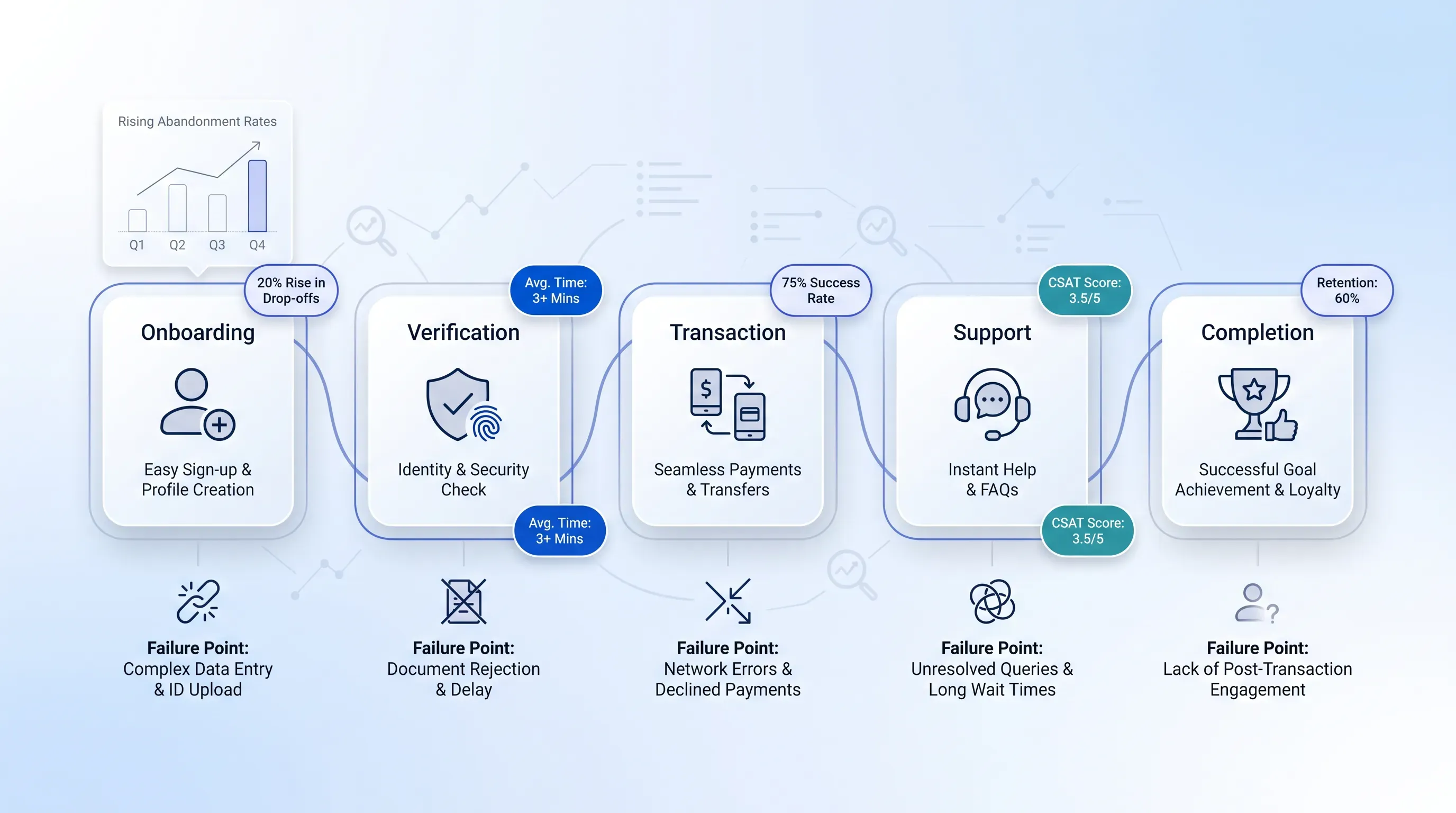
Diagnosis is only useful if you can find these failures in your own product. Journey mapping is the technique, and the version that matters is lightweight and built around completion. Lay out each step of a single banking customer journey as the customer experiences it and mark the point where action turns into stall. Record the actual drop-off location. Glassbox describes the point of the exercise as uncovering where there are areas of struggle or friction, then ordering potential changes by impact.
Do not map everything. A typical regional bank has more than 1,500 customer journeys according to McKinsey, and trying to fix all channels at once is how initiatives stall. Guidance from CMSWire is to identify high-impact journeys by volume and business risk, with known pain points used to narrow the work, because a focus on the journeys with the clearest return builds momentum early.
So prioritize before you map. Pick your candidates on three signals:
-
Volume, meaning the journeys the most customers actually run
-
Revenue, meaning the journeys tied directly to money coming in
-
Current friction, meaning the journeys where you already see drop-off or ticket spikes
One caution worth taking from TheyDo's guidance: match what customers say against how they behave; compare interview themes with app usage and ticket volumes, because banks routinely assume a flow is intuitive when the data says otherwise.
Who owns the blocker
Most bank customer experience failures in mobile-first banking are not owned by anyone. That is precisely why they persist. A blocker in the space between onboarding and the core system belongs to product and operations, while engineering still has to make the fix work; in practice, that shared responsibility keeps the issue open.
The cause is structural. Backbase describes the underlying problem as siloed channels with their own data and argues that a real fix requires systems that share data in real time and workflows that cross departmental boundaries. When teams are split and legacy workflows are case-driven, the spaces between steps go unowned. The blocker falls through the cracks between product and operations, with core systems and support pulled in too, and each team can honestly say it was not theirs.
This is where a journey map becomes action. For every blocker you surface, attach a name. Ownership diffused across four teams is the reason bank customer experience modernization stays tactical and stuck. So write down who owns the onboarding funnel drop-off and transaction status, then capture the owner for the handoff and support context. A blocker with an owner gets fixed. A blocker without one gets discussed.
Metrics that show completion
Measure the three lenses with numbers that expose blockers.
The bank customer experience metrics below tell you where a journey breaks and point you at the owner:
-
Task and journey completion rate: of everyone who starts, how many reach the done state. This is the headline number for the completion lens.
-
Onboarding funnel drop-off by step: the count at each screen, which pinpoints the exact step where applicants go cold.
-
Transaction success and failure rate: how often money actually moves, paired with whether the customer was told when it did not.
-
Branch-to-digital handoff completion rate: how often a journey that crosses channels resumes with context intact rather than restarting.
-
Time-to-resolution for support: how long a stuck customer waits, which exposes whether agents have the context to resolve rather than just log.
Contrast these with the lagging indicators most dashboards lead with. Net Promoter Score (NPS) and Customer Satisfaction (CSAT) tell you a customer was unhappy, but they arrive after the customer already left and they do not tell you which screen lost them. Completion-focused metrics point at a specific step and owner, with the system in view. Sentiment scores confirm the damage. Operational metrics help you find and undo it before the next customer hits the same wall.
Audit your top three journeys
Turn all of this into one concrete move. Take your top three customer journeys by volume and revenue and map each one step by step, with the operational blocker named for each journey. That audit is the fastest way to see where each banking customer journey breaks, because completion and trust decide whether a mobile-first bank keeps its customers as journeys cross channels.
Doocat fixes the plumbing behind bank customer experience journeys rather than redesigning screens. Its microservices core keeps state consistent across mobile and branch, with web on the same view, so onboarding and payments share one customer record that support can also use. If you have surfaced the blockers breaking your bank customer experience, book a call with Doocat to work through them.