Doocat

Tanzania Instant Payment System: A TIPS Guide for Banks and PSPs

Content authorBy DoocatPublished onReading time12 min read
A hand holds a smartphone displaying analytics, with a laptop and organized desk items softly blurred in a warm, modern workspace.

This article explains how a TIPS connection works from the inside through the payment flow and the preparation work, then through failure tests and the evidence a supervisor will ask for. It assumes no prior knowledge of the specifications and ends with the questions you still need to confirm with the central bank or your connection provider.

Where most TIPS projects go wrong

A Tanzania Instant Payment System connection fails in planning long before it fails in production. The technical part of TIPS integration Tanzania, a set of API calls and a certificate, is the smaller half of the work. The larger half is deciding who owns liquidity at 2 a.m. and what your core banking system does when a response never arrives. It is also deciding which status your contact center is allowed to read out to a customer.

So this guide follows one payment through the rail, then turns that flow into a scope and an ownership map. A test plan and a readiness table you can hand to an audit committee follow from that. Where a requirement depends on current TIPS Bank of Tanzania documentation, I say so instead of guessing.

Tanzania instant payment system basics

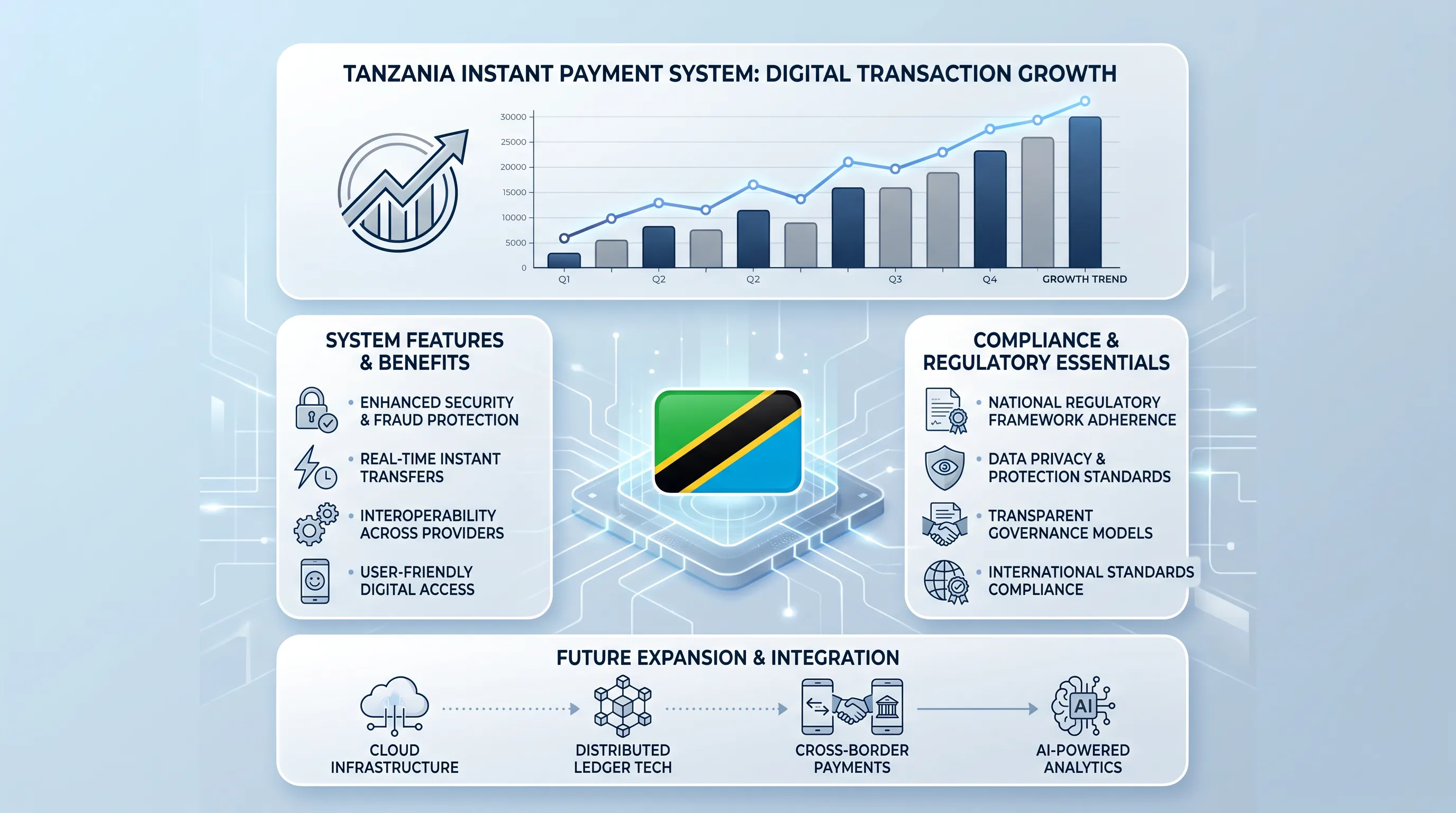
Infographic showcasing the Tanzania Instant Payment System with a gradient background, charts, and simple icons in a clean, modern style.

The Tanzania Instant Payment System is the national real-time retail payment switch built and operated by the central bank. It connects banks and non-banks, which the rules call digital financial service providers, onto one rail instead of a web of bilateral links. Start with the definition in the TIPS Bank of Tanzania materials, because participation obligations flow from those materials.

The scale is no longer experimental. In 2025 the system processed 643.96 million transactions worth TZS 54,952.97 billion, with 47 participating payment service providers. A year earlier the count was 46 participants and 452.50 million transactions, so the curve is steep and the operational bar rises with it.

Two design decisions matter for your build. The switch was developed in-house on the Mojaloop open-source platform in a hub-and-spoke model, and it runs on a proprietary messaging standard, which AfricaNenda noted when it compared messaging standards across African systems. If your core speaks ISO 20022 natively, you need a translation layer. Mutashobya Mushumbusi, Head of Retail Payments at the Bank of Tanzania, describes the platform as running 24/7/365 with same-day settlement and roughly 1.5 million transactions a day.

TIPS and other systems

Treating the national rails as interchangeable is the fastest way to misprice a project. The Tanzania Interbank Settlement System (TISS) is the real-time gross settlement system for high-value and time-critical interbank payments, and commercial banks publish fees capped at TZS 10,000 per transfer regardless of amount. The Tanzania Automated Clearing House (TACH) handles cheque images and electronic funds transfers in multiple settlement windows. Retail instant payments belong on the Tanzania Instant Payment System.

TANQR sits on top, not beside. The Tanzania Quick Response Code Standard was published in August 2022 and built on the EMV QRCPS specification from EMVCo for merchant-presented codes, which means QR is an addressing and acceptance layer that still clears through the switch. By 2025, 27 licensed institutions were deploying TANQR, of which 21 were banks and 5 were mobile money operators.

Bilateral connections are what this replaced. Before 2018, interoperability ran on negotiated pairs, and the four electronic money issuers settled through prefunded accounts on counterparty platforms with separate interparty fee agreements. If you still maintain legacy bilateral links, decide early which ones the project retires.

Tanzania instant payment system flow

One transfer of one shilling amount between two institutions. Following a single Tanzania Instant Payment System payment end to end gives everyone in the room, even people who will never read an API specification, the same picture of where responsibility sits and where it hands off.

Ready to digitise your financial institution?

Talk to our team about your roadmap and discover scalable digital banking solutions tailored to banks, fintechs and microfinance institutions.

Request a Demo →

Initiate and validate

The sender picks a channel first: mobile app or Unstructured Supplementary Service Data (USSD). An agent or a branch is another route, as is a scanned QR code. The channel determines what identifier the sender supplies for the beneficiary, which is a mobile number used as an alias or an account number, with a merchant payment number encoded in the QR as another form.

Then the sending institution validates in sequence. It authenticates the customer and confirms the debit account or wallet is active and unrestricted. It resolves the beneficiary identifier to a participating institution and a display name. It checks available balance against the amount and fees and screens the transaction against limits and sanctions rules. Name resolution deserves attention, because the whole point of a central directory is that the sender sees who they are paying before confirming.

Route and post

Once the customer confirms, the sending institution builds the instruction with a unique end-to-end reference and submits it to the switch. The Tanzania Instant Payment System validates the message and identifies the receiving institution. It applies scheme-level checks and forwards it.

The receiving institution runs its own checks on the beneficiary account or wallet and on any credit restrictions or limits. It posts the credit and returns a status. That status is the authoritative outcome for the payment, and your systems treat it as such instead of inferring success from a timer or a partial response.

Confirm and reconcile

The sender gets a notification carrying the transaction reference. Both institutions update their ledgers, and settlement records are produced against the scheme's settlement arrangements. Reconciliation then compares channel records and core postings against switch reports and settlement positions for the same business day.

Anything that does not reconcile cleanly goes to exception handling, and the rule needs to be written before go-live: an uncertain status is never treated as a success. If the sending ledger says posted and the switch report says rejected, the item opens a case and the customer gets a definite answer within your published timeframe.

Prepare the institution

Turning that flow into a plan means answering five questions in order, and a Tanzania Instant Payment System project stalls when teams skip from question one straight to coding. Every TIPS integration Tanzania banks have completed since the 2021 pilot started with scope, not with endpoints.

TIPS integration Tanzania scope

Decide whether you connect directly or through an aggregator or technology provider, because that single choice reassigns most of the obligations below. Eligibility comes from your licence: the Payment Systems (Licensing and Approval) Regulations, 2015 restrict operation of a payment system to a body corporate incorporated under Tanzanian law as a bank or financial institution, or as a non-bank equivalent. Non-bank issuers carry extra conditions, which cover a separate trust entity and a TCRA network or application licence where a telecom channel is involved.

List the use cases you are actually launching with. Person-to-person and merchant payments through TANQR are distinct scopes with distinct testing. Bank-to-wallet and wallet-to-bank are distinct as well. Government bill payments through the Government Electronic Payment Gateway and incoming remittances follow the same rule. Inbound international transfers became compulsory on the rail from 1 August 2025 under a central bank directive, which changes the scope for anyone handling diaspora flows.

Then write down, party by party, who owns certification and connectivity. Security keys and settlement belong on the same list, as does production support. Where a provider owns a line, get it in the contract with a service level attached.

Map data and statuses

Build one mapping document that follows a field from the customer's screen to the switch message and back. Customer identifier and beneficiary alias each need a named owner in the channel and the core, and in the integration layer and the specification. Account or wallet number and amount and currency follow the same rule. Narrative and end-to-end reference do as well, as does transaction status.

Status mapping is where silent defects live. Your core has its own posting states and your channel has its own display states. The scheme has its own response codes. Define the translation table explicitly so it states which scheme codes are final and which are pending. State which codes require a query before anyone acts.

Assign operational ownership

Name a person, not a department, against each of these before the first test cycle:

  • Liquidity and settlement position monitoring, including weekends and public holidays, since the rail runs continuously

  • Daily reconciliation and break resolution, with a cut-off time and an escalation path

  • Fraud monitoring and transaction limits, with authority to block

  • Incident management and customer complaints, each with a named deputy, plus reversals and regulatory reporting, with change management on the same terms

The part of TIPS integration Tanzania teams underestimate is the last line. Change management sounds procedural until a specification update lands and nobody owns the regression test.

Ready to digitise your financial institution?

Talk to our team about your roadmap and discover scalable digital banking solutions tailored to banks, fintechs and microfinance institutions.

Request a Demo →

Test failure scenarios

Happy-path testing proves nothing about a real-time rail. Your Tanzania Instant Payment System test plan defines an expected result and a named piece of evidence for every scenario below, and "we tested it" is not evidence. A log extract with timestamps and references is.

  • Delayed response from the receiving institution, where the customer sees a pending state and the system does not auto-reverse

  • Timeout with no response at all, resolved by a query or a defined reconciliation outcome

  • Duplicate request with the same reference, which must post once

  • Receiving institution unavailable, which produces a clear rejection and an immediate hold release

  • Validation rejections for closed accounts and wrong aliases, plus limit breaches and screening hits

  • Conflicting statuses between the channel, the core, and the switch report, routed to a case with an owner

  • Retry storms and reversals, plus reconciliation breaks carried overnight and customer complaints raised before the break is resolved

Sign each scenario off with the business owner. The contact center script and the reconciliation procedure are deliverables of this phase.

Build the readiness table

Supervisors and internal auditors ultimately want the same thing: evidence that requirements are being met. For the Tanzania Instant Payment System, these requirements can be grouped into three main categories: business, technical and operational.

  • Business requirements include confirming the appropriate licence and participation route, approving use cases, transaction limits and pricing, and formally accepting the scheme rules and fee schedule. Evidence may include licence copies, participation approvals, signed provider contracts, board or Executive Committee minutes, product approval documents and countersigned participation agreements.

  • Technical requirements focus on ensuring that the system is properly connected, secure and able to process transactions reliably. This includes having connectivity, certificates and key management in place, completing field and status mapping, proving idempotency and duplicate handling, and achieving the required certification or provider conformance. Acceptable evidence includes certificate inventories, key ceremony records, network test logs, signed mapping documents with version histories, transaction test results, posting confirmations and certification documents from the operator or provider.

  • Operational requirements ensure that the system can be managed and supported effectively. Organisations should have a functioning reconciliation procedure, appropriate liquidity and settlement monitoring, clearly defined processes for incidents, complaints and reversals, as well as monitoring, alerting and reporting capabilities. Evidence can include written procedures, reconciliation dry-run results, named process owners, staff rotas covering nights and holidays, escalation matrices, service-level agreements, sample case files, dashboard screenshots and alert configuration records.

The key is to ensure that every requirement has clear, documented evidence that can be presented to supervisors, auditors and other relevant stakeholders.

Keep the evidence column literal. A requirement with "process documented" against it is a requirement nobody has tested.

Confirm current requirements

TIPS Bank of Tanzania specifications and circulars change, and this guide is not a substitute for them.

Confirm each of the following in writing with the TIPS Bank of Tanzania or your connection provider before you freeze the Tanzania Instant Payment System design, because getting one of them wrong late costs a release cycle:

  • Eligibility and participation route, including whether direct connection is available for your licence class

  • Current technical specifications and test environment access, plus message versions and certificate requirements

  • Testing and certification steps, with the criteria for sign-off

  • Transaction limits and fees, plus settlement arrangements and liquidity or prefunding obligations

  • Service levels and the production cutover procedure, plus reporting obligations and dispute and reversal rules

The TIPS Bank of Tanzania publishes circulars that affect all of this, which cover charges for bank-to-bank transfers through retail platforms and opening digital channels through the platform. Read those before you connect to TIPS. Bank of Tanzania circulars, not vendor summaries, carry the obligations.

Evaluate supporting platforms

Whatever sits between your channels and the rail has to do specific jobs. Judge any platform on orchestration of API calls with retry control and on validation before submission. Idempotency on references and status management against a mapped table belong on that list. Reliable posting to the ledger and reconciliation tooling belong there too. Tamper-evident audit trails go with monitoring and alerting. Security controls over keys and data go with configurable limits and routing. Case management for exceptions belongs on the same list. Ask for proof on each line, since a demo environment hides the behavior you care about most, which is what happens when something does not respond.

Doocat builds core banking and digital banking software. Payment processing software is part of the same suite, and the customers are banks and microfinance institutions, with fintechs as well. The software runs on microservices with REST APIs and webhooks for external payment rails. That capability set maps onto the TIPS integration Tanzania requirements above. It does not mean Doocat ships a certified connector for this rail, and anyone who tells you otherwise during a procurement should be asked for the certification document.

Closing the gap between plan and production

The connection itself is rarely the hard part. What separates a clean go-live from a six-month cleanup is whether you mapped statuses honestly and tested the failures. Naming the people who own money movement outside office hours is the other half of that test. Build the evidence as you go and the readiness review becomes a formality.

If you are scoping a core or channel build around this rail, Doocat's team works on exactly these integration and ledger problems. Book a call to review your architecture before you commit to a Tanzania instant payment system delivery date.

Ready to digitise your financial institution?

Talk to our team about your roadmap and discover scalable digital banking solutions tailored to banks, fintechs and microfinance institutions.

Request a Demo →

Use the original end-to-end reference as an idempotency key and store its outcome before accepting a retry. A timeout must trigger a status query or reconciliation check, not a new payment. Test repeated submissions, delayed replies, and channel refreshes to prove one customer instruction creates one posting.

Don't promise cancellation after confirmation. Treat the instruction as submitted and follow the current scheme process for reversals, disputes, or mistaken payments. Confirm those rules with the Bank of Tanzania or connection provider, then give staff a scripted process that records consent, reason, approvals, and the final status.

TIPS operates continuously, including weekends and public holidays, but your institution still needs coverage for liquidity, reconciliation, incidents, and customer queries. Confirm how settlement, reporting cut-offs, and prefunding work outside business days in the current participation documents before setting internal service targets.

Keep the customer instruction, authentication result, beneficiary details shown, amount, fees, unique reference, timestamps, request and response messages, ledger entries, and reconciliation outcome. Preserve changes and staff actions in an access-controlled audit trail, because these records support complaints, exception handling, audit review, and regulatory requests.

Doocat shouldn’t be assumed to provide a certified Tanzania instant payment system connector. Its software can support core, channel, ledger, and API integration work, but direct participation and certification depend on your licence and current operator requirements. Ask Doocat and the connection provider for written scope, certification evidence, and responsibility boundaries before contracting.

Schedule a Meeting

Book a time that works best for you

You Might Also Like

Discover more insights and articles

A middle-aged woman in business attire reviews financial documents at a desk in a bright, plant-filled office with a monitor displaying analytics.

GhQR in Ghana: Merchant Onboarding and Payment Flows

This article walks through how an acquiring institution moves a Ghanaian retailer from sign-up to live acceptance, with the controls that keep a launch from going sideways. It uses GhIPSS documentation as the reference point and closes with the platform capabilities your institution needs to confirm before the first payment lands.

Two diverse professionals engaged in a friendly discussion over a tablet in a bright, modern office with large windows and blurred coworkers.

Murabaha Financing: Contracts and Examples for African Banks

This article walks through how murabaha financing becomes a working bank product: the transaction sequence and the controls your core system has to enforce. It is written for the teams who have to build the thing and then defend it in an audit.

A mid-aged manager reviews documents at a warm wood desk in a sunlit office, with a monitor displaying analytics in the background.

SACCO Management System: A Buyer’s Guide for Kenyan SACCOs

This article walks through how a Kenyan savings and credit cooperative can define what it actually needs from new software and check vendor claims against evidence before it plans a migration that doesn't break member balances. It ends with a checklist you can score vendors against before any price talk begins.

Close-up of hands holding a smartphone displaying a banking app, set in a cozy home office with blurred background elements.

Mobile Money Interoperability in Ghana: How GhIPSS MMI Works

This article maps the four transfer flows supported by Ghana's national mobile money interoperability platform and shows who owns each step of them. It covers transaction direction and the questions to settle before a new connected channel goes live.