Mobile money interoperability basics
Mobile money interoperability means a customer on one platform can move funds to a customer on another without both sides sharing a provider. GhIPSS, a wholly owned subsidiary of the Bank of Ghana incorporated in May 2007, runs the shared switch that makes this possible across participating wallets, with bank accounts and e-zwich cards on the same switch.
The GhIPSS mobile money interoperability service covers four documented functionalities, and they don't all behave the same way. One pulls funds. The others push them. Treating them as a single capability is how operations teams end up with reconciliation breaks they can't explain.
Mobile money interoperability in Ghana went live on May 10, 2018, and the volumes of mobile money interoperability ghana since then are not small.
GhIPSS MMI transfer flows
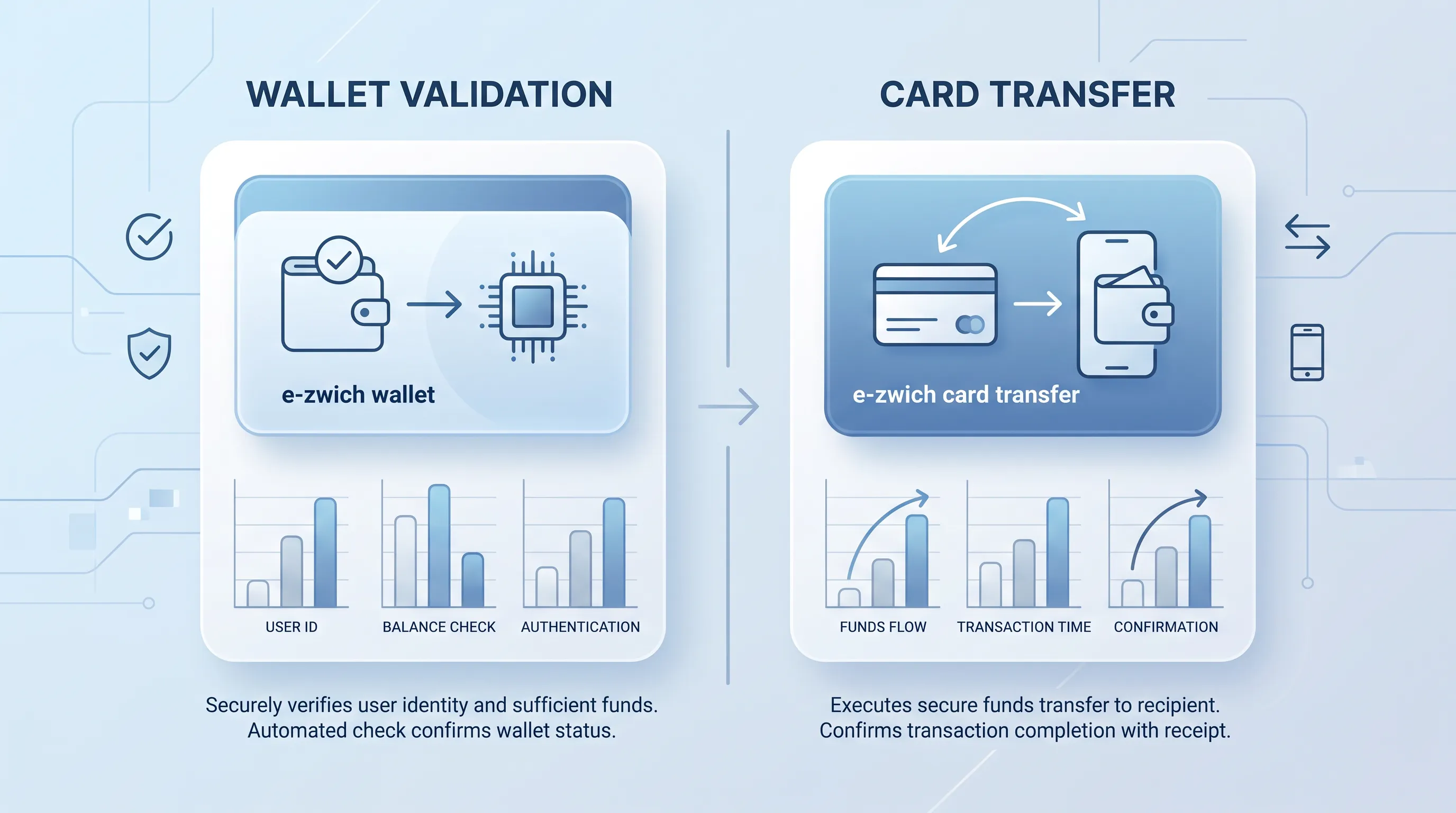
By 2025, the GhIPSS mobile money interoperability platform processed 290.31 million transactions worth GhS 51.60 billion, up 37.80 percent in volume on the prior year. Wallet-to-wallet accounts for the overwhelming majority of that, at 282.95 million transactions. The remaining three flows are smaller in volume but carry most of the operational complexity.
Archie Hesse, who led GhIPSS from 2012 until July 2025, described the pre-switch era plainly in an interview with Oxford Business Group: "The landscape became fragmented, with each telco offering the service only within its network." The switch removed that fragmentation. Each participant needs to know exactly what its own system is doing in each flow, which is why mobile money interoperability deserves a flow-by-flow map.
Each example below uses a hypothetical cedi amount to make the direction unambiguous.
Cross-network wallet transfers
A customer holding a wallet with Provider A sends GH¢150 to a customer on Provider B. She initiates it herself, from her own handset, through her provider's short code or app. GhIPSS instructs customers to dial their existing short code and follow the prompt.
Provider A is the sending institution. It sends a name enquiry through the switch so Provider B can validate the destination wallet and return the registered name, after which the sender confirms before the debit happens. Funds are pushed from her wallet to the destination wallet, and the final status comes back to Provider A, which is the party that must tell the customer what happened.
Bank account to wallet
This is the flow that gets described incorrectly most often. The documented functionality lets mobile money users "debit or pull funds from their bank accounts and credit their wallets or other wallets." A customer with a linked account at a participating bank initiates a GH¢300 pull from her wallet channel, and the bank is the one being debited.
So the initiating channel is the wallet and the source of funds is the bank account, with the destination a wallet that need not be the initiator's own. The bank validates the account and the mandate, then checks the available balance before releasing anything. Calling this flow bank-initiated inside your procedures will send your support team to the wrong system when a customer calls, because the bank's channel logs will show nothing at all.
Bank-to-wallet and wallet-to-bank together accounted for 7 percent and 6 percent of mobile money transaction value respectively in 2024, according to the Bank of Ghana's FinTech sector report. The GhIPSS mobile money interoperability rules govern the switched portion of those volumes, and providers also run non-GhIPSS bank-to-wallet arrangements that the same report counts separately.