Doocat

Murabaha Financing: Contracts and Examples for African Banks

Content authorBy DoocatPublished onReading time12 min read
Two diverse professionals engaged in a friendly discussion over a tablet in a bright, modern office with large windows and blurred coworkers.

This article walks through how murabaha financing becomes a working bank product: the transaction sequence and the controls your core system has to enforce. It is written for the teams who have to build the thing and then defend it in an audit.

Why the structure decides the configuration

Murabaha financing looks simple on a slide and gets complicated the moment someone has to build it. A customer wants an asset. The bank buys it and owns it before selling it on at a disclosed price. Every one of those verbs creates a record and a point where a configuration shortcut can void the contract.

The pressure to build it properly is rising. Sub-Saharan Africa now has 104 Islamic banks and windows operating, according to the ICD-LSEG Islamic Finance Development Report 2025, and markup-based instruments already account for about 56 percent of financing at Islamic banks in the region on IMF estimates. So the question is whether your product behaves like a sale in the ledger, or like a loan wearing a different label.

How murabaha financing works

A cost-plus sale has two legs, and they happen in order. The institution acquires an identified asset from a supplier at a known acquisition cost and takes ownership before selling that same asset to the customer at a price that states the cost and the markup separately. The customer pays that price.

Compare that with a conventional facility, where the bank credits an account and the customer does whatever the sanction letter permits. Abu Dhabi Islamic Bank puts the distinction bluntly in its own customer guidance: "The bank's profit is earned through the sale of an asset that it has owned, rather than from charging interest on money lent." The obligation is a sale price, fixed at contracting.

That single difference drives most of the build. Because the selling price is fixed when the contract is signed, there is no accrual engine recalculating a rate. Because ownership must sit with the institution first, there is an inventory position on the balance sheet, however briefly, which the Accounting and Auditing Organization for Islamic Financial Institutions (AAOIFI) addresses in FAS 28 on deferred payment sales. And because the cost must be disclosed, the acquisition figure stops being an internal number and becomes a contractual representation. A suitable core banking system should preserve those records and controls across the transaction lifecycle.

Murabaha financing example
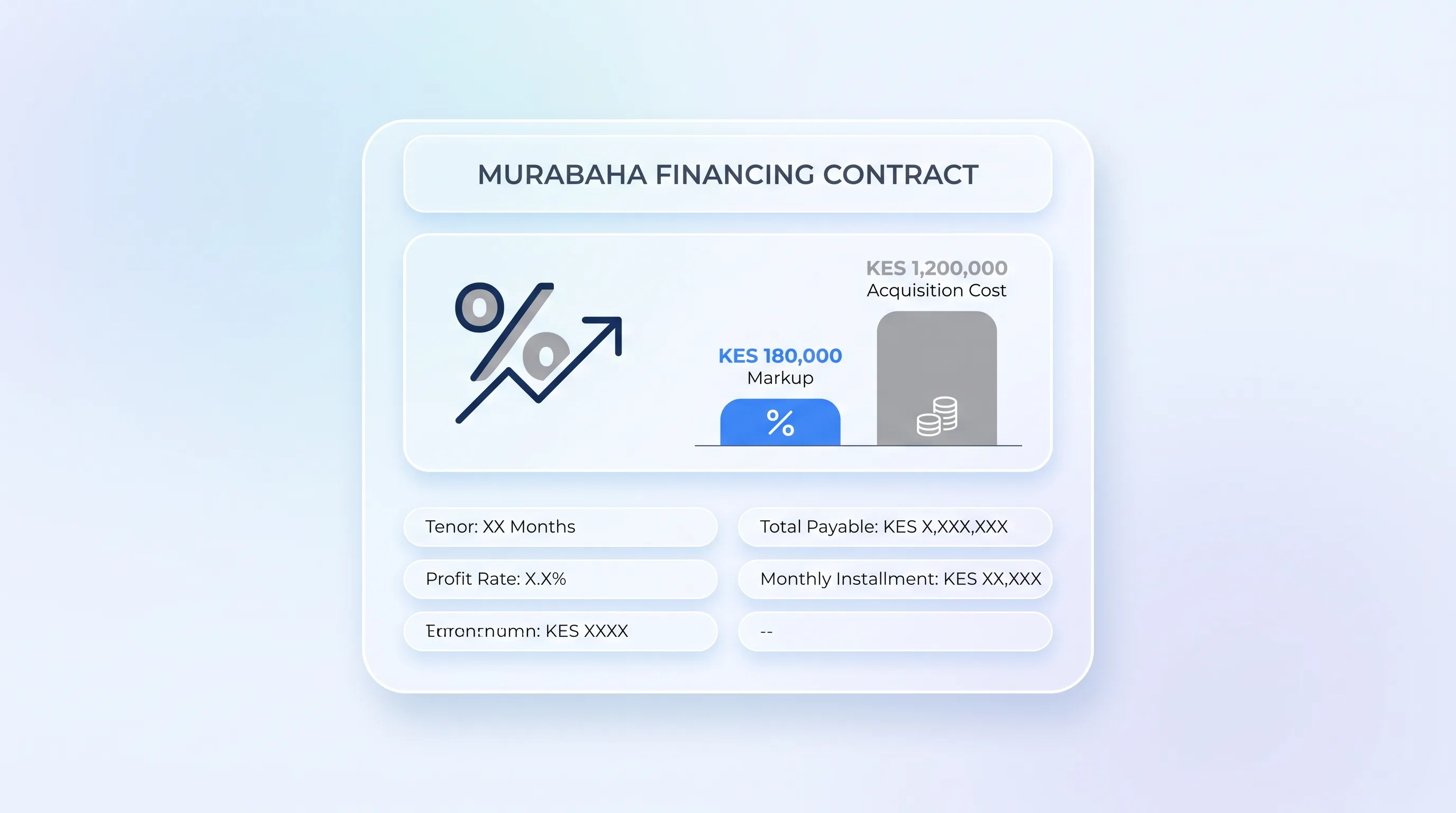
A clean, modern UI card displaying murabaha financing details with a markup percentage icon, set against a soft blue and white gradient.

The figures below are illustrative. They are chosen to make the arithmetic visible.

A manufacturing customer in Nairobi identifies a packaging machine. The supplier quotes KES 1,200,000. The institution buys the machine at that price and sells it to the customer for KES 1,380,000 after taking ownership. The contract discloses the KES 1,200,000 acquisition cost and the KES 180,000 markup on its face. The customer pays a KES 180,000 deposit at execution and settles the remaining KES 1,200,000 in twelve monthly installments of KES 100,000.

That is the whole murabaha financing example, and the deposit is where configuration goes wrong first. If the deposit is treated as a payment against the selling price, the schedule balances at exactly twelve installments. If it is treated as a reduction of acquisition cost, the disclosed cost figure in the contract is now wrong, and so is every downstream statement.

The 15% is not a rate

The KES 180,000 markup is 15 percent of the KES 1,200,000 acquisition cost. It is not an annual rate, and nothing in the contract converts it into one. A twelve-month tenor happens to make the two numbers look comparable, which is precisely why the comparison misleads: stretch the same markup over twenty-four months and the cost to the customer does not change, while the implied annualized figure halves.

Your disclosure templates have to hold that line. Where a central bank requires an effective-rate equivalent for consumer comparison, publish it as a separate regulatory disclosure and keep it out of the contractual price fields. Mixing the two inside one document is how a murabaha financing example turns into evidence that the product is a loan.


Ready to digitise your financial institution?

Talk to our team about your roadmap and discover scalable digital banking solutions tailored to banks, fintechs and microfinance institutions.

Request a Demo →

The contract lifecycle

The sequence matters more than any individual control, because a step performed out of order cannot be repaired by documentation afterwards. Bank Negara Malaysia's policy document states it without qualification: the contract "shall not be entered into prior" to the seller's purchase of the asset. Build the system so that ordering is enforced by status.

What follows maps the stages most institutions implement. Treat it as a starting structure. Local law and your own Sharia governance body will each add requirements, and in Nigeria, for instance, every licensed non-interest institution must run its products past a Shariah Advisory Committee under the CBN's Shariah governance guidelines before launch.

Request and asset checks

Everything starts with a request that names an asset. The customer specifies what they want and the asset itself gets checked for eligibility against the institution's approved list. A supplier quotation fixes the acquisition cost that will later be disclosed.

The purchase promise, or wa'd, sits here. It binds the customer to buy once the institution has acquired the asset, which is what makes the institution willing to take the ownership position at all. Deposit treatment is decided at this point too, which covers whether a security deposit taken before execution is refundable and under what conditions. Nothing moves to the next stage until credit approval and asset eligibility sign-off both exist as recorded decisions in murabaha financing workflows, because the institution is about to spend its own money.

Purchase and ownership

The institution contracts with the supplier and pays. Where agency is permitted, the customer can act as the institution's agent to buy the asset, but the paperwork then has to prove the customer was buying for the bank and not for themselves. AAOIFI's standard allows this arrangement, and it remains the most common source of compliance findings, because ownership that passes directly to the customer leaves nothing for the institution to sell.

Possession is either physical or constructive. Bank Negara's parameter accepts constructive possession where there is physical evidence of effective transfer such as a warehouse receipt, which is workable for equipment sitting at a supplier's yard. During the window between acquisition and resale, the institution assumes the ownership risk, and your insurance and accounting treatment have to reflect that. The records proving acquisition are the invoice and whatever title or receipt document the asset class produces before any murabaha contract is drawn up.

Murabaha contract execution

Only now can the contract be signed. The document discloses the acquisition cost and the markup separately from the total selling price. It sets out the payment schedule and the security taken.

Bank Negara's documentation requirement is a usable checklist for the fields your system must populate: description of the asset and selling price alongside acquisition cost and profit amount. A murabaha contract missing the cost disclosure is not a murabaha contract at all, because disclosure is what distinguishes it from an ordinary negotiated sale. Make those fields mandatory at the system level rather than relying on the branch to complete them.

Servicing and closure

Execution triggers the schedule. The receivable is booked at the selling price with the profit element deferred and recognized across the payment period, which is where FAS 28's amortized cost approach differs from conventional interest accrual. Payments allocate against the schedule and statements show the fixed selling price rather than a moving balance.

Closure needs the same discipline as origination. Final settlement releases collateral and closes the deferred profit position. Retain the full evidence chain, because a Sharia audit will ask to see the acquisition proof for a contract that settled three years ago.

Ready to digitise your financial institution?

Talk to our team about your roadmap and discover scalable digital banking solutions tailored to banks, fintechs and microfinance institutions.

Request a Demo →

Required document checklist

Every stage above produces artifacts, and the audit question is always whether they exist in the right order with the right dates. These are the records a murabaha financing file contains before anyone calls it complete:

  • Customer request naming the asset, plus the credit approval and asset eligibility sign-off

  • Supplier quotation and the asset specification it refers to

  • Purchase promise signed by the customer, and the agency appointment where the customer buys on the institution's behalf

  • Supplier invoice and proof of payment from the institution's own account

  • Title document, delivery note, or warehouse receipt evidencing ownership and possession before resale

  • The executed murabaha contract with cost, markup, and selling price stated separately

  • Repayment schedule, security and collateral documents, and the approval log showing who authorized what and when

Date stamps carry as much weight as the documents themselves. An invoice dated after the sale agreement tells an examiner the sequence was reconstructed, whatever the file otherwise contains.

Operational exceptions

Exceptions are where products built on the happy path fall apart. Supplier delays leave an approved customer waiting while the purchase promise ages. Failed purchases leave the institution holding an asset nobody has agreed to buy, which is the real cost of taking ownership risk. Price changes between quotation and invoice break the disclosed cost figure and require a fresh approval rather than a quiet field edit.

Early settlement and arrears both need written policy before launch, and neither has a universal answer. AAOIFI permits a rebate for early payment but does not allow it to be stipulated as a contractual entitlement, while Bank Negara made it mandatory and published a formula: ibra' equals deferred profit less any early settlement charges. In the UAE, the Higher Sharia Authority's Resolution No. 76/3/2019 requires an ibra of unearned profit and bars early settlement fees beyond actual cost. Three regimes, three different system behaviors.

Late payment splits the same way. AAOIFI's standard contemplates an undertaking by the customer to donate a sum to charity on delay, with the Sharia board verifying the money is indeed spent on charitable causes and not retained. The CBN Rule Book takes a comparable position for non-interest microfinance banks, as it allows a default penalty that shall be given out to charity. Decide with legal and your Sharia committee which treatment applies, then configure a separate charity ledger so penalty income never touches the profit and loss account.

Common configuration mistakes

Most of these are ordinary system defaults inherited from a conventional lending module that nobody turned off. The compliance failure comes later.

  • Disbursing cash to the customer instead of paying the supplier, which makes the murabaha contract a loan in substance regardless of the document title

  • Allowing the sale agreement to be executed before ownership evidence is uploaded, the single failure that makes the whole transaction void

  • Calculating markup on the financed amount after deposit rather than on acquisition cost, which produces a disclosed figure the invoice does not support

  • Burying fees in the selling price instead of disclosing them as separate line items

  • Treating document uploads as optional attachments rather than status gates

  • Rounding installments so the twelve payments in a murabaha financing example no longer sum to the contracted selling price

  • Applying deposits against the cost base in one module and against the receivable in another, so the schedule and the ledger disagree

  • Permitting repricing after execution, since the selling price is fixed once the contract is signed

  • Writing approval decisions to a field that overwrites, leaving no trail of who approved the earlier version

The concentration risk makes this worth getting right. In Bangladesh, Bai-Murabaha alone reached 50.3 percent of Islamic bank investment by June 2025 on Bangladesh Bank figures, and the World Bank's risk analysis for Islamic banks put murabaha at 41 percent of financing as the first choice across the industry. A configuration defect here is the book.

Configure with Doocat

Doocat's Islamic banking module includes a cost-plus financing product with markup calculations that disclose cost and profit separately, which is the field structure the murabaha financing contract requires. Fees are configurable per product and governance controls and audit trails are built into the module rather than bolted alongside it. Deployments across African markets such as Sudan and Somalia run the same product engine with jurisdiction-specific reporting.

One thing the software does not do is certify your product. Doocat supplies the configuration and templates, and certification comes from your own Sharia board against your specific deployment. Build the murabaha financing example you intend to launch inside a test entity and let your committee sign off on the live configuration rather than a specification document.

Two adjacent products need separate treatment and separate guidance. Ijara is a lease, where the institution retains ownership and the customer pays rent, which we cover in a dedicated workflow article. Mudarabah sits on the liability side as a profit-sharing investment account with its own allocation mechanics, and neither belongs inside a cost-plus sale configuration.

Before you launch

Get the sequence right and most of the compliance work takes care of itself. Order the stages so ownership always precedes resale and gate each status change on the document that proves the previous step happened.

Doocat builds core banking software with Sharia-compliant product templates and audit trails your Sharia board can review directly. If you're mapping your product against these controls now, book a call with our team to walk through murabaha financing configuration for your institution.

Ready to digitise your financial institution?

Talk to our team about your roadmap and discover scalable digital banking solutions tailored to banks, fintechs and microfinance institutions.

Request a Demo →

No. Murabaha is structured around an identified asset that the institution acquires and sells, so a service or unrestricted cash advance doesn’t fit the same contract. A bank seeking to finance services needs a different Sharia-approved structure, documented separately from its murabaha product.

Banks should set the purchase currency, sale currency, exchange-rate source, and conversion date before approval. The system should record the acquisition amount in the transaction currency and the reporting-currency equivalent. After execution, currency conversion must not change the fixed selling price, and local accounting rules still apply.

Banks should test the full lifecycle with normal and failed transactions, including duplicate invoices, missing ownership evidence, changed supplier prices, early settlement, and late payment. Each test should confirm that status gates, ledger entries, schedules, permissions, and audit records produce the approved result. Doocat can be assessed against these test cases before deployment.

Yes, if the contract identifies each asset or defines a permitted asset schedule clearly enough to establish what was purchased, what it cost, and what was sold. The bank should retain separate supplier and ownership evidence for each item. Combining unrelated purchases under one vague description weakens cost disclosure and audit review.

A bank should preserve versioned approvals, timestamps, user identities, and the original documents after execution. Corrections should create a new record with a reason and authorization instead of replacing the earlier value. This gives auditors a trace from the customer request through acquisition, sale, payment allocation, and closure.

Schedule a Meeting

Book a time that works best for you

You Might Also Like

Discover more insights and articles

A mid-aged manager reviews documents at a warm wood desk in a sunlit office, with a monitor displaying analytics in the background.

SACCO Management System: A Buyer’s Guide for Kenyan SACCOs

This article walks through how a Kenyan savings and credit cooperative can define what it actually needs from new software and check vendor claims against evidence before it plans a migration that doesn't break member balances. It ends with a checklist you can score vendors against before any price talk begins.

Close-up of hands holding a smartphone displaying a banking app, set in a cozy home office with blurred background elements.

Mobile Money Interoperability in Ghana: How GhIPSS MMI Works

This article maps the four transfer flows supported by Ghana's national mobile money interoperability platform and shows who owns each step of them. It covers transaction direction and the questions to settle before a new connected channel goes live.

A business manager discusses loan strategies in a bright office, holding a tablet displaying a banking dashboard, with employees working nearby.

How African MFIs Can Reduce Fraud in Cash Loan Collections

Cash collection fraud shrinks when every repayment carries a unique, device-generated receipt reference tied to one borrower and one loan, and when the officer who collects cash never posts or reconciles it. Add daily handover matching and an independent borrower complaint channel, and most leakage becomes visible within 24 hours instead of months.

A business-casual office worker demonstrates a payment process on a smartphone to a customer in a bright, modern office setting.

Ijara Financing: Asset Leasing Workflows for African Banks

This article walks through how an asset-based lease moves from supplier quotation to contract closure inside a bank, and what each step leaves behind in documents and system records. It is written for the teams that have to build or review that workflow together.