Why the stack matters more than the product
Most fintech banking solutions get sold to you one box at a time. A core system in one meeting and a payments engine in the next. Then a third vendor swears its lending tool plugs into everything. Each demo looks clean on its own. The trouble starts when you try to picture how the pieces run together as one system, because nobody in those meetings was selling you the system. They were selling you a part.
That framing is the real problem. When you treat these products as substitutes competing for the same slot, you end up with overlapping features that duplicate data and create unscoped integration work. Cost creeps in through the seams. So does risk, because a payment that can't reconcile against the ledger is a payment you can't trust.
The better way to look at it is as layers. The system of record sits at the bottom, while distribution is at the top. Payments and lending sit between them, while compliance runs through all of it. Each layer has a defined job and a clear way to connect to its neighbors. Get those relationships right and the products almost choose themselves.
What follows is a map of that fintech banking solutions stack. Read it as the shape of the thing you're building.
The core layers of fintech banking solutions
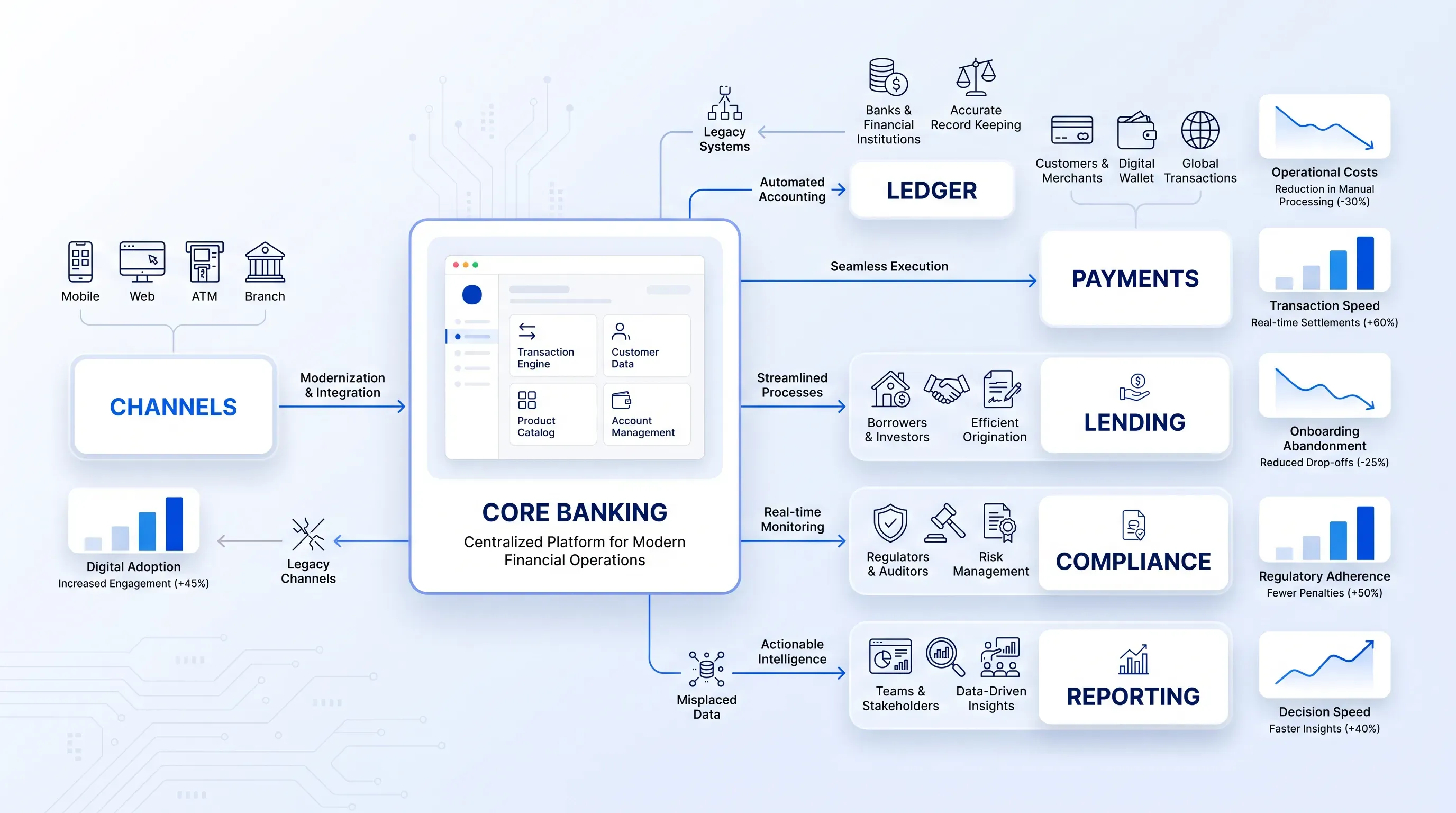
A modern fintech banking solutions stack is a set of distinct layers, and each one answers a different question. The core answers "what is true about this account right now." The channels answer "how does the customer reach us." Payments move money in and out. Lending decides who gets credit and tracks it back. Compliance and reporting sit across the whole thing because they draw from every layer and answer to the regulator.
The relationships between layers matter more than the boundaries. Think of the system of record at the bottom as holding the truth. Channels and distribution sit at the top, where customers actually touch the bank. Payments and lending are capabilities that run between the two, and compliance cuts vertically through all of them. When you keep those roles clear, you avoid the two mistakes that break stacks: pushing digital experience logic down into the core, and pushing core responsibilities up into the channels.
The layers below are the categories worth mapping for fintech banking solutions before you shortlist anything. Each has a clear start and stop.
Core banking and the ledger
A fintech core banking solution owns the ledger. Accounts and balances, together with the record of every posting that ever hit the book. This is the system of record, and everything else in the stack depends on it being right. If the balance in the core is wrong, no channel or report can fix that downstream.
A fintech core banking solution holds financial positions. Customer experience logic belongs outside it because mobile apps need channel-specific rules and a presentation layer. Push those into the core and every screen change becomes a core change, which is how legacy systems ossify in the first place.
The good news is that a fintech core banking solution no longer has to be a closed monolith; today's fintech core banking solution is designed to be open. Modern cores ship with ledger infrastructure and documented APIs, with built-in reconciliation. That shift is not cosmetic. On a modern core, a new product launch can take under two weeks. A legacy setup demands six to twelve months. The pressure is real, too, since about 70% of tier-one banks still run a pre-2000 core, and modernization now reduces operating costs by 30 to 50% once the migration is done.
The replacement wave is not slowing. The core banking market is forecast to reach $29.01 billion by 2031 at a 9.12% annual rate, and incremental, phased modernization already accounts for 48.7% of that activity. That number tells you something about how institutions prefer to move, which is a point we'll return to later.
Digital channels and onboarding
The channel layer of digital banking infrastructure is where customers actually meet the bank. Mobile banking and web banking give them access, along with account-opening and self-service flows. It sits on top of the core, and its job is to provide distribution and experience. A channel reads balances from the core and writes instructions to it. It never holds its own version of the ledger.
This is the boundary institutions get wrong most often. A channel connects to core functions. When a mobile team starts calculating fees or storing balances locally to make a screen faster, they've quietly created a second source of truth, and reconciling two truths is a problem you pay for forever.
Channels are also where you feel competitive pressure first. A customer never sees your core, but they judge you on the app in their hand every day. That's why so many institutions modernize the channel layer ahead of the core. They stand up a sharper front end while the system of record stays where it is. It buys time and relieves the most visible pain, though it doesn't solve the underlying constraint.
Onboarding lives here too, and the stakes are higher than they look. A 2025 Fenergo survey of 600 decision-makers found that 70% of firms lost clients in the past year to inefficient onboarding, with abandonment rates averaging around 10%. Every step you add to account opening is a step where someone walks away.