Doocat

Treasury Management System for Financial Institutions: Controls, Liquidity, and Integration

Content authorBy DoocatPublished onReading time12 min read
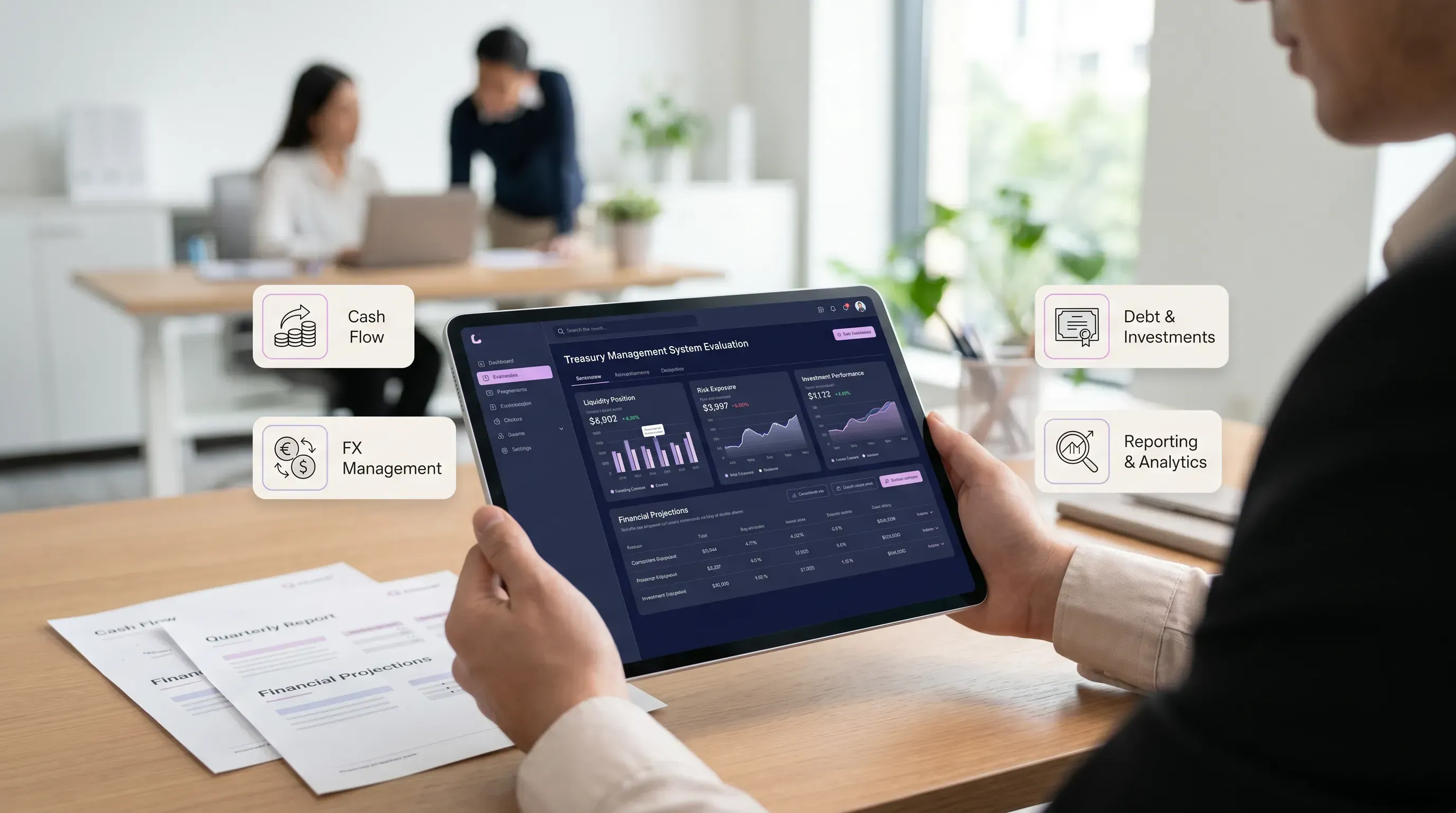
A bright, organized analytic workspace featuring a treasury leader holding a tablet displaying a treasury management dashboard.

This article explains what a treasury management system does inside a bank or microfinance institution with multi-entity operations, and how to judge whether a given system fits your daily operations. It walks through the core operational areas a system must handle well and lays out what readiness and rollout look like in practice.

What treasury leaders actually need

You already run a treasury function. The problem is that it sits across half a dozen banks and a stack of legal entities, with three or four currencies in the mix, and it holds together because someone rebuilds the position in a spreadsheet every morning before the rest of the business wakes up. That works until it doesn't. The day a treasury management system search begins is the day a manual reconciliation breaks under volume or the board asks for a liquidity number you can't produce before lunch.

The pains that drive the search are specific. Cash visibility arrives late, so decisions about borrowing or sweeping happen on yesterday's data. Approvals are inconsistent because each entity runs its own informal sign-off. And liquidity gets managed reactively, account by account, instead of as one controlled position. A 2024 corporate treasury survey found a 0.28 correlation between the number of countries a company operates in and its struggle to maintain real-time cash visibility, which matches what every multi-jurisdiction treasury already feels.

This article is a guide to evaluating a treasury management system against those realities. It assumes you know what treasury is and skips the basics. What follows is the functional scope that separates a real fit from a demo that looks good, along with a sober view of what it takes to put one in.

What a treasury management system covers

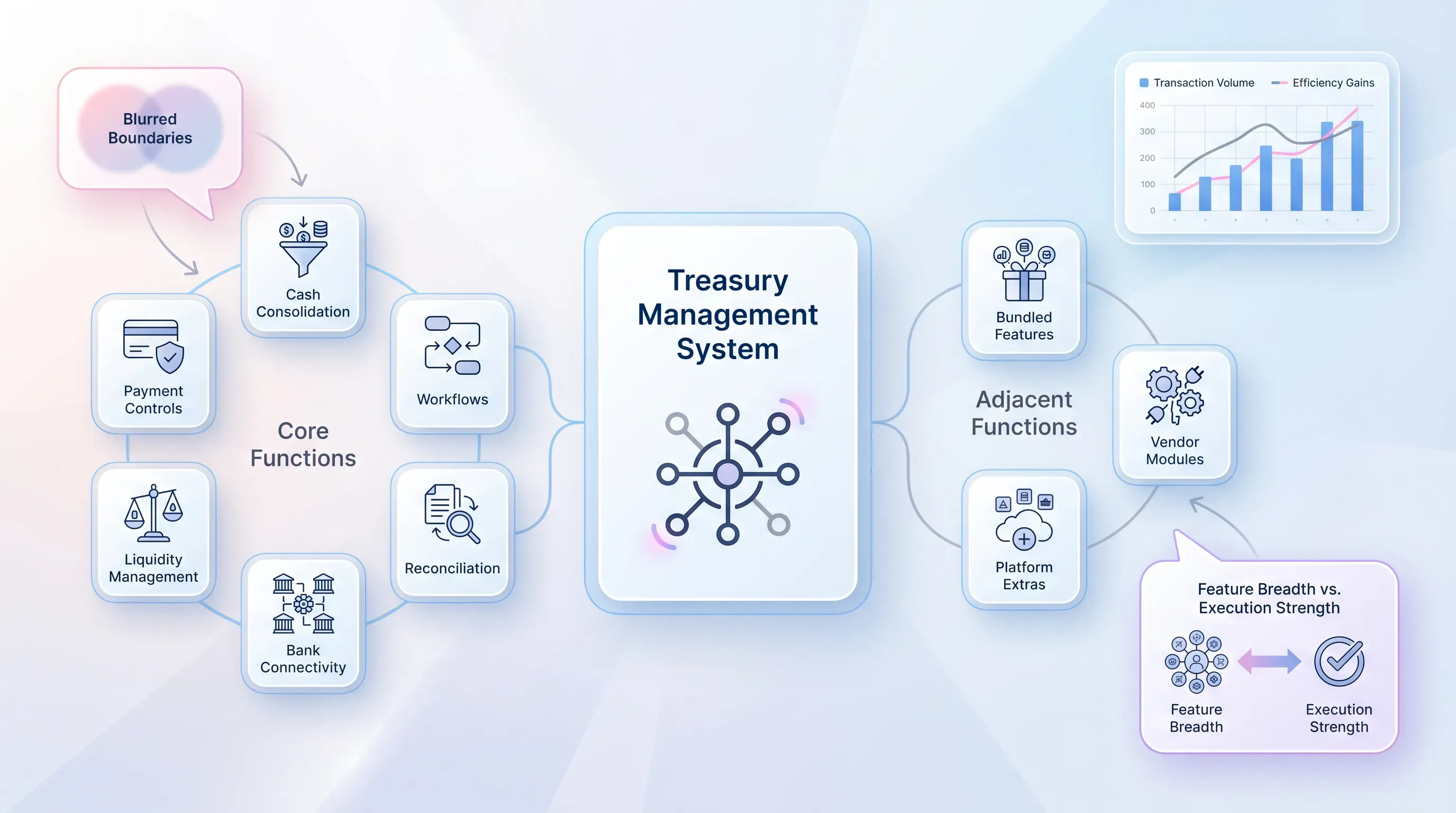
Professional infographic UI showcasing a Treasury Management System with interconnected nodes, rounded cards for core functions, and minimal charts.

Draw the boundary first. A treasury management system has one core job: it consolidates cash and controls payment approvals, with liquidity management handled through connections to your banks and core systems so the same data doesn't get keyed twice. That is operational treasury execution. Everything the system does feeds that loop, and anything outside it belongs in a different conversation.

The distinction matters because vendors blur it. Broader cash management strategy and investment portfolio management are adjacent functions, and some platforms bundle complex hedging with them. They are not the operational core, and judging a system on feature breadth instead of execution strength is how institutions end up paying for modules nobody opens. Keep the evaluation on the daily workflow: can the system show where your money is and keep each movement controlled through forecast and reconciliation?

Here is the functional scope worth holding the system to:

  • Consolidated cash positioning across banks, accounts, currencies, and entities

  • Payment execution with enforced approval workflows and segregation of duties

  • Liquidity forecasting and limits tied to actual balances

  • Bank connectivity and automated reconciliation against statements

  • Integration with your Enterprise Resource Planning (ERP) system or banking core

If a candidate does these well as one connected process, it fits operational treasury. If it does one of them brilliantly and the rest through workarounds, you'll feel the gap by month-end.

Core operations a system must handle

This is where evaluations are won or lost. The areas below are parallel capabilities, and the mistake is to grade them in isolation. A treasury management system with excellent cash positioning and weak approval controls shows you a clean position you can't safely act on. The test is whether these areas operate as a single daily workflow, because that's how a treasury team actually uses them.

This is also the line that separates a system built for a multi-entity institution from one that suits a single-currency operation. A single-entity treasury can survive gaps by hand. A group with eight entities and four banks cannot, because the manual effort compounds with every account added.

Cash visibility and positioning

Everything depends on this. The treasury management system pulls balances from every bank account and legal entity into one same-day position, with currency detail included automatically through bank feeds instead of manual statement downloads pasted into a model. Good positioning gives the team accurate intraday balances and a consolidated view built from confirmed transactions matched against expected ones.

For a multi-entity group, this is the difference between starting the day informed and starting it blind. If your team currently reconstructs the group position each morning from portal logins and overnight files, that work is the first thing a system retires. Nomentia's treasury analysis is blunt about the cost of not having it: without real-time visibility, forecasts lose credibility because by the time the CFO sees the report, the numbers are already stale. Test the feed coverage against your actual banks, not a generic list, and check how the system handles same-day intraday updates rather than only end-of-day files.

Liquidity risk controls

Visibility tells you where cash is. Liquidity risk controls tell you whether you're safe and let you act before a shortfall, not after. The treasury management system supports forward-looking cash forecasts tied to actual balances and exposure limits by entity, with counterparty exposure and currency controls built in to flag concentration before it becomes a problem. Buffers and limits require configuration and enforcement that survive pressure.

For banks and microfinance institutions, this is required control work. Under Basel III, banks must hold a Liquidity Coverage Ratio of at least 100%, which means high-quality liquid assets must cover projected net outflows over a 30-day stress period. You can't defend a number like that to a regulator or a board if your liquidity risk controls live in a spreadsheet that one person maintains. Forecasting is getting harder, too. According to the 2025 Cash Forecasting & Visibility Survey, the share of treasurers who call forecasting "easy" has fallen to 14% from 28% in 2018. The liquidity risk controls a system enforces are what keep a defensible position defensible when conditions move against you.

When you evaluate, push on how forecasts reconcile against actuals over time, and whether liquidity risk controls can be set per entity and rolled up to the group. A system limited to consolidated-level forecasts hides the entity-level exposures that cause trouble. Strong liquidity risk controls also mean the system shows variance between forecast and actual, so the team learns where the model is weak instead of trusting it blindly.

Approval and payment controls

If you're accountable for a control failure, this section is where you need evidence the controls hold at scale. The treasury management system must enforce approval workflows, with segregation of duties built into payment authorization rules across every entity under central governance. Configurable approval tiers, where a payment routes through different sign-offs based on amount and account, with counterparty rules embedded, are the baseline. Full audit trails are non-negotiable.

The risk is concrete. The 2025 AFP Payments Fraud and Control Survey found that 79% of organizations were targets of attempted or actual payments fraud in 2024, with business email compromise cited by 63% of respondents as the top avenue. Recovery is getting worse, not better: only 22% of organizations recovered 75% or more of funds lost in 2024, down from 41% the year before. "Technology alone can't always prevent these types of attacks," said Roderick Brown, Senior Vice President of Wholesale Payments Fraud Control Solutions at Truist. "That's why it's critical for organizations to minimize opportunity through layered security, strong payment verification processes and comprehensive training programs." A system that enforces the workflow is the layer that holds when a fraudulent payment instruction looks legitimate.

Check whether approval rules can differ by entity while staying centrally governed, and whether the audit trail captures who approved what, when, and from where. That record is what you hand an auditor when they ask how a payment was authorized.

Bank connectivity and reconciliation

Connectivity decides how much manual work you actually retire. The treasury management system connects to banks through host-to-host and the Society for Worldwide Interbank Financial Telecommunication (SWIFT) network, with Application Programming Interface (API) channels handled in the same connectivity layer, and then reconciles incoming statements against expected transactions automatically. Breadth of connectivity and accuracy of reconciliation matching are the two numbers that matter, because a system that connects to four of your six banks leaves two banks on the old manual process.

Reconciliation is where treasury time disappears and where AI is now aimed. In Strategic Treasurer's research, the share of practitioners expecting AI to reduce manual reconciliation rose to 62% in 2025 from 55% the prior year. Whether or not a vendor markets AI, the practical question is the same.

Ask two things during evaluation:

  1. Which of your specific banks does the vendor already connect to in production, with what channel, and how long does onboarding a new bank take?

  2. What auto-match rate does the matching logic produce on real statement data, and what happens to exceptions?

A vendor that can answer the first with named banks and the second with a demonstrated match rate against your own files is telling you the truth about how much work you'll stop doing.

Connecting the system to ERP and core

The treasury management system can't be an island, because the moment data has to be re-keyed between treasury and accounting, you've reintroduced the error and delay you bought the system to remove. It has to integrate with your ERP or banking core so information flows both ways. The practical integration points are posting journal entries from treasury activity and syncing master data like bank accounts and counterparties, with treasury records reconciled against the general ledger.

This is where projects stall. Gartner research cited by NetSuite found that 75% of ERP implementations get derailed, and integration testing is the workstream compressed when timelines slip. The Association of Corporate Treasurers makes a related point in its technology guide: when a group runs different systems or even different instances of the same system, integration becomes a significant project in its own right because local processes capture data in small but incompatible ways. If you don't plan for that, the integration becomes the thing that delays go-live by a quarter.

For a multi-entity institution, decide early how data flows. Do you post journal entries per entity into separate ledgers, or consolidate first and post once? Does master data live in the ERP and sync down to treasury, or the reverse? Getting this answer wrong means either entities lose their own clean records or the group view never reconciles. Settle the consolidated-versus-entity question before configuration starts, because it shapes every mapping decision after it.

Reporting that supports decisions

Reporting is what you hand to management and auditors, and it's what you use to run the day. The split that matters is between the position and cash views your team checks each morning and configurable reporting you can adapt without filing a vendor ticket. A system where every new report requires the vendor's professional services team is a system that will always lag the questions your board asks.

What an experienced treasury leader reports on is narrow and specific:

  • Current and projected cash positions by entity, currency, and bank

  • Cash forecasts with variance against actuals

  • Exposure and limit usage, including currency concentration and counterparty limits

  • Approval and payment audit trails for control and fraud review

This ties back to liquidity risk controls and approval controls covered earlier, because reporting is how those controls become visible to the people who hold you accountable for them. The 2024 Deloitte Global Treasury Survey found that improving cash forecasting capability ranked as the second most important priority for the year ahead, behind only liquidity management. If the system can't report a forecast against actuals in a form the board reads, it isn't supporting the decision the board is actually making.

Readiness and rollout planning

Readiness starts before you sign anything. The work that determines whether a rollout goes smoothly is unglamorous: clean your bank account and counterparty master data, and document the approval and payment processes your teams actually use; an internal owner also needs to carry the project outside the rhythm of fortnightly committee meetings. Skipping data cleanup is the most common way to import old problems into a new system.

A realistic rollout sequence runs through configuration and testing, then uses parallel running before phased go-live across entities. Configure the workflows and limits to match the processes you documented. Test approvals and connectivity against real data; reconciliation gaps show up only when you run your own statements and payment chains through the system. Then run in parallel with the old process long enough to prove the numbers match before you cut over.

For a group, go live one entity or one region at a time. A phased rollout contains the damage when something breaks and lets the team carry lessons from the first entity into the next. The honest view is that this takes longer than a vendor timeline suggests, because the testing of liquidity risk controls and reconciliation against your real banks is where the surprises live. Plan for that, and build the schedule around proving the controls hold rather than hitting a launch date. The cash visibility you're buying is only real once the feeds and reconciliation are tested against your own accounts.

Choosing the right fit

The decision comes down to operational fit and control strength. A system that handles your cash visibility and enforces your liquidity risk controls, with approvals held at scale through connections to your actual banks, beats one with a longer feature list that relies on workarounds. Test candidates against your own daily workflows and run your own statement files through their reconciliation; make the vendor prove connectivity to your specific banks before you trust the demo. The single best next step is a structured evaluation checklist that scores each system against the operational areas in this article, built before you sit through a single pitch.

Doocat builds banking and financial software for banks and financial institutions with multi-entity operations, which is the same operational ground a treasury management system has to hold. Before you book vendor demos, build a treasury readiness checklist that captures your bank coverage and approval rules, with liquidity risk controls and integration points documented beside them, then judge every treasury management system against it.

Prepare account master data, entity structures, bank formats, user roles, approval limits, and counterparty lists before comparisons start. Add sample statement files and recent payment batches. This lets each vendor test against your operating reality instead of a generic demo dataset.

Parallel running should cover at least one full reporting cycle and the payment types that carry the highest risk. For a monthly close process, that usually means running both processes through close and reconciliation. Cut over only when balances, postings, and approval records match within agreed tolerances.

Yes, approval rules can differ by subsidiary if the system supports central policy with local thresholds. For example, one entity can require two approvers above a set amount while the parent keeps group-level oversight. The key is that exceptions and rule changes stay visible in one audit record.

Yes, involve audit before demos because they can define the evidence needed for payment approvals, segregation of duties, and control testing. Doocat builds banking and financial software for multi-entity financial institutions, so the practical next step is to build a treasury readiness checklist before vendor demos.

Spreadsheet forecasting isn't enough as the only control record for regulatory liquidity reporting. A treasury management system gives a traceable link between actual balances, forecasts, limits, and approvals. Spreadsheets can still support analysis, but regulated institutions need controlled data sources and repeatable reconciliation for defensible reporting.

Schedule a Meeting

Book a time that works best for you

You Might Also Like

Discover more insights and articles

A modern mission control hub with blurred monitors, focused staff at workstations, and a large visualization wall displaying analytics.

Cash Management Systems for Banks and MFIs: Selection and Integration Guide

This article explains how to evaluate and roll out cash management systems across a distributed network of branches and agents. It covers the capabilities that matter, how integration with core banking and wallet settlement actually works, and how to deploy without breaking daily operations.

Title:
Fintech and Payments Infrastructure: How Banks and MFIs Should Build the Right Stack

Meta description:
Plan your fintech and payments infrastructure so you can scale operations and manage comp

Fintech and Payments Infrastructure: How Banks and MFIs Should Build the Right Stack

This article walks fintech and payments leaders through the full payments stack and how it operates across two distinct regions. We cover the movement of money through the stack, with back-office accuracy and compliance frameworks tied directly to the decisions teams face as they scale.

Title:
Fintech Banks in Europe and Africa: Infrastructure, Compliance, and Scaling Decisions

Meta description:
To run fintech banks in Europe and Africa, you must understand infrastructure. This guid

Fintech Banks in Europe and Africa: Infrastructure, Compliance, and Scaling Decisions

This article explains what fintech banks actually are once you look past the consumer-facing app and study the operating model underneath. It walks through the infrastructure and compliance decisions that shape how fintech banks grow across European and African markets.

Title:
Microfinance Bank Technology Stack: Core, Lending, Mobile, and Agent Banking

Meta description:
Build your microfinance bank technology stack to reach remote customers and cut your operational

Microfinance Bank Technology Stack: Core, Lending, Mobile, and Agent Banking

This article maps the full technology stack a modern microfinance bank needs to scale beyond the branch. It walks through each layer, from the system of record to customer-facing channels, and shows how the pieces fit together to support remote service delivery.