Doocat

Open Banking Payments for Financial Institutions: Use Cases and Implementation

Content authorBy DoocatPublished onReading time12 min read
A person seated in a cozy home, approving a payment on their smartphone, with soft natural light and warm furnishings in the background.

This article walks through how open banking payments work in production, from initiation to reconciliation. It is written for product and operations teams at banks and fintechs, including microfinance institutions, who already understand payments and are weighing account-to-account flows against cards and existing transfers.

Why direct bank payments matter now

If you run payments today, open banking payments are worth a serious look because the costs you carry on cards keep climbing while your visibility into each transaction stays poor. A chargeback alone costs a merchant an average of $128 in fees and internal time, and the global count is forecast to reach 359 million transactions a year by 2029. Bank transfers avoid that, but most are slow to confirm and hard to track.

There is a direct alternative built on the rails you already trust. Account-to-account payments move money with the payer's explicit consent, instructed through regulated bank APIs. Treat it as infrastructure, because that is the decision in front of you.

This piece follows a single payment from the moment it is initiated through settlement and reconciliation, with refunds and failure recovery covered as operational exceptions. The focus stays on initiation and operations.

What open banking payments actually are

Open banking payments are push-based account-to-account payments. The payer instructs their own bank to send money directly to your account, and the instruction travels through a regulated Application Programming Interface (API) with the payer's explicit consent. That is the whole model in one sentence, and it changes how you think about the rest.

Three parties matter here. There is the payer and the bank that holds the payer's account. A third party initiates the payment on the payer's behalf. Under Articles 66 and 67 of PSD2, banks must let an authorized initiator provide payment initiation services and instruct a transfer once the account holder consents. The European Commission describes payment initiation services as a true alternative to credit card payments, since the payer only needs an online payment account.

Contrast that with cards. A card payment is a pull. You hold details and request funds, and the card network can claw them back through a dispute. Open banking payments are push transfers the payer authorizes at their own bank, so they are direct and final. There is no chargeback mechanism, which the Federal Reserve notes reduces merchants' exposure to disputes and reversals. It also differs from a direct debit, which pulls funds on a mandate while an open banking payment pushes them on a single instruction.

How open banking payments work end to end

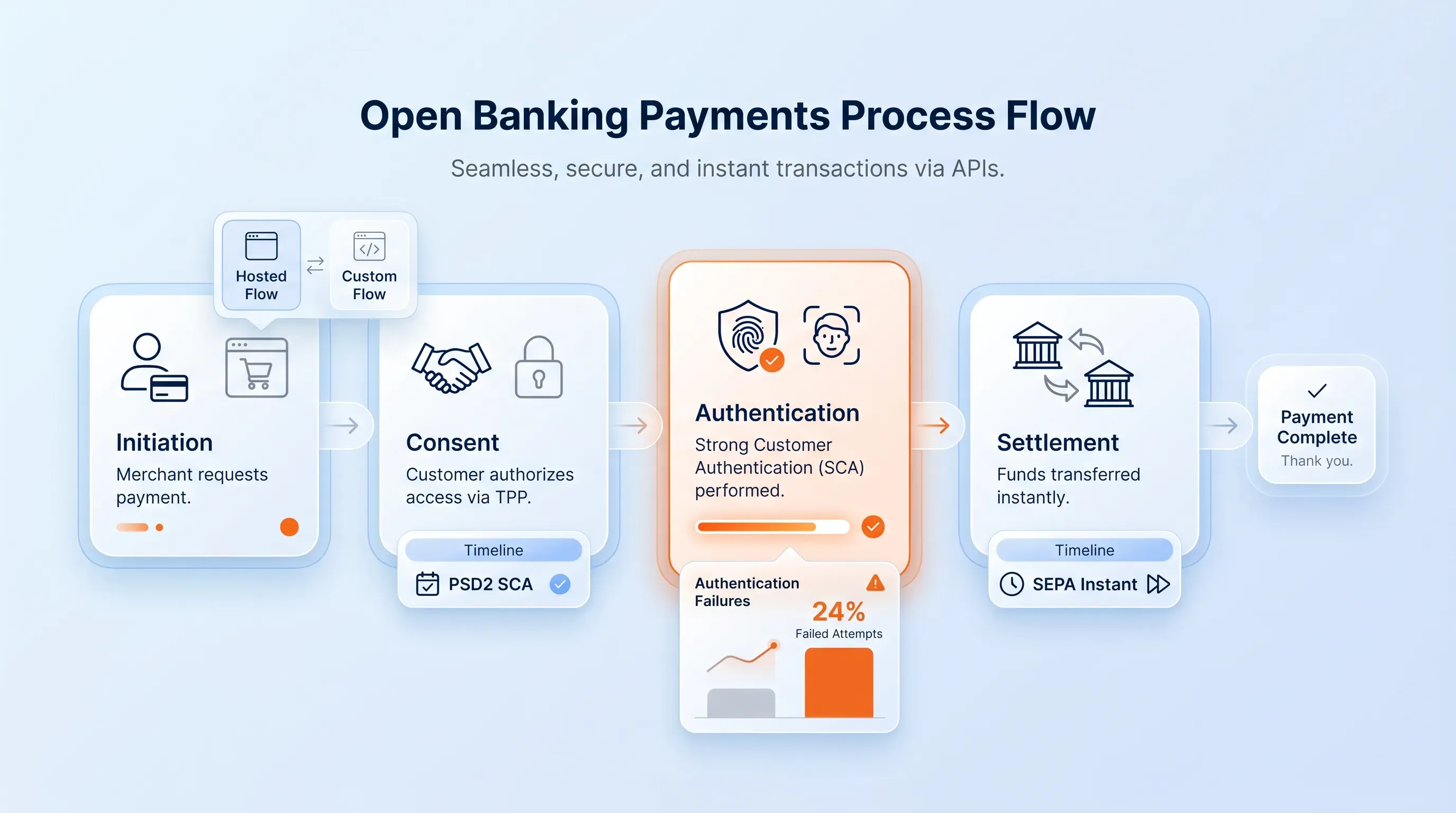
Professional infographic visualizing the open banking payments process with smooth UI cards for each stage and supporting charts.

Before picking apart edge cases, it helps to see one payment travel the full distance. The lifecycle breaks into three stages that your teams will build and run separately, yet the payer experiences them as one continuous journey. Each stage has a clear owner and a clear place where things go right or wrong.

Payment initiation services

The journey starts when your platform creates a payment order through payment initiation services. The order carries the amount and currency. It also names your account as the beneficiary and includes a reference that ties the payment back to an invoice or basket. The money stays with the payer's bank until the instruction moves it, which is why the German Bundesbank stresses that no payments will be made without the account holder's express permission.

This is where your first build-versus-buy decision lands. You can hand the payer to a hosted flow run by your provider, or you can build a fully API-driven checkout inside your own product. A hosted flow is faster to ship and keeps more of the compliance burden with the provider. An API-first flow gives you control over every screen, which matters when conversion depends on the experience around the payment.

Two practical points shape the choice:

  • Hosted pages reduce engineering time and certification scope, so they suit a first launch or a smaller team.

  • Custom flows let you match your own brand and reduce screens, but you own more of the testing and the failure handling.

Ready to digitise your financial institution?

Talk to our team about your roadmap and discover scalable digital banking solutions tailored to banks, fintechs and microfinance institutions.

Request a Demo

Consent and bank authentication

Once the order exists, the payer is handed off to their own bank to approve it through their banking app or web login. This step is the strong customer authentication PSD2 has required since September 2019, and it uses two independent factors. Because the payer authenticates at their bank, you never see their credentials, which is what makes the model hard for fraudsters using stolen details.

This redirect is also where customers leave. TrueLayer's research found that authentication causes more drop-off than any other stage, with 24% of payment failures happening there. So the handoff is both your security backbone and your conversion risk in the same step. Tink reduced one Deutsche Bank flow's duration by 17 seconds and lifted end-to-end conversion by 10% by matching the bank's own login fields.

Consent scope decides what happens next time. A one-off payment authorizes a single transfer and nothing more. A recurring arrangement, such as a UK variable recurring payment, lets the payer connect an authorized provider once and then allow recurring payments within agreed limits, which removes the repeat authentication on every charge. Decide early which one your use case needs, because it reshapes the entire flow.

Confirmation and settlement

After the payer authorizes, the bank returns a status to your platform, and this is where teams build flawed logic. Accepted and settled are different things, with initiated as the status between them. An accepted instruction means the bank took the order. Initiated means it has been submitted to the rails. Settled means the money is in your account, and that last signal should release goods or recognize revenue.

The money moves over the underlying rails. In the euro area that is increasingly SEPA Instant, where the Instant Payments Regulation took effect on 9 January 2025 and requires euro transfers to land and confirm within ten seconds. Speed depends on the rail and the bank involved. If either side is on a slower scheme, the payment can be authorized in seconds yet settle later, so build your fulfilment around the settled signal and treat the rest as progress updates.

Where open banking payments fit best

Open banking payments earn their place where card fees and chargebacks bite hardest and where you want richer data on each transaction. They serve the parts of your model where account-to-account payments do real work. Plaid notes that merchants with high average transaction values or elevated chargeback rates stand to benefit most. Thin margins strengthen that case.

High-value checkout is the clearest fit. A single percentage point of card fee on a large basket is real money, and the chargeback risk on big-ticket items is exactly what account-to-account payments remove. Account funding and top-ups are another strong case, because the payer is moving their own money into a wallet or trading account, and instant settlement lets you credit the balance quickly. Bill and invoice payment fits well too, since the structured reference travels with the payment and matches cleanly against the invoice.

The best use cases for open banking payments

Payouts run the model in reverse because funds move from your account to a customer, and they avoid the cost and delay of card refunds entirely. Recurring and variable payments are where adoption is moving fastest. UK Open Banking recorded that variable recurring payments reached 8.7% of the 11.8 million open banking payments in a single month, a steeper curve than single initiated payments.

Where does it struggle? Low-value impulse purchases, where the extra authentication screen costs you more conversion than the card fee it saves. The same caution applies anywhere your customers expect the buyer protection that a card dispute gives them, because that protection does not exist here.

Ready to digitise your financial institution?

Talk to our team about your roadmap and discover scalable digital banking solutions tailored to banks, fintechs and microfinance institutions.

Request a Demo

Handling refunds, failures, and exceptions

This is the part most teams underestimate, and it is the part you will own day to day. Because open banking payments are push-based and final, you issue a new payment back to the payer for a refund. That means you have to capture and store the payer's account details with consent at the time of the original payment, or you will have no way to send money back without chasing the customer for details.

Failures cluster into a few predictable types, and each needs its own response:

  1. Authentication abandonment, where the payer drops out at the bank screen. Recover this with a clear retry prompt and a fallback method, since the payer never authorized anything.

  2. Insufficient funds, where the balance is too low at that moment. Retrying immediately fails, so wait two to three days for the balance to refill, as decline-recovery guidance from Gr4vy advises.

  3. Bank timeouts and rejected payments, which are technical or policy failures. Retry a timeout soon, but route a payer with a hard rejection to another method.

Real-time balance checks help you avoid the most common failure before it happens. Chargebacks911 points out that open banking lets you query a real-time balance and confirm funds exist before you submit, which cuts failed payments and the admin that follows.

Then there are exceptions that fall outside clean success or failure. A payer sends the wrong amount or pays an old reference. Another payer splits a payment across two transfers. These need a structured workflow. Route every unmatched or partial payment into a structured resolution queue with an owner and a defined next action. An aging clock belongs in the queue as well, because the volume grows with your transaction count and silent backlogs become disputes.

Reconciliation and payment data

Reconciliation is where the model's richer data becomes both a gift and a new job. You match each settled bank credit against the order or invoice it belongs to with the reference you set at initiation. When the reference is clean and the rail is instant, matching is close to automatic. The work appears in the gaps.

The first gap is timing. A payment confirmed at the bank can settle later if the rail is slow, so your reconciliation has to hold open items and match them when the credit lands after authorization. The second is shape. You will see many-to-one cases, where a customer pays several invoices in one transfer, and partial payments, where one invoice arrives in pieces. Both break naive one-to-one matching, so your logic needs to split and aggregate against the reference and the amount.

The payoff is visibility. Card settlement arrives batched and stripped of detail, while account-to-account payments carry the payer reference and a clear credit, which means faster matching and fewer disputes to chase. Feed that data into your existing reconciliation and reporting, because the value shows up only when finance and operations work from the same matched records.

Choosing a provider and rolling out by region

Two decisions determine whether your implementation succeeds. The first is which provider you build on. The second is how you expand across markets, and the two are linked, because no provider performs equally everywhere.

Judge a provider on the things that move your numbers. Bank coverage and connection quality decide how many of your customers can pay and how often the flow completes, since user drop-off drives around 90% of lost conversions. Look closely at supported payment types, especially one-off and recurring payments, and at the refund and reconciliation tooling, because you saw above how much operational weight those carry. Uptime and conversion reporting at each step tell you whether the provider can hold the flow together under load. The build-versus-buy line runs through here too, between a hosted integration that ships fast and an API-first one that you control.

Planning your regional rollout

Regional rollout is where a flow that works in one market needs rework in another. Bank coverage and authentication norms differ by country. Settlement rails and the regulatory framework do too. Euro-area banks now sit under the SEPA Instant ten-second rule, but the UK is in SEPA's geography yet not under that regulation, so a UK-to-EU payment faces delays beyond a domestic one. Asia-Pacific runs on different public infrastructure again, with India's UPI rail and Australia's Consumer Data Right shaping a market growing at a 14.20% CAGR through 2031.

So sequence your markets. Start where coverage is deep and the rails are instant. Prove the flow and the reconciliation before you carry the learnings into the next market while budgeting for the parts that will not transfer. A phased rollout beats a simultaneous one because each market teaches you something the next one needs.

Getting started with open banking payments

Open banking payments deliver the greatest value when they're designed as part of a broader payments strategy rather than treated as a standalone integration. From selecting the right payment initiation model to handling authentication, reconciliation, refunds, and regional rollout, every implementation decision affects customer experience and long-term operational efficiency.

At Doocat, we help banks, fintechs, and financial institutions design and implement secure, scalable open banking payment solutions that fit their business goals. Our team combines expertise in payment infrastructure, API integrations, compliance, and financial operations to help organizations launch faster, reduce implementation risk, and build payment experiences that customers trust.

If you're planning to introduce open banking payments or modernize your existing payment infrastructure, book a consultation with Doocat to discuss your requirements and identify the best approach for your business.

Ready to digitise your financial institution?

Talk to our team about your roadmap and discover scalable digital banking solutions tailored to banks, fintechs and microfinance institutions.

Request a Demo

Yes, payment initiation usually requires authorisation as a regulated payment institution or work through a licensed provider. In the EU and UK, the provider must be authorised for payment initiation services. If you use an authorised provider, confirm its licence scope, covered markets, and responsibilities in the contract.

Start with one use case, one country, and a limited customer group. Track bank selection, authentication completion, accepted payments, settlement times, refunds, and unmatched credits. For a client rollout, the test should include finance and operations teams, because reconciliation errors often appear after the payment succeeds.

Customers can still raise a complaint, but open banking payments don't have the card chargeback process. Since the payer authorises the transfer at their bank, refunds usually require a separate payment back to the payer. Your support policy should explain refund eligibility, timing, and the evidence needed to review a claim.

Keep the payment reference, payer bank identifier, consent record, status history, settlement timestamp, and refund details where consent allows it. Store only what you need for reconciliation, audit, fraud review, and customer support. Retention should follow your regulatory duties and your data protection policy.

Offer a fallback when the payer abandons bank authentication, the bank rejects the payment, or the selected bank is unavailable. A card or standard bank transfer can protect checkout completion in those cases. Track fallback use by bank and country, since repeated failures point to coverage or connection issues.

Schedule a Meeting

Book a time that works best for you

You Might Also Like

Discover more insights and articles

A banking advisor assists a customer with KYC onboarding on a tablet in a bright, modern office with natural light.

KYC Know Your Customer Guide for Banks and MFIs: Checklist, Workflow, and Controls

This article turns KYC know your customer from a scattered set of manual checks into a documented, repeatable workflow you can run across your onboarding team. You'll get a KYC checklist template to adapt and the controls that make the whole thing defensible in an audit, with a clear split between individual and business requirements.

A customer advisor assists a client with the KYC onboarding process on a tablet in a bright, modern office setting.

KYC Banking Workflows: How Banks and MFIs Can Scale Onboarding and Compliance

This article treats KYC banking as an operational workflow you can map. It walks the full journey a customer takes from first data capture through ongoing review, and shows where your handoffs and exception queues leak time or risk.

A finance professional reviews documents and reports at a modern office desk, taking notes while using a laptop in warm daylight.

Fintech Payment Infrastructure for Banks, MFIs, and Wallet Providers

This article breaks payment systems into their real parts and shows how rails and wallets hand off into settlement, while reconciliation and exception handling keep the record straight. It is written for wallet providers and for fintech payment teams inside banks or microfinance institutions who already run a payment product but keep hitting the same operational walls as volume grows.

A customer and bank advisor collaborate at a modern desk, focused on a tablet, in a bright, spacious bank branch.

Customer Experience in Banking Industry: How to Fix Friction Across Digital and Branch Channels

This article treats customer experience in banking industry work as an operational problem that lives in the handoffs between your digital and branch channels. It uses customer journey mapping to walk through where friction accumulates during onboarding and when support or compliance work crosses channels, then gives you a way to map it with owners so you can prove that a fix worked.