Doocat

Corporate Treasury Management for Banks and Multi-Entity Financial Institutions

Content authorBy DoocatPublished onReading time9 min read
A treasury manager and financial analyst review a cash management dashboard in a modern executive office with natural daylight.

This article maps what corporate treasury management looks like once a finance team moves past spreadsheets and bank portals. It walks through the core responsibilities and shows how a connected system changes daily visibility and forecasting, with execution handled through the same workflow.

Why treasury looks different now

If you run corporate treasury management at a growing company, the job stopped being bookkeeping a while ago. Interest rates move in ways that punish idle cash and reward fast decisions. You hold accounts across several banks, sometimes several currencies, and the pressure to know your exact cash position has climbed up to the C-suite. Treasury sits at the center of that conversation now.

The old way of working still lingers. Each Monday morning, you build the cash position from bank portal exports and a master spreadsheet. By the time the numbers are clean, they describe last week. Over one-third of treasurers still primarily use Excel rather than a dedicated system, and one industry estimate puts the waste at about 4,800 hours a year maintaining those files. A modern team works from live data instead. That gap is why modernizing matters right now, and it's what the rest of this piece is about.

What corporate treasury management covers

In corporate treasury management, treasury is the function that owns the company's money: its location and its movement, with exposure managed along the way. You already know the fundamentals, so the point here is a clean map of the responsibilities a modern team carries and where the manual version of each one cracks. Deloitte's 2024 survey found that visibility into global operations and cash remains the most challenging and time-consuming area for treasury departments, which tells you where most of the pain lives.

The work breaks into three areas that run in parallel. Each one looks manageable on its own. The trouble starts when you try to run all of them from disconnected tools.

Cash and liquidity management

This is the core of the job. You need to know how much cash the company holds and whether enough is available to cover operations, with bank and currency placement clear enough to avoid parking money that should be earning. Cash management is the operational side: tracking balances and moving funds through cleared payments. A cash management system is what makes that tracking timely instead of retrospective.

Liquidity management is the planning layer on top. It asks whether you'll have enough cash at the right place and time over the days and weeks ahead. The two depend on each other, because you can't plan liquidity from balances you can't see. The common pain is the absence of a single, current view across every account, which forces treasury to operate, as one Bottomline analysis put it, "in the dark". Good liquidity management closes that gap by turning scattered balances into one position you can act on.

Ready to digitise your financial institution?

Talk to our team about your roadmap and discover scalable digital banking solutions tailored to banks, fintechs and microfinance institutions.

Request a Demo

Risk and compliance

In corporate treasury management, treasury also owns the company's financial exposure. Foreign exchange swings hit revenue and costs when you operate across currencies. Interest rate moves change the cost of debt and the return on cash. Counterparty risk means asking whether the bank or customer on the other side will actually pay. PwC's global treasury work ranked FX and interest rate risk as the most impactful economic risks treasurers face, which is why these sit squarely on treasury's desk.

Then there's the control side: regulatory compliance and internal controls, with clean audit trails across every jurisdiction you touch. Poor visibility makes all of this harder, because you can't hedge an exposure you haven't measured or prove a control you can't trace. The risk comes from not seeing the position clearly enough to act before the market moves against you.

Funding and banking relationships

Corporate treasury management also covers how the company is financed: its debt and short-term investments, with capital structure shaped around both. That work runs through banking partners, and a growing company accumulates them. Each new market or subsidiary brings another account and another portal to log into.

Companies spread accounts across banks for practical reasons. As the treasury software firm Nomentia notes, those reasons include risk diversification and local market access across currencies. But every relationship adds operational overhead, which is why rationalizing partners and consolidating the data matters. PwC found that 40% of treasurers plan to rationalize bank accounts within two years. If your goal is to operate efficiently rather than juggle disconnected relationships, fewer partners and one consolidated data feed is the direction to move.

How a cash management system improves visibility

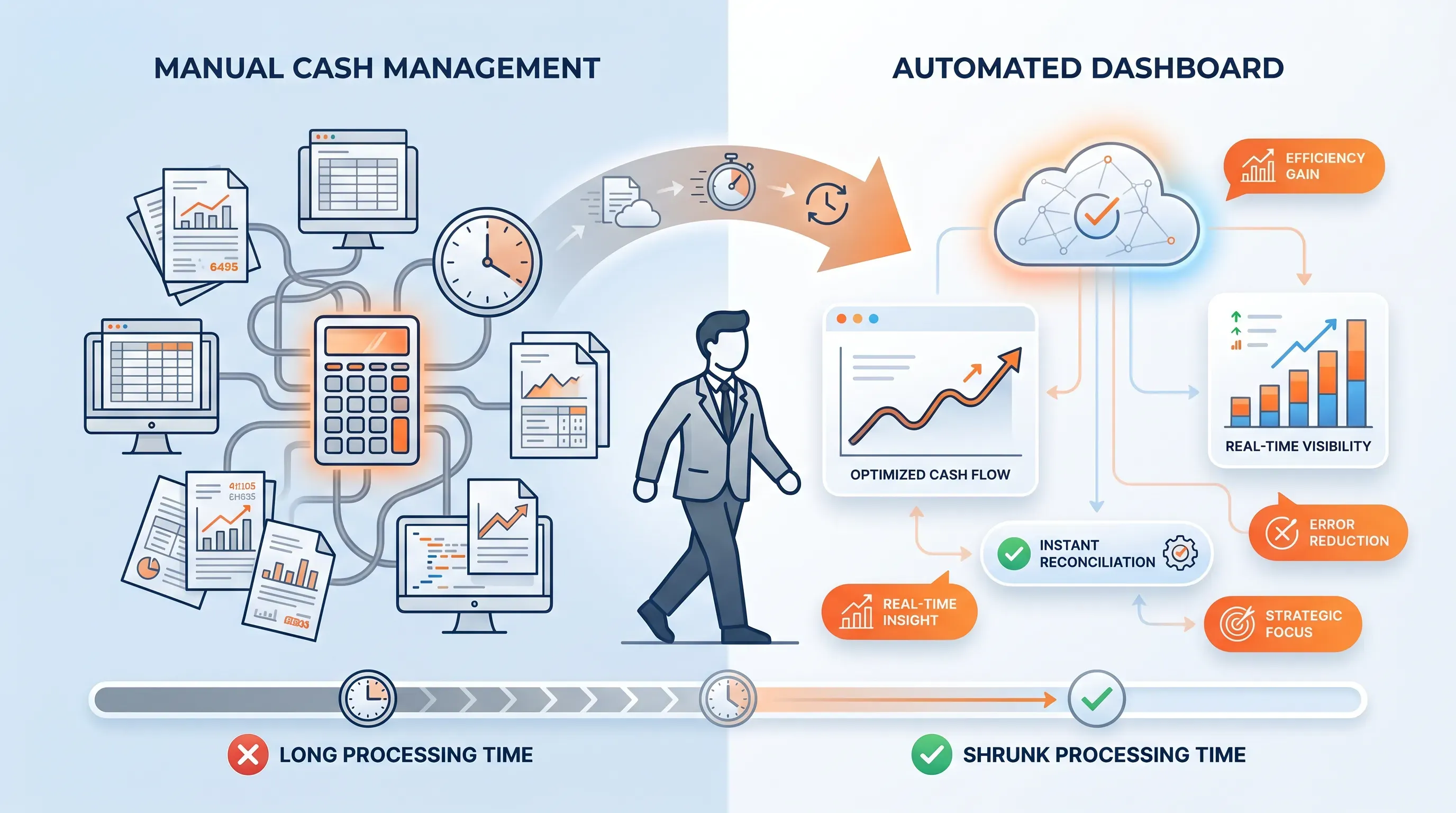
Infographic depicting a treasury manager's transition from a cluttered manual workspace to a sleek automated dashboard, emphasizing efficiency.

Here's the practical before-and-after. In the manual world, your cash position is an artifact you assemble. You pull statements and categorize transactions before reconciliation, and the answer you get is always slightly stale. A cash management system flips that. It connects your bank accounts and your Enterprise Resource Planning (ERP) software, with accounting data feeding one platform, so you read the position directly.

That connection creates a single source of truth. A single login shows balances and cash positions in real time across accounts and institutions, with currencies handled in the same view. The treasury manager Robert Zavertnik described the old approach at Cloud Software Group bluntly: the team would start "on Friday night, sending out all those spreadsheets" and not finish reconciling until halfway through Tuesday. A connected system removes that cycle entirely.

Visibility then turns into execution, which is where the daily payoff shows up:

  • Faster decisions, because the position is current when you look at it rather than three days old

  • Fewer duplicate or late payments, since payment flows route through one controlled view

  • Automated reconciliation, which clears the manual matching that ate the week

  • Proactive fund movement, so you sweep idle cash or cover a shortfall before it becomes a problem

Real-time payments were named in Deloitte's 2024 survey as the instruments most likely to be adopted in the coming year, precisely because instant settlement keeps that cash position accurate. The question to weigh is straightforward. How much of your week goes to assembling numbers that a cash management system would simply show you?

Ready to digitise your financial institution?

Talk to our team about your roadmap and discover scalable digital banking solutions tailored to banks, fintechs and microfinance institutions.

Request a Demo

How liquidity management strengthens forecasting

If your forecast lives in a static spreadsheet, it's a snapshot of assumptions you made the day you built it. The business moved since then. Disciplined liquidity management replaces that snapshot with a live model that updates as historical cash patterns feed forward-looking indicators within scenario analysis. Instead of one fixed projection, you model what happens if a large receivable slips or a currency moves, and you see the shortfall or surplus before it lands.

The accuracy problem is well documented. EY's survey of treasurers found that 65% do not have highly accurate 12-month forecasts. Deloitte ranked improving cash forecasting as the second-highest priority for the year ahead, behind only liquidity management itself, yet only about 18% of respondents rated their forecasting as above average. Poor forecasts are a data failure, because a forecast is only as good as the inputs feeding it.

Better forecasting feeds control directly. When you trust the numbers, you can plan a debt paydown on a date you know cash will be there and reinvest a surplus instead of letting it sit, with capital expenditure scheduled around operating needs. The 2024 survey from the CFO platform Agicap put a price on this error because unreliable forecasting leads to hundreds of thousands in avoidable fees and missed opportunities. Accurate forecasting lets you make a decision you can defend in front of the board, because you can show the work behind it and avoid relying on a guess.

Building a modern treasury operation

Put the pieces together and a modern setup has one defining trait: it's connected. Visibility and forecasting run through one system, with payments and control inside the same workflow and manual exports removed from the process. That's the difference between a treasury that reacts and corporate treasury management built to plan. The maturity ladder is real, and the rungs run in order, which is why the treasury technologist Le Blévennec observed that "many companies are still fixing the basics" before reaching for advanced analytics. A platform fits as the connective layer across that operation, and Doocat sits in that part of the modern treasury stack.

Two practical concerns surface when finance leaders evaluate this move:

  • Integration with what you already run. The platform has to connect to your existing banks and your ERP, because ripping out core systems isn't realistic. The value comes from pulling balances and transactions into one place, with exposures visible in the same view.

  • Team skills to operate it. Talent is a genuine constraint. HSBC found that 62% of treasurers cite access to talent as a hurdle to transformation, so a platform that automates reconciliation and data consolidation lets a lean team cover more ground without hiring for it.

The goal is to give a small treasury team the same command of cash and liquidity management that larger corporates build with far more headcount.

Where to start

The line between a modern treasury and a reactive one comes down to two things: whether you can see your cash in real time and whether you can forecast it with confidence. Everything else follows from that. If you're still assembling your position by hand, the first move is to consolidate your accounts and data into one view, then build forecasting on top of it. Look at a connected platform like Doocat against your current process and measure the hours you'd reclaim. That comparison is how the case for modern corporate treasury management makes itself.

Ready to digitise your financial institution?

Talk to our team about your roadmap and discover scalable digital banking solutions tailored to banks, fintechs and microfinance institutions.

Request a Demo

Spreadsheets create risk when balances are stale, formulas are hard to review, or only one person understands the file. In corporate treasury management, those issues affect funding, hedging, and payment timing. Track late reconciliations, manual corrections, and time spent collecting bank data to decide whether the process needs a system.

Connect bank balances and ERP open items first. Those feeds give treasury the minimum data needed to compare actual cash with expected inflows and outflows. After that, add debt schedules and FX exposure data if those items affect daily cash decisions.

Update a short-term cash forecast daily when payments or collections change each day. A 13-week forecast usually needs daily balance updates and a weekly review of assumptions. Longer forecasts can be refreshed monthly, provided treasury checks large planned cash movements before board reporting or funding decisions.

Yes, treasury automation can work across more than one bank if the platform supports the banks' file formats or bank connectivity channels. Confirm coverage before setup by listing every account and currency. Then check each payment type. Doocat, as described in the article, fits this role by bringing bank data into one operational view.

Set approval limits and user roles before payment activity moves into one workflow. At a minimum, separate payment creation from approval and require a second review for high-value transfers. Treasury should also document who can release payments and how exceptions are recorded.

Schedule a Meeting

Book a time that works best for you

You Might Also Like

Discover more insights and articles

A banking advisor assists a customer with KYC onboarding on a tablet in a bright, modern office with natural light.

KYC Know Your Customer Guide for Banks and MFIs: Checklist, Workflow, and Controls

This article turns KYC know your customer from a scattered set of manual checks into a documented, repeatable workflow you can run across your onboarding team. You'll get a KYC checklist template to adapt and the controls that make the whole thing defensible in an audit, with a clear split between individual and business requirements.

A customer advisor assists a client with the KYC onboarding process on a tablet in a bright, modern office setting.

KYC Banking Workflows: How Banks and MFIs Can Scale Onboarding and Compliance

This article treats KYC banking as an operational workflow you can map. It walks the full journey a customer takes from first data capture through ongoing review, and shows where your handoffs and exception queues leak time or risk.

A finance professional reviews documents and reports at a modern office desk, taking notes while using a laptop in warm daylight.

Fintech Payment Infrastructure for Banks, MFIs, and Wallet Providers

This article breaks payment systems into their real parts and shows how rails and wallets hand off into settlement, while reconciliation and exception handling keep the record straight. It is written for wallet providers and for fintech payment teams inside banks or microfinance institutions who already run a payment product but keep hitting the same operational walls as volume grows.

A customer and bank advisor collaborate at a modern desk, focused on a tablet, in a bright, spacious bank branch.

Customer Experience in Banking Industry: How to Fix Friction Across Digital and Branch Channels

This article treats customer experience in banking industry work as an operational problem that lives in the handoffs between your digital and branch channels. It uses customer journey mapping to walk through where friction accumulates during onboarding and when support or compliance work crosses channels, then gives you a way to map it with owners so you can prove that a fix worked.